


Introducing… Bloomberg Market Concepts (BMC)
07/09/2023

If you’re looking for a course that provides an introduction to the global economy and financial markets, then Bloomberg Market Concepts (BMC) might be the answer.
Created by Bloomberg, BMC is an e-learning tool. It is an interactive self-paced certification course delivered through the Bloomberg terminal. The course content utilises Bloomberg data, news and analytics to teach financial concepts. It consists of a library of courses enabling you to learn more about the financial markets, and Bloomberg.
The Core Concepts course has 4 modules (takes approx. 8 hours) which cover the following areas:
- Economic Indicators
- Currencies
- Fixed Income
- Equities
There are also further modules which you can take:
Terminal Basics (approx. 2 hours) explains the Bloomberg terminal functionality including the keyboard, command line, tabs, menus and autocomplete to help navigate the platform and find the data. It also covers screening for stocks and bonds and downloading data to Excel. [Highly recommend to complete if you are going to be using the Bloomberg terminal as a tool for your assignments and data collection for a thesis].
Commodities (approx 1.5 – 2 hours) introduces the background to the market, key players and how trades are made.
Equity Options (approx 1.5 – 2 hours) explains the Stock Options market and the language that is used and how trades work in this market.
Portfolio Management (approx. 2 hours) explains how to create a portfolio, learn how to invest in your portfolio and use tools to analyse the performance of your portfolio. [Please note: no live trading is possible on Bloomberg academic subscriptions].
After successful completion of the Core Concepts modules of BMC [identified by a blue badge  ], you will receive a certificate of completion which is available to download and include on your CV or attach to your LinkedIn profile.
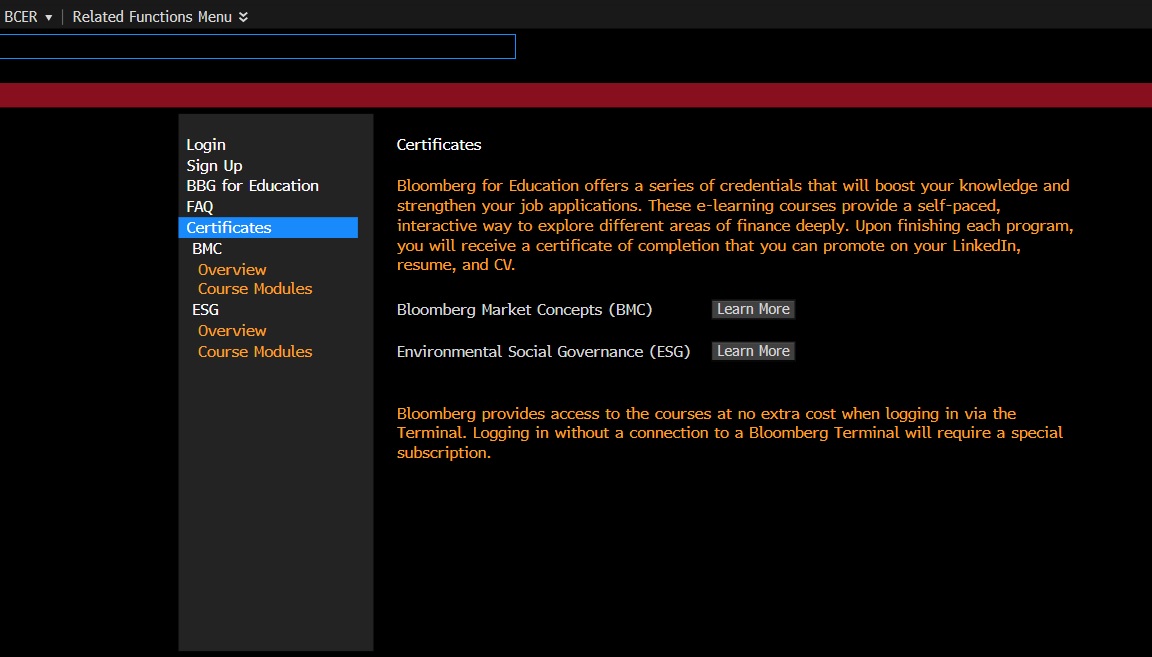
To get started on the BMC, you need to login to Bloomberg’s Certification pages. Simply type BCER <GO> into the terminal to open the Bloomberg for Education Certification menu. First you will need to create a separate login by signing up for the e-learning courses. You can then login and access the BMC modules as described above in addition to Bloomberg’s ESG certification course. Please bring your own headphones as there is video material included.
Remember to book your Bloomberg terminal in advance. More information – and how to book – is available on our webpages. Remember to bring your own headphones. Bluetooth headset users should bring their dongle too!
If you have any questions about BMC or the BCER, then please contact the Library.

Categories & Tags:
Leave a comment on this post:
You might also like…

Referencing the use of generative AI in your work
We recognise that Artificial Intelligence (AI) has, and will increasingly, become a part of our everyday lives and that we need to adapt to it. Hopefully you will have already seen the guidance for staff ...

Finding part-time work whilst studying at Cranfield – is it right for you?
We know that the cost of living in the UK is a real and ongoing challenge for many students. Whether you are still considering postgraduate study or already preparing for life at university, you ...

Leaving Cranfield soon? Have you heard about Alumni Library Online?
We are proud to offer one of the UK’s leading university library services for alumni. Alumni Library Online gives you instant access to thousands of top quality journal articles and the latest thinking to support ...

Want to know more about research methods?
Research methods are the strategies and tools used to gather, analyse and interpret data or evidence to uncover new information or create better understanding of a topic. Research methodology is the theory, justification and assumptions ...

Come for Cranfield, stay for Milton Keynes: how Bucks, Beds and the OxCam region are just getting started
Heard the one about the entry-level job that needed three years of experience? Sadly we all have, and that’s why in a jobs market where practical, hands-on experience is so important, study where collaboration ...

British Standards and ISO standards demystified
We are frequently asked how to find ISO (International Standards Organisation) standards. The best way to find them is to go straight to our British Standards Online (BSOL) service. Why go to British Standards if you ...