

The ‘seductive’ side of sustainability
11/01/2018
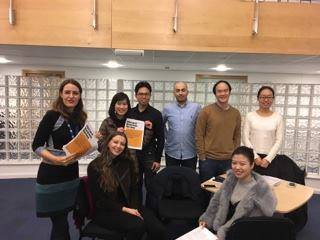
Since starting my master’s in Corporate Sustainability, many people have asked, what is sustainability? Countless times I’ve heard “oh, that’s needed, but how do you implement it?” At times, it has been a difficult question to answer due to the large umbrella that sustainability covers. This has made me sit and think, how do you explain sustainability? How do we, as future business managers, explain to potential customers how sustainable purchasing will benefit them and society?
At Cranfield, we are fortunate to have many opportunities. We are lucky to entice industries and entrepreneurs to come and give us speeches and talks about their businesses in practice. Lately, we had Guy – a PhD alumni from Cranfield – from Enervee explain how they put sustainability into practice.
Enervee is a company that is trying to tackle what on the surface seems like a very simple question: “How can you easily buy the most energy efficient products for your home?”
As with most business questions, the answers are not normally straightforward.
Sustainability has many interpretations and understandings, and it can be hard to translate a simple meaning or definition to customers that they can relate to. What was evident from the talk is that sustainable purchasing (an effort to buy more green, environmentally and socially sustainable goods and services) has seductive results.
But what is is a “seductive result”?
To me it is one that first and foremost helps the customer to save energy and money. More savings will only help push the demand and drive forward more awareness and thereby purchases.
Savings to the customer can happen on a larger scale. By offering more ethical and sustainable awareness, it drives rival companies to compete on standards, in which they might not have competed on before, in the hope to gain/retain customers. For example, companies might compete in trying to create the most sustainable and ethical supply chain.
For me, the talk raised two ways in which businesses can help ensure customers are aware of how sustainable purchases can not only better their lives, but society as a whole.
Firstly, it is for businesses to recognise that trying to change a customer’s buying behaviour is difficult and most likely will not work. Therefore, it is more effective to provide customers with more information. The more information customers receive, the easier it becomes to weigh up decision-making choices. Knowledge is power, and the presentation of facts and figures helps substantially. For example, Enervee created their own numerical scale, ranking competitor products, making the cross-comparisons of rival brands easier to assess.
Therefore, the presentation of data is key. An interesting point Enervee adopted was to change their data font. This font was more difficult to read, which made customers pay extra attention to reading the product information. This resulted in more sustainable purchasing and avoided micro-sleeping.
It is becoming evident that the sustainability movement is increasing in momentum. Businesses and customers now have the ability to act. More and more success stories are being discussed on a daily basis and showing their results are seductive. Sustainability can lead to a distinct competitive advantage, and through setting the standards and going above the law, it illustrates to competitors and customers a source of innovative thinking. For me, I hope that as time moves on, there is only a bigger demand for sustainable goods and services. The louder we shout about sustainability, the more heads we will turn and convert to the cause.
—
Find out more about our Management and Corporate Sustainability MSc course…

Categories & Tags:
Leave a comment on this post:
Comments are closed.
You might also like…
How Cranfield accelerated my career in Logistics and Supply Chain Management
After graduating from the MSc in Logistics and Supply Chain Management at Cranfield University, I've been reflecting on the experiences that made my journey so valuable and the impact it has had on my ...

Mendeley: a powerful tool to organise and manage your references
Are you looking for a way to manage your references, create in-text citations and reference lists for your assignments or thesis? If so, you may wish to consider using Mendeley. What is it? Mendeley is ...

Keen to develop your study skills?
Alongside the technical skills and academic knowledge that you will gain on your course, as a Cranfield student you have the opportunity to develop a range of other skills that can enhance your learning experience. ...

The V-conomy: powering the sixth wave of global economic growth
The world could be on the verge of a major surge in economic growth and development, driven by the convergence of AI and clean energy technology. Waiting to ride the K-wave The Russian ...

Need help using the Python programming language?
We know some of our students are currently trying to learn Python, so we wanted to make you aware of some great LinkedIn Learning videos that can help. But don't you have to pay for ...

What does it really take to become a Chevening Scholar?
Say “Turkmenistan” to most people and you’ll get a blank look. That was true when I left Ashgabat for the UK to study an MSc in Logistics and Supply Chain Management at Cranfield University ...
BLOODY GOOD READ. Really impressed I look forward to more.