


Performance Reporting Measures vs Performance Management Measures – Part 2
05/12/2019
Another Problem with % Measures
You may have read my blog from last week comparing Performance Reporting Measures vs Performance Management Measures.
Performance reporting is littered with measures that may appear to carry meaning for some people, but in our observations, have been misleading and impenetrable to many. And certainly don’t help understanding nor how to improve!
Here are some examples of reporting measures that we introduced previously:
- % items completed: % implies a ratio – with a numerator and denominator. E.g. % Repairs Completed defined by (Number of Repairs Completed / Total Number of Repair Calls) * 100
- % completed within some timeframe: E.g. From a previous blog’s A&E Figures, we saw % A&E attendants seen in 4 hours or under.
- Complicated Measure Combinations: E.g. % Forecast Accuracy in Supply-chain
- Applying sophisticated statistical treatment to raw performance measures that only stats specialists can read: E.g. Exponentially weighted moving averages
- Statistical representation of a population of people or things: E.g. Electric Car Use by Country
There’s one more critical problem with % measures I didn’t mention last time. And this one is particularly mind-bending, even to some of those who have studied Maths!
You start to stumble across the problem when you start drilling down into sub-sets of the data to “better understand what is going on”. So, for example, regarding A&E data, you may want to drill down by hospital and by age-group. You do this at your peril!
But, to keep this light, we’ll select an alternative example from Wikipedia that you can all go take a look at – batting percentages over two years for two baseball players. We could have picked a cricketing example, but who knows what’s happening in the Test in New Zealand right now – well I said I wanted to keep this light!
So here are the baseball figures – the figures are (number of hits) / (number of “at bats”):

So looking at the individual year’s batting % in each of 1995 and 1996, you’d want to bet on David Justice. BUT! When you look at their combined % for the 2 years, you’d want to go with Derek Jeter. Confused?
I won’t explain this paradox here, since Wiki does a very good job of it – but it is well-known (to some mathematicians and stats guys) as Simpson’s Paradox. It happens because both the numerator and denominator can vary independently.

The ONLY way to resolve this is to have a clear PURPOSE for the business process (Wiki refers to STORY), which will guide the reader on whether to use the aggregated % or the component %s, OR to use an alternative measure altogether.
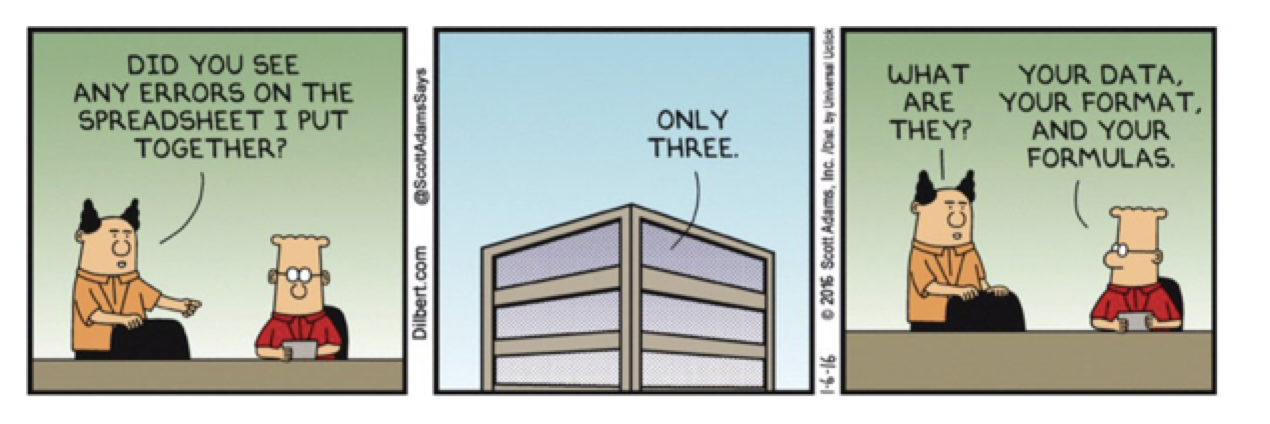
And I’m pretty sure Dilbert would encourage you to look at the underlying raw data – i.e. number of “at bats” and the “hits” separately (instead of, or, worst case, as well as %’s) if you really want to understand what’s happening!

Categories & Tags:
Leave a comment on this post:
You might also like…

Keen to develop your study skills?
Alongside the technical skills and academic knowledge that you will gain on your course, as a Cranfield student you have the opportunity to develop a range of other skills that can enhance your learning experience. ...

The V-conomy: powering the sixth wave of global economic growth
The world could be on the verge of a major surge in economic growth and development, driven by the convergence of AI and clean energy technology. Waiting to ride the K-wave The Russian ...

Need help using the Python programming language?
We know some of our students are currently trying to learn Python, so we wanted to make you aware of some great LinkedIn Learning videos that can help. But don't you have to pay for ...

What does it really take to become a Chevening Scholar?
Say “Turkmenistan” to most people and you’ll get a blank look. That was true when I left Ashgabat for the UK to study an MSc in Logistics and Supply Chain Management at Cranfield University ...

Get a head start on referencing and plagiarism
We offer a module on Referencing And Avoiding Plagiarism which you can find on your Canvas dashboard. It explains the role and importance of citing references and how to incorporate the work of other authors ...

How Cranfield shaped my journey as an Aerospace Engineer
If I'm being specific about the moment it clicked, it was reading a paper called "On the Role and Challenges of Computational Fluid Dynamics (CFD) in the Aerospace Industry" by two Boeing engineers, P. ...