

A Tale of Two Worlds – Or Cost Accounting vs Throughput Accounting
16/05/2019

On our travels, we often come across situations where a senior executive has decided to have an “efficiency drive”. And often this entails bringing in expensive consultants to do some “analysis”. And from this the bad news of redundancies and “expensive” departments being cut permeates the air!
There are major problems with this approach, not least on employee morale, particularly when they and we can see the futility of chasing costs – because that’s what tends to happen – costs get chased from one place to another across the organisation, or potentially worse, into unsuspecting partner organisations.
One example in a large communications company was when high-powered consultants came in with an incentive to cut £10m in costs. They did just that in the planning department – but more than doubled the costs in the delivery – along with a massive deterioration in service to the end customer. The company is still struggling with this 10 years later! And we’ve seen this sort of thing happen too many times … so, if that’s the problem, what’s the solution …
To characterise the problem, we need to understand the difference between the “Cost Accounting World vs Throughput Accounting World”. And anyone who’s interested can pick up an easy to read book by Eli Goldratt and Jeff Cox called The Goal (get the third edition).
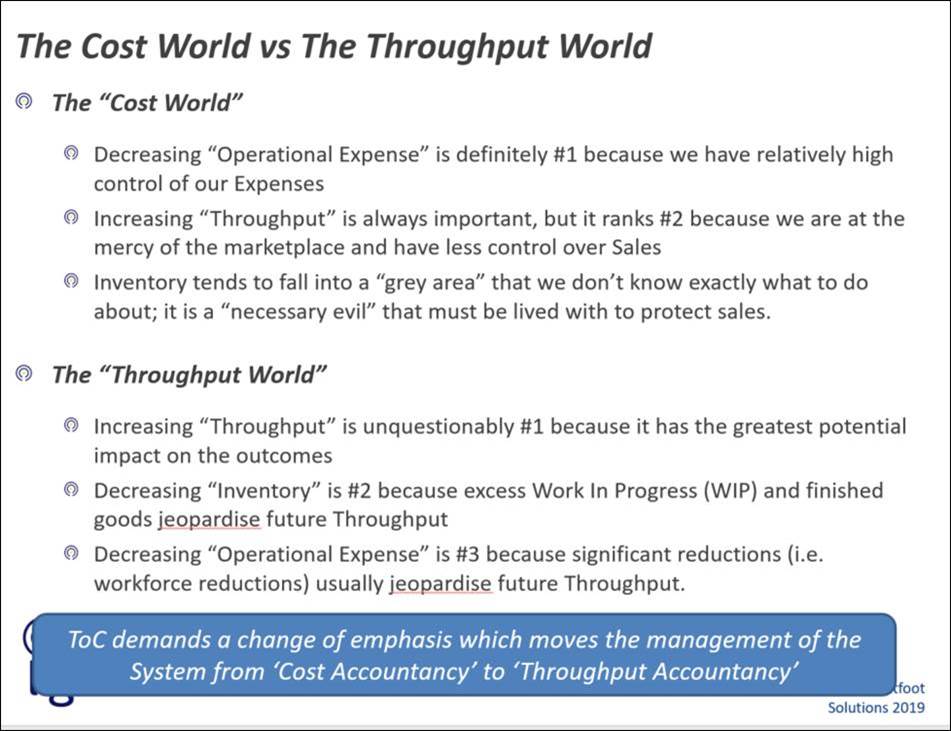
Essentially, the Cost Accounting World is an inside-out view and the Throughput Accounting World is an outside-in view.
In a Cost Accountancy World, people talk about Costs, Efficiency, Productivity, Sweating the Asset, Process-mapping, organisational/departmental efficiencies, Best-practice, Benchmarking. How many times have you heard “we’ve benchmarked your organisation / department against similar organisations / departments and your costs are 50% higher!” Benchmarking hardly ever takes into account the different contexts of each organisation / department being compared. If you’ve read any of our previous blogs on the Cynefin Framework, you’ll recognise that Benchmarking is a Simplistic tool, often being applied to organisations operating in a Complex Domain, when at best, this technique should be reserved for the Simple Domain.
In a Throughput Accounting World, people talk about Outcomes, Throughput Time, Work In Progress, Process-flow, Value/Waste/Failure Demand, Critical to Quality, and Applied Systems-thinking. By focusing relentlessly on these aspects of the way you run your business, you’ll not only improve Customer Experience, you’ll automatically drive down Costs and drive up Productivity. And, as a biproduct, Well-being will also improve, while Absence due to Stress etc. will drop.
Churchill is credited with saying: “Most people, at some time in their lives, stumble across truth. And most jump up, dust themselves down, and hurry on about their daily business as if nothing had ever happened.” I think Dilbert may be experiencing some of this, are you?!?!

Categories & Tags:
Leave a comment on this post:
You might also like…

Moving to the UK to study? How to plan for banking, exchange rates and transfers
Currency and banking are two of the most practical parts of financial planning for international students. They are also often the most overlooked. We asked Dr Lakshmy Subramanian, Course Director for Cranfield University's Banking, ...

Cranfield: an environment where innovation thrives
The latest Knowledge Exchange Framework rankings from UK Research and Innovation (UKRI) gives an insight into the real and meaningful impact that UK universities have. The seven categories that make up KEF6 cover everything ...

How Cranfield accelerated my career in Logistics and Supply Chain Management
After graduating from the MSc in Logistics and Supply Chain Management at Cranfield University, I've been reflecting on the experiences that made my journey so valuable and the impact it has had on my ...

Mendeley: a powerful tool to organise and manage your references
Are you looking for a way to manage your references, create in-text citations and reference lists for your assignments or thesis? If so, you may wish to consider using Mendeley. What is it? Mendeley is ...

Keen to develop your study skills?
Alongside the technical skills and academic knowledge that you will gain on your course, as a Cranfield student you have the opportunity to develop a range of other skills that can enhance your learning experience. ...

The V-conomy: powering the sixth wave of global economic growth
The world could be on the verge of a major surge in economic growth and development, driven by the convergence of AI and clean energy technology. Waiting to ride the K-wave The Russian ...