

How does Cranfield prepare you to be a forensic scientist?
23/01/2024
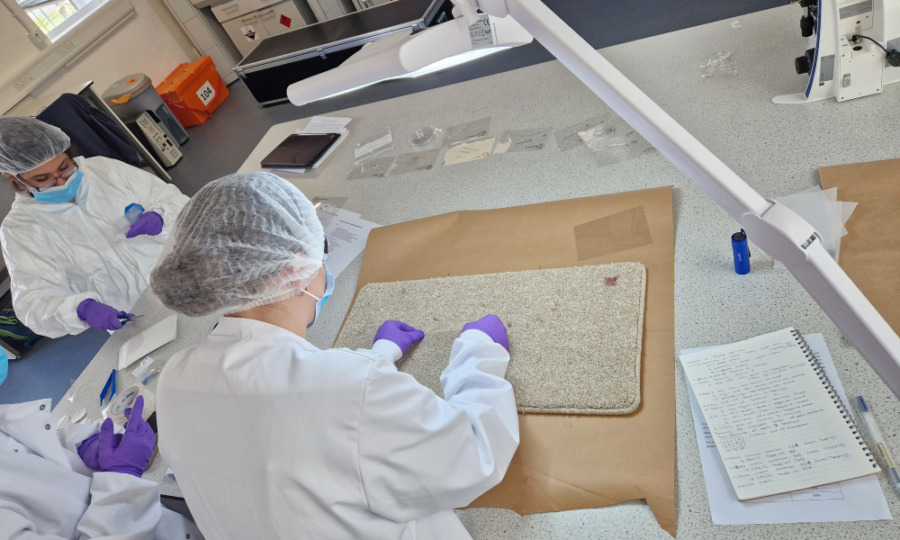
We are often asked at events, especially by younger students looking at moving through the undergraduate process. “How do I get into forensics?”
As a University, we are committed to the long-term future of forensic science teaching and how with the right skills, the professional environment of forensic science is a broad and fascinating spectrum of roles, responsibilities, and understanding.
What do we know about the history of forensic science?
Forensic science has been in practice for hundreds of years. The skill of identifying, interpreting, analysing, and presenting evidence is a hugely important part of how we as a society can learn, improve or innovate from the smallest of incidents to the most devastating of disasters.
The sixteenth-century French Army surgeon Ambroisé Pare is widely considered one of the founding fathers of modern Forensic Pathology, as he studied the effects of violent trauma on internal organs. The era of transition between blade to projectile injuries saw increasingly more devastating injuries, and therefore study into what the effects were to those who had died from their injuries and how survivors were able to overcome the impact of the weapon.
Northern Europe saw several innovations from Italy, France, and Germany in the coming centuries adding to the medicines and practices that were being discovered in Asia by travelling researchers.
The desire to know more about how a person died or the events that led up to their death was counter to the beliefs of the time where rumour, accused witchcraft or religious persecution would be the main result in conviction of crimes.
Fast forward to 1784, where in Lancaster, England, the first murder conviction in the United Kingdom recorded, using forensic techniques as the main form of evidence, in the conviction of John Toms of the murder of Edward Culshaw when a pistol wad with torn paper surrounding the musket ball and power was found to match a torn newspaper in Toms’ pocket.
As a society we thrive on investigation, the quest for knowledge and demand for answers. The desire for scientific knowledge can be recorded back thousands of years and this eventually developed into the world of forensic science that we know today.
From the early days of toxicology in the 1800s, fingerprinting criminal suspects, to Henry Goddard’s use of forensic ballistics to track bullet speed and velocity. The world continues to benefit from enhanced expertise in the forensic field.
Where does Cranfield fit in?
Cranfield University have provided education and expertise in forensic science for over 25 years within the Cranfield Forensic Institute (CFI). During that time the expert-driven and postgraduate nature of our courses has allowed thousands of students to learn, progress and provide experience after experience to demonstrate the importance of their study.
Our courses reach across the spectrum of the core branches of science. We seek to provide the widest possible route for students to dictate their own path from our extensive forensic programme of modules to innovative new courses using state-of-the-art facilities.
We run specialist Master’s courses in
- Counterterrorism
- Digital Forensics
- Forensic Archaeology and Anthropology
- Forensic Biology
- Forensic Ballistics
- Forensic Explosive and Explosion Investigation
- Forensic Investigation
The role of a forensic scientist is not defined by one specific talent or expertise, but by the constant need and awareness to explore and investigate across the breadth of the scientific spectrum.
Whether that be looking into the latest ways of improving encrypted data recovery in digital forensics, to having the nuanced look at how mass casualty events occurred and how they could be mitigated in future.
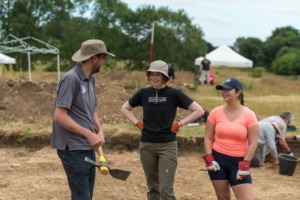
It’s not all CSI:Miami – You can spend weeks away on field trips learning from the experts in areas such as archaeology, underwater recovery, ballistics and explosives.
We look to train all our students and equip them to achieve their career potential. The modules not only provide the theory and techniques of how to analyse but give you the interpersonal skills in presentation and explanation.
Forensic scientists are often called as key witnesses in criminal cases. This often-daunting experience is developed by all students on our forensic programme attending a module dedicated to courtroom skills. The ability to succinctly and professionally present evidence that could be the key factor to a conviction.
There is a growing need for forensic analysis in both the public and private sectors and we have seen graduates go on to roles across the board in forensic science, policing and security sectors.
It is easy to assume that forensics is all people in white suits looking at fingerprints, but the scope is wider than you think.
Ever wondered who checks artwork for fakes, forgeries or defects in museums, auctioneers, or galleries?
How about who are examining lost techniques in ways of mixing materials and creating incredible infrastructure from hundreds of years ago, recovering the remains of fallen soldiers from over one hundred years ago to allow repatriation, or just simply working in one of the United Kingdom’s biggest bakery chains to mitigate theft and digital crime.
Forensic science can make the difference between knowledge and assumption. It can provide the key indicator for cause and effect and ultimately make the decision if something was right, or if it was wrong.
We want to create a balance of expert professionals in industry, but also those who want to continue an academic career and research into the next generation of techniques, facilities and understanding.
Cranfield Forensic Institute will continue create a path for those who like so many before them, have the desire to know more.
Over a series of blogs we will explain how Cranfield is utilising its expertise and teaching methods to provide and promote the next generation of subject matter experts and thought leaders.
This series will aim to inform, inspire and energise. Giving you the information for why we believe so strongly in our teaching, and how we can develop and shape the future of each student who passes through the doors at Cranfield University.

Categories & Tags:
Leave a comment on this post:
You might also like…

How do I access the full-text of Harvard Business Review (HBR)?
This is a frequently asked question, and it's worth knowing how to access this key management journal. So, how do you access HBR in full-text? The short answer is via our eJournals finder. You can find ...

Engineering problem to solve? Let Knovel help you find a solution
Did you know that Knovel provides you with more than just eBooks? Knovel is a key database for many engineering, mechanical and materials courses here at Cranfield University, and contains content from an extensive range ...
What happens when female scholars meet influential leaders?
On the 5 March 2026, our British Council Women in STEM Scholars had the privilege of sitting down with two excellent role models of industry and academia: Professor Dame Karen Holford, ...

From MSc to CEO: Igniting a research revolution
For many, a master’s degree is achieving a big milestone. Kilyan Ocampo, Computational Fluid Dynamics alumni shares how studying at Cranfield helped launch his career in the energy sector. Today, Kilyan ...

Commuting, collaborating and growing: My first term experience at Cranfield
My first term at Cranfield University has been an extremely positive and rewarding experience. While the course has been intense at times, it has pushed me in the best possible way and allowed me ...

Sourcing country analysis – a guide to Library sources
For those researching a country, you will find that country information tends to take two forms: Analysis - country reports are descriptive reports covering most areas of interest on a country. They contain an analysis ...
Comments are closed.