

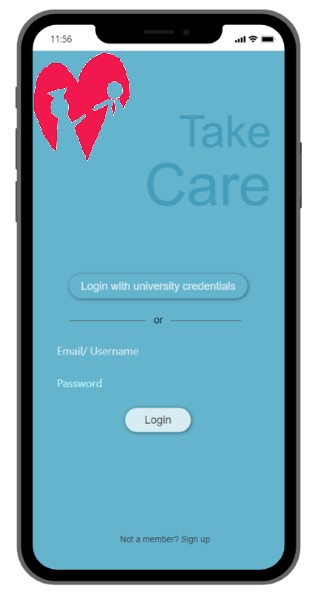
#TakeCare app – for student well-being
03/07/2019
We first got the Information about the Change Agents Conference (CAN2019)/JISC Hackathon through Cranfield University intranet for registration.
Our master’s diverse four member team consisted of Carolyn Nandozi and Shafa Rahimun from Geographic Information Management MSc, Clinton Machoka from Aerospace Computational Engineering MSc, and Khadijah Abdullahi Habib from Safety and Human Factors in Aviation MSc .
Studying at Cranfield University for the past 8months has honed our communication, presentation, public speaking and many other skills while pushing us to be winners in what we do. For this reason, we were confident about the competition, focused on our best performance and representing our institution alongside some of the UK’s renowned universities.
We got the unique opportunity of selecting one from different themes centred on student and educational institution:
1. Student wellbeing
2. Student curriculum improvement
3. Responsive and welcoming campuses
4. Artificial Intelligence (AI) or Intelligent Assistants
One of the reasons why we chose students wellbeing and mental health was because this is a growing concern amongst students, especially international students as students from different cultures are not used to confronting mental and wellbeing issues as they hardly recognise their reality. Another reason was because some of us had experienced first-hand or witnessed our friends experiencing these problems, and existing apps and websites weren’t really working for us. Furthermore, there were issues of students’ time and location management including anonymity discussions in comfort to setup meetings with our students health and wellbeing centre for full utilisation of its services, which formed more gaps of analysis for solutions. Seeing similar experiences within peers and young adults in similar situations also helped us form a solution through technology. With this idea, the proposal was made by our team leader, Nandozi, to the organisers from JISC/CAN2019, and we were sent invitations and schedules for the two-day hackathon.
Arriving Tuesday, 28th May 2019, the Hackathon fell in the month of Ramadan* which made some group members take preparations for attending the competition while observing their fasts, but the organisers had considered it for appropriate arrangements.
On Wednesday, 29th May 2019, we were briefed to then starting working on our ideas at Open University. Firstly, we built on our two weeks concept preparations to fully identify the problem for the exact solutions to then discuss all relevant contents to be included in the app, colors, logos, and our target audience. The next step was to brainstorm and split the tasks amongst ourselves, this made everyone accountable and helped us work faster.
Shafa designed the application interface prototype, Clinton developed a working forum and quiz portal through web-based technologies, while Khadijah and Nandozi created contents for the app including motivational quotes, notifications which content followed students’ academic peak year ranging from welcome week, first module, first assignment, career weeks, group projects, thesis, presentations, job worries and applications until academic year end. Nandozi and Khadijah also attended the conference seminar on the mental health situation for distance learning students, which improved our knowledge and branch our focus to not only on-site students, but the abovementioned demographic as well.

#TakeCare App team hacking hard!
We had “stand up” sessions, for progress feedback. Our team also had longer night meetups to discuss our progress and pitch strategy guided by Cranfield Bettany Centre Start-up Weekends format.
There were seven teams in total, each team had only three minutes to present their idea to the audience. Our team, as representative of Cranfield University, was the sixth to present where we talked briefly about our ideas, and the prototypes were shown in our two different target devices, a iPhone and a Google Pixel handset, to the audience to give them an opportunity to go through the designed interface. #TakeCare tech brings together and provides peer to peer support by alumni, mentors and fellow students for a student’s wellbeing in real-time. The tech can be integrated into university technologies for instant access such as black board and intranet taking care of the student’s every academic step ensuring their wellbeing while boosting their achievement.
Later interactions with audiences complimented our ideas as the best! And one key point that came up consistently was the peer to peer wellbeing support and the human element in technology which is in need of prevalence in forming solutions, as seen by academics and educators.
On announcement for the winners, it was quite interestingly, there were two teams that won the competition –from UCL and our very own Cranfield! It was a very thrilling and humbling experience to win the competition, especially as for most of us it was our very first hackathon participation.
Along with prizes, we got exposure and our work by supplying the organisers with a blog post about our idea formation, development and lessons learnt. The overall occasion was extremely encouraging, as it gave us the motivation to further develop our idea into a fully formed application, while giving us the chance to represent our university and gain some new skills and experience. We also thank our university for giving us these different opportunities to further embed ourselves into extra-curricular activities, and expanding our dimensions lifelong.
Written by Khadijah Habib, Shafa Rahimun and Carolyn Nandozi.

Categories & Tags:
Leave a comment on this post:
You might also like…
Building more than research: Reflections from the ECRn Symposium 2026
There’s something quietly powerful about a room full of early career researchers. Not just the ideas, although there were plenty of those—but the conversations, the curiosity, and the sense that everyone is figuring things ...

Library services over Easter, 3-6 April
Kings Norton Library will remain open for study 24/7. You will need your University ID card to enter the building and can use the self-service machines to borrow and return items as usual. Barrington Library ...

How do I access the full-text of Harvard Business Review (HBR)?
This is a frequently asked question, and it's worth knowing how to access this key management journal. So, how do you access HBR in full-text? The short answer is via our eJournals finder. You can find ...

Engineering problem to solve? Let Knovel help you find a solution
Did you know that Knovel provides you with more than just eBooks? Knovel is a key database for many engineering, mechanical and materials courses here at Cranfield University, and contains content from an extensive range ...
What happens when female scholars meet influential leaders?
On the 5 March 2026, our British Council Women in STEM Scholars had the privilege of sitting down with two excellent role models of industry and academia: Professor Dame Karen Holford, ...
From MSc to CEO: Igniting a research revolution
For many, a master’s degree is achieving a big milestone. Kilyan Ocampo, Computational Fluid Dynamics alumni shares how studying at Cranfield helped launch his career in the energy sector. Today, Kilyan ...