

My PhD funded by the Sue White Fund: ‘Sensing charcoal making and understanding links to deforestation in Tanzania.’
14/12/2018
The charcoal business in Tanzania is widely spread but the activity is not regulated, and the level and distribution of charcoal kilns are not well known. Studies show that charcoal making causes deforestation and pollution, but its emission and extent of deforestation associated with this activity are largely neglected.
Under these backdrops, my PhD (Sensing charcoal making and understanding links to deforestation in Tanzania) will employ ambient air monitoring exercises coupled with source apportionment studies, questionnaires and GIS analysis of forestry to understand the levels of emissions and distribution of charcoal kilns. The results of the study will help us to understand why the impacts of charcoal making are varied and will benefit the industrial partners (Alphasense Ltd) by being linked to atmospheric data collection in developing countries.
Before I started my PhD I was working as a tutor at Forest Industries Training Institute, which is under the Government of Tanzania and training students in Environmental Management. I was actively looking for a PhD in the field of Forestry and another related field like Environment. Then I found this PhD online, when I started going through the advertisement I found myself very interested in the research and decided to apply for the project. After applying for the post, I attended a Skype interview and a couple of months after I received my offer letter to start in September last year (2017).
I am currently based at The University of Dar es Salaam Tanzania, they signed an agreement to host me at the College of Natural and Applied Science in the Department of Botany. Therefore currently, I’m being hosted here while doing my research. I’m being supervised directly by Dr.Iq Mead and Dr. Monica Rivas Casado from Cranfield University and supervisory meetings are scheduled on weekly and monthly basis.
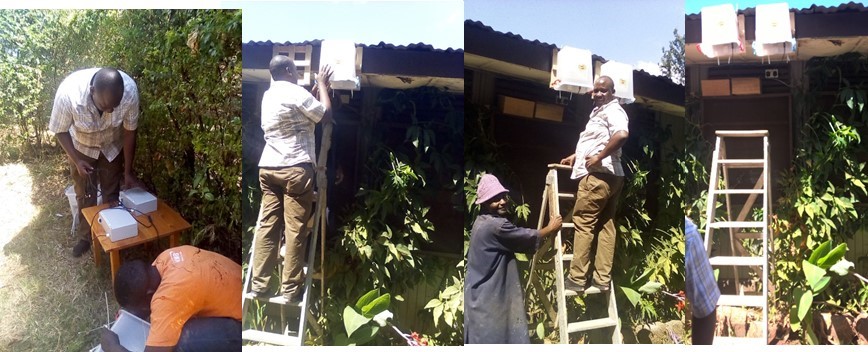
My objective during this PhD is to investigate the impacts of charcoal making and use on the environment and catchments. More specifically to identify areas of increased charcoal production using advanced miniaturised gas phase and particulate sensors (Fig.1) around the Usambara Mountain in Tanzania, identify areas of high-density kilns using source apportionment studies, differentiate charcoal Kiln emission plumes from other regionally important sources and to link charcoal production with increased flooding risk and changes in water level in catchment the areas.
It was through the Sue White Fund that I was able to start this PhD, the progress I have made so far through my research sponsored by the Sue White Fund is:
- Showing how to investigate the sources pollutants in the area under investigation – this was done by using a backward trajectory analysis to show that in the dry season (June) at Usambara mountain typical air mass movements are from the sea to the inland.
- My initial land use studies taken in conjunction with my trajectory work has the potential to investigate the sources of pollutants and links to deforestation in Tanzania.
- I have developed skills on how to use R software to analyse air quality in our local environment. Under this software infrastructure, it enabled me to collect meteorological data of the study site such as wind speed and wind direction. Gaining this skill facilitates easy understanding of the sources of pollutants that links to deforestation in Tanzania.
- Further, based on my conversations with researchers at University of Dar es Salaam this work is a significant step forward in the better understanding of air quality in Tanzania. It has the potential to understand the links of human activities like charcoal making and deforestation and policy implications regarding environmental conservation in Tanzania.
This PhD is progressing well and now about 14 months has completed so far. I’m very content to be part of this project as I have gained knowledge and skills on how to deploy and collect data using cutting edge technology in developing countries. Further, I’m very satisfied to the way Sue White fund has handled this project up to this moment.
Header image: Pictures showing deployment of Miniaturised sensors in the field (trial sensor deployment)

Categories & Tags:
Leave a comment on this post:
Comments are closed.
You might also like…
The V-conomy: powering the sixth wave of global economic growth
The world could be on the verge of a major surge in economic growth and development, driven by the convergence of AI and clean energy technology. Waiting to ride the K-wave The Russian ...

Get a head start on referencing and plagiarism
We offer a module on Referencing And Avoiding Plagiarism which you can find on your Canvas dashboard. It explains the role and importance of citing references and how to incorporate the work of other authors ...
How Cranfield shaped my journey as an Aerospace Engineer
If I'm being specific about the moment it clicked, it was reading a paper called "On the Role and Challenges of Computational Fluid Dynamics (CFD) in the Aerospace Industry" by two Boeing engineers, P. ...
Introducing Kings Norton Library
Welcome to all our new students! We are looking forward to meeting you soon. You will find Kings Norton Library in the centre of the Cranfield campus, and it is open 24/7 to all staff ...

Setting your research on the right course: Four questions every researcher should ask
Whether you are just beginning your doctoral journey or are already well into your research career, successful research rarely happens by accident. Like any successful mission, it depends on good planning, informed decisions, and getting ...

5 budgeting mistakes students make (and how to avoid them)
Good financial planning isn't about how much money you have. It's about the habits you build. We asked Dr Lakshmy Subramanian, Course Director for the Banking, Economics and Finance MSc, about the budgeting mistakes ...
Congratulation for the great job performed so far.
Great work. I really get interested with your study. Hope it will be more useful to develop some of our policy!!!!. Wish you all the best
This is fascinating! Best of luck and please keep us updated!