


Office-Mania!!
25/06/2020

I was just 6 months into my PhD when this pandemic started. I had just gotten used to being in a new environment, got a new house and suddenly something changed. I found myself having to adapt to a new situation, and I kept repeating myself “you have to stay at home and manage your time better now”.
When I had to cope with this new situation, I started to narrow down what was keeping me up in the office. I tried to recreate my entire day at university, at home. I know it sounds crazy, but it is actually not!
First thing first: what did I have on my desk? What did I actually need? So, I wrote a list of things that I was using daily when I was at my desk. I went through my Uni routine: from 8.30 until 5 I worked, then from 5.30 until 6.30 it’s gym time (I have to be honest, gym time was not an “everyday thing”), then I ate dinner, watched a film and went to sleep.
The thing that I liked more when I was at the university, at my desk, was setting it up and cleaning it afterwards. It seems weird, but that was the key thing that helped me through this entire pandemic.
So, literally every morning I am preparing my desk at home. I set up my computer, I insert two plugs (one for the phone) and I linked my wireless headphones. On the right side of my laptop, I place my notebook and my pencil case and, on the left, … my first espresso!
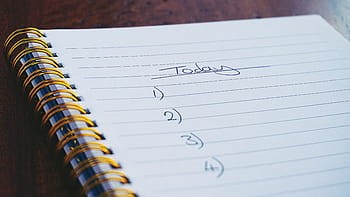
Then, I read my “Stop Worrying!” timetable. I think the main problem with the pandemic was feeling like you are not doing enough. That is why managing your time is the best thing that can help you to understand how much you are doing and If you are doing enough. My “Stop Worrying!” timetable is a list of things that I have to do, together with their deadlines. In this way, I knew what task I had to do for the day. You have no idea how satisfying it is crossing something off from that list once you have done it.
When you go into the office, you set your mind from 8 until 5, but when you are at home you do not look at the time anymore. The problem that I had at the beginning of this time was to try and manage not only my time, but also my entire project. Usually, the first part is about writing literature review, and even though I did my literature review I did not focus about writing much compared to fieldwork. So, when the lockdown came, I had to deal with the fact the I had a lot of writing to do and had to plan for it.
Every evening around 5 I place everything back leaving my desk completely empty. In this way I manage to have my office hours at home. I started to feel like we are always worrying too much, but that every time something comes that can interfere with the PhD is actually something that we can turn around.

Categories & Tags:
Leave a comment on this post:
You might also like…
Moving to the UK to study? How to plan for banking, exchange rates and transfers
Currency and banking are two of the most practical parts of financial planning for international students. They are also often the most overlooked. We asked Dr Lakshmy Subramanian, Course Director for Cranfield University's Banking, ...
Cranfield: an environment where innovation thrives
The latest Knowledge Exchange Framework rankings from UK Research and Innovation (UKRI) gives an insight into the real and meaningful impact that UK universities have. The seven categories that make up KEF6 cover everything ...
How Cranfield accelerated my career in Logistics and Supply Chain Management
After graduating from the MSc in Logistics and Supply Chain Management at Cranfield University, I've been reflecting on the experiences that made my journey so valuable and the impact it has had on my ...
Mendeley: a powerful tool to organise and manage your references
Are you looking for a way to manage your references, create in-text citations and reference lists for your assignments or thesis? If so, you may wish to consider using Mendeley. What is it? Mendeley is ...

Keen to develop your study skills?
Alongside the technical skills and academic knowledge that you will gain on your course, as a Cranfield student you have the opportunity to develop a range of other skills that can enhance your learning experience. ...

The V-conomy: powering the sixth wave of global economic growth
The world could be on the verge of a major surge in economic growth and development, driven by the convergence of AI and clean energy technology. Waiting to ride the K-wave The Russian ...