


Keeping you updated on my Group Project and Norfolk!
26/05/2021
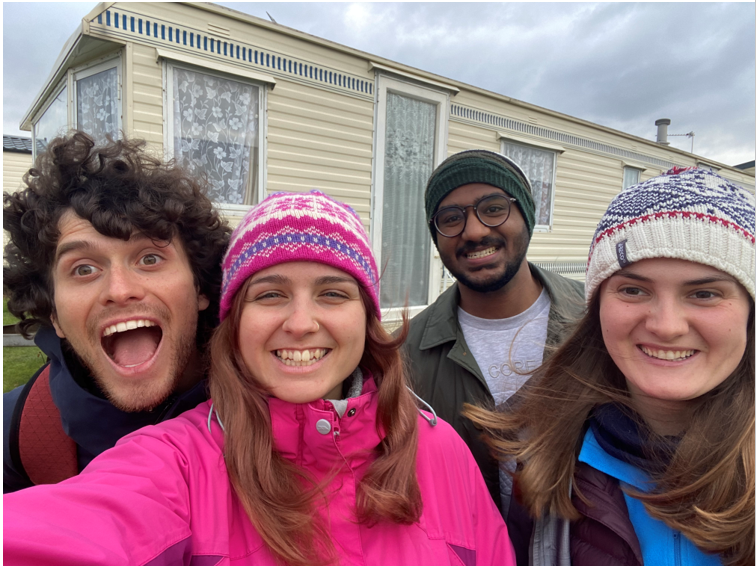
What has been your favourite memory from studying at Cranfield University so far?
It was actually quite nice to finish the last taught module, because it felt like we had completed a milestone! Also, because it had all been online, it was quite tiring! It felt like an achievement because we knew we had now completed 40% of the course! After the modules term, you move onto your Group Project and then onto your Thesis Project and these are both very different types of tasks!
We have also just completed our Group Project and that has felt like a milestone too! It’s a bit scary though as the end of the course feels very near now! Where’s the time gone? It’s gone so quick!!
In terms of the studying, those have probably been my favourite two memories!
Two weeks ago, me and my housemates went away, when the restrictions lifted, to celebrate the end of the Group Project! We went to Norfolk, and it was two of their first times visiting beaches in the UK, and we stayed on a caravan site. This was a really good trip and a really nice memory!
-
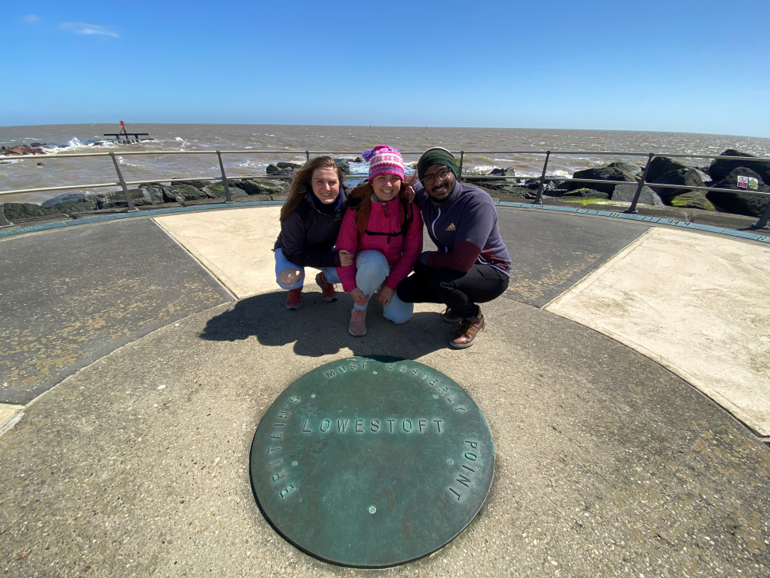
Us at Lowestoft, the most Easterly Point in the UK
How have you found online learning?
It’s been challenging at times as I really value the interaction of face-to-face teaching and I feel like I listen and pay more attention! But there has been one advantage, because of how bad the weather’s been it’s quite nice having to not cycle in at 8am to campus. I would have preferred face to face learning, I think most people would have! But at the same time, you just kind of learn to adapt and get on with it!
Being online did make the group project more difficult in a way, because with working people you don’t know and you’ve never met and you’re just working online with them, it can be a bit more difficult. It would have been nicer to have face to face meetings. But I mean, we can’t really do much about that!
Which module did you enjoy the most?
The modules term feels like such a long time ago!
I enjoyed the Waste Management in a Circular Economy: Reuse, Recycle, Recover and Dispose and the Pollution Prevention and Remediation Technologies modules.
Some of them I didn’t enjoy as much as the assignments as they were a lot more challenging. For example, the consultancies style of reports was more difficult for me to understand and get my head around at first!
But overall, they were all good and there was none that I didn’t enjoy!
Could you tell us a bit more about your Group Project?
My Group Project was titled ‘Diagnosis and Recommendations to Enhance Wardown Lake’ which is a lake in Luton and it was sponsored by Luton Council. The project was actually part of the Water theme, consisting of only myself and another student, from the Environmental Engineering MSc, another student from the Geographical Information Management MSc with the rest of the students from the Water theme.
I only knew one person prior to starting the project which made it more challenging with the online aspect. But we made it work and we actually all met up, well besides from one of us who was still studying in France!
With the rule of six outdoors in place the University couldn’t take us to the Lake itself, but we were told by the supervisors and project sponsors that if we could make our own way there and make it count as exercise than we were free to visit. So, we all met each other outside and went to the Lake and did a site visit, which really helped with the project! It was also really nice to meet all of the group in person! When face to face teaching on campus started again, we met an hour or two before our supervisor meetings and had a coffee and a chat, rather than just going straight into the meetings.
We have our final presentation this week where we will present to the sponsor… so wish us luck!
-
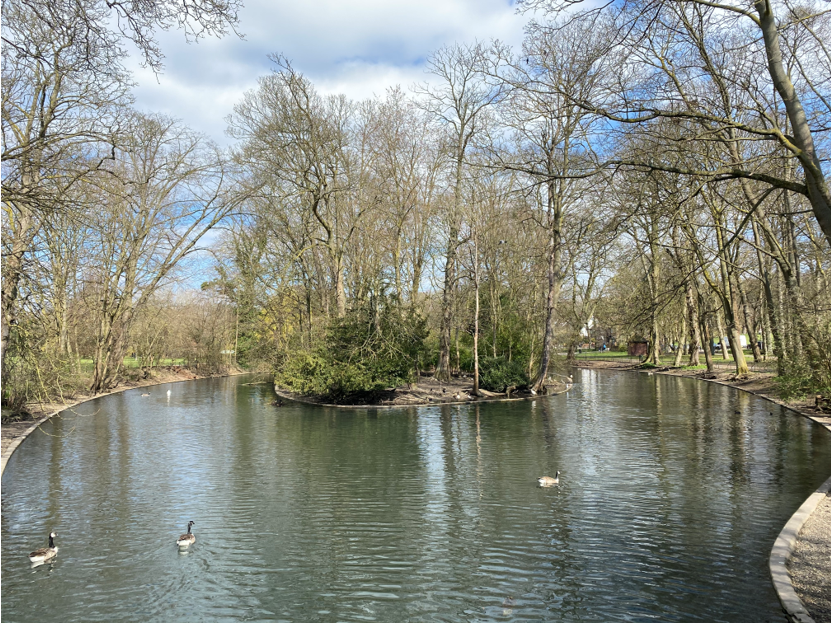
Wardown Lake at Wardown Park, Luton
How have you found working with students from different courses and different themes?
As the group project was largely water based… obviously!! The guys from the water course knew a lot more about the sedimentation and the processes of the Lake. We knew from the environmental side more about the catchment management from our Catchment Management module. The team member from the Geographical Information Management MSc, obviously knew everything about making the maps on GIS software, which was something I’ve not done at all since the second year of my undergrad, and it gave me nightmares back then! It was nice to have experts in each section of the project. I think that really helped!
Have you been able to use the knowledge that you learnt in your modules?
The outcome of the project was a consultancy style report so my experience in the modules term came in handy as two of my assignments were also consultancy style reports. The module on Catchment Management and Land Engineering, where we learnt about controls for erosion, came in very useful, even though other members of the team covered those aspects, I at least knew what was going on!!
In terms of the presentation side of the Group Project, we had breakout rooms in taught modules where we had the opportunity to present to each other and work on those softer skills.
Are you looking forward to the next part of your course, the Thesis Project?
Yes, I am! I have begun my background reading already and because we just jumped straight into it from the Group Project it was quite nice for us to have a weekend away in-between so that it didn’t feel so continuous from like the Christmas break.
I’m looking forward to it, it’s going to be nice to do my own project! I’m very strict on my timekeeping, so working with others was challenging at time to deal with people’s rather relaxed attitudes!! I quite like the idea of being able to manage my time and do my work on parts that I want to work on when I want to work on them.
What are you looking to do after you complete your MSc?
I am considering doing a PhD!! But… I don’t know, I’m still very undecided!
I’m still interested in too much of broader scale of topics and I need to narrow things down. I found picking a Group Project and picking my Thesis topic quite challenging because I like exploring different areas. There’s nothing at the minute that I think to myself “Oh, I really want to specialise in that area!”
I think my interest in a PhD is something that’s developed, I’ve always enjoyed studying. That is why I chose to carry on with an MSc!
Has completing your MSc made you change your career plans?
I started the course not knowing really what I wanted to do. Now I know the topics that I enjoy more than others and I’ve got more of an insight into the different career opportunities and paths that I could take.
What tips and advice do you have for next year students?
Try and keep on top of your work, but take breaks when needed! Also don’t feel bad for not working or taking some time off because some people will be like “work work work”, but then you will just burn out! So try and enjoy yourself! Also get out and visit Cranfield and the surroundings area and just enjoy yourself because the year goes really quickly! Some of my favourites now include Aspley Heath, Olney, Salcey Forest and The Grand Union Canal.
-
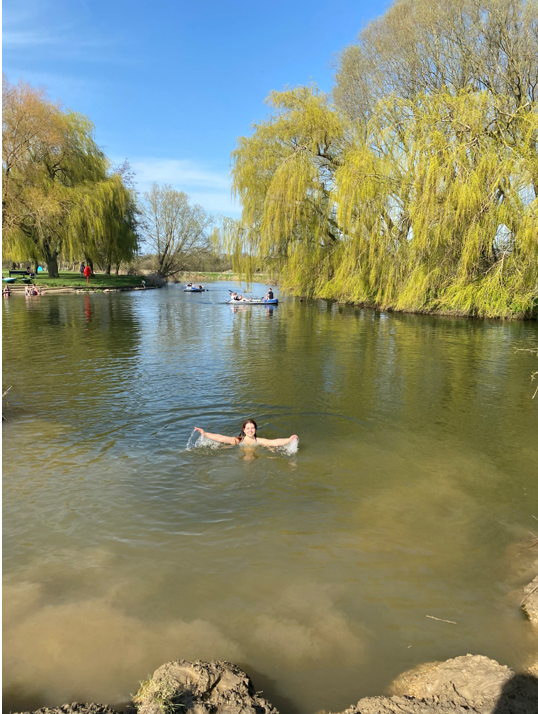
Wild swimming at Olney (When the weather was actually warm!) -

Exploring Salcey Forest
Any places in Norfolk you would recommend students visiting!?
We stayed in a place called California, and we laughed a lot because the weather was not great!
We went on a 20 km walk to a beach called Horsey Gap, where you can see wild seals and there were seals in their hundreds!
We have also done quite a few different road trips around England! We went to Cambridge, the Cotswold’s last year before everything locked down again with a few trips to London already this year.
-
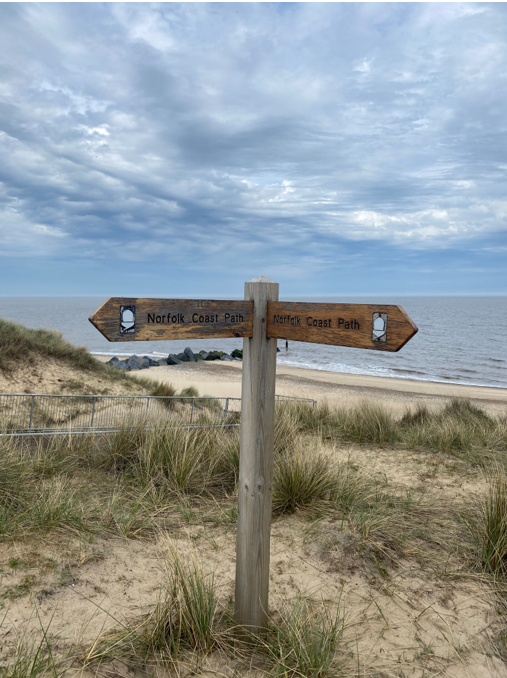
The Norfolk Coast Path -

The Seals at Horsey Gap

Categories & Tags:
Leave a comment on this post:
You might also like…

Engineering Tomorrow. Part two: Can we move around the world without emissions?
Moving people and goods around the world is essential to modern life. But every journey has an environmental cost, and reducing the emissions associated with transport is one of the major engineering challenges of ...

Following in the footsteps of aerospace pioneers
I came to Cranfield to understand how aircraft stay in the sky. Months later, I was measuring the performance of aircraft engines in flight aboard the National Flying Laboratory Centre's Saab 340B. My ...

From looking up at jet engines to powering the future of flight
From flying aboard Cranfield's Saab 340B flying classroom to rebuilding a gas turbine component by component, Jouni Kailouh's journey shows how specialist, hands-on experience can turn a fascination with propulsion into a future career ...
Engineering Tomorrow. Part one: Can we power the future without costing the Earth?
The world needs energy. To power homes, industries, transport and the technologies shaping our future. But as demand grows and the pressure to reduce emissions increases, how do we generate the energy we need ...

Looking ahead: Building foresight skills for a more sustainable future
As sustainability challenges become more complex and uncertain, organisations need people who can look beyond today's pressures and think strategically about the future. From changing regulations and emerging technologies to supply chain disruption and ...

Brazil to Cambridge: How Cranfield helped me build a career in data analytics
I was hungry for something bigger. Before Cranfield, I was living in São Paulo, Brazil, working as a Data and Market Intelligence Analyst in the trading division of Raízen. My background is actually ...