

‘Grill the Aspiring Geeks’ – Cranfield University stories from the Disruptive Innovation Festival
01/12/2017
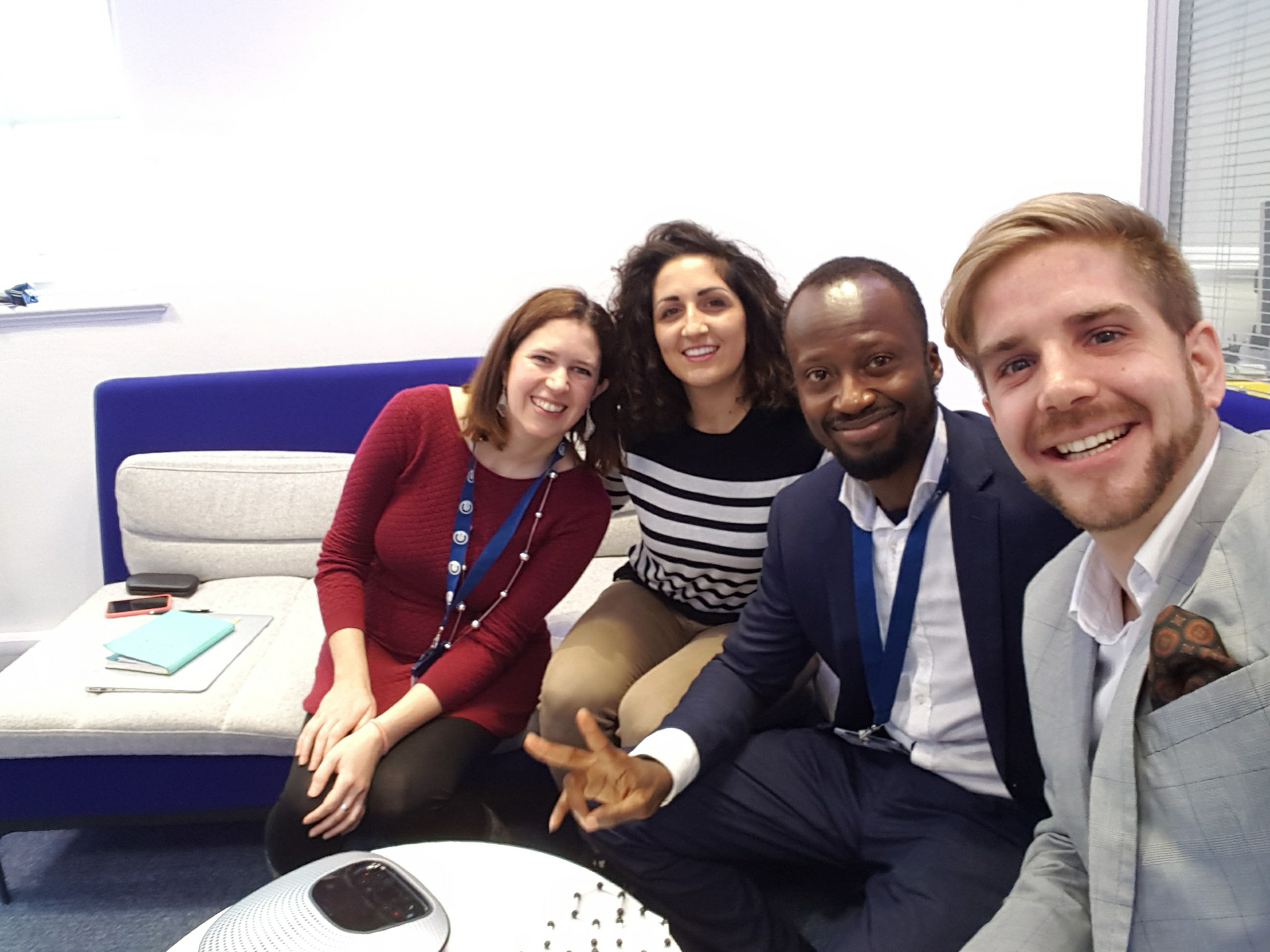
We recently took part in The Disruptive Innovation Festival (DIF), a three-week-long online festival of ‘disruptive’ ideas (from November 6th to 24th 2017), which is free and accessible to everyone.
The festival challenged us to think about “What if we could redesign everything?” in a world where repair, reuse, remanufacturing, refurbishing, and recycling are becoming increasingly important, disrupting our conventional way of doing things. Within the festival, our Cranfield session focused on the Circular Economy, and we were interviewed in a session called ‘Grill the Aspiring Geeks’.
‘Grill the Aspiring Geeks’ has the aim of bringing research to general audience, in a 50 minute back-to-back question and answer from the public where we approached the topic from different perspectives. In my session other two PhD researchers were involved, Tobias Widmer (part of the Circular European Economy Innovative Training Network, Circ€uit, under the Horizon 2020 Marie Skłodowska Curie Action 2016), and Oke Okorie (PhD Researcher in the School of Aerospace, Transport and Manufacturing, Cranfield University).
Previous to the DIF session, we had a brief preparatory chat with Dr. Mariale Moreno (Academic Fellow at Cranfield University, and also the organizer of the session), where we discussed the format of the interview and expressed our ideas regarding the potential question from the audience.
It has been a great experience but it was also very challenging; the questions were live, we had to formulate an answer in few seconds and we had to interact with ourselves as well! An interesting kind of multitasking which we hadn’t done before, but it was worth it. It was also a lot of fun, and the time passed a lot faster than what we were expecting.
We all had different and complimentary feedbacks about the DIF event. I thought that taking part in these activities could be a good preparation for my PhD viva and could serve as practice for potential job interviews, since questions which were asked were varied, and were not strictly related with what I does for my PhD a daily basis. Oke and Tobias enjoyed being pushed to think outside the box, enjoyed simplifying the detailed part of their research to easy-to-understand forms for a general audience. Generally, we all enjoyed contextualizing our work in a larger setting.
We enjoyed being part of DIF and we believe more researchers should challenge themselves and putting themselves out there to discuss their work with a wider, varied audience. Who knows what could come out of it? However, as a suggestion, we recommend to keep the ideas simple, and focused to the general background and research questions that characterize your research (Why? What? How?).
Certainly, we are looking forward to hearing about and possibly participating in next year’s DIF Aspiring Geeks session(s)! The videos are up on https://www.thinkdif.co/ and can only be viewed till the 4th of January –a perfect Christmas treat, we would suggest!

Categories & Tags:
Leave a comment on this post:
You might also like…

Keen to develop your study skills?
Alongside the technical skills and academic knowledge that you will gain on your course, as a Cranfield student you have the opportunity to develop a range of other skills that can enhance your learning experience. ...
The V-conomy: powering the sixth wave of global economic growth
The world could be on the verge of a major surge in economic growth and development, driven by the convergence of AI and clean energy technology. Waiting to ride the K-wave The Russian ...

Need help using the Python programming language?
We know some of our students are currently trying to learn Python, so we wanted to make you aware of some great LinkedIn Learning videos that can help. But don't you have to pay for ...
What does it really take to become a Chevening Scholar?
Say “Turkmenistan” to most people and you’ll get a blank look. That was true when I left Ashgabat for the UK to study an MSc in Logistics and Supply Chain Management at Cranfield University ...

Get a head start on referencing and plagiarism
We offer a module on Referencing And Avoiding Plagiarism which you can find on your Canvas dashboard. It explains the role and importance of citing references and how to incorporate the work of other authors ...
How Cranfield shaped my journey as an Aerospace Engineer
If I'm being specific about the moment it clicked, it was reading a paper called "On the Role and Challenges of Computational Fluid Dynamics (CFD) in the Aerospace Industry" by two Boeing engineers, P. ...