

My dream to study phosphorus
21/12/2018
My passion for farming from young age drove me to agricultural college. After my first and second degree I have been involved with smallholder farmers making sure they get the best out of their fields, money and energy invested should be worth it. More recently I was involved in a project with Michigan State University which focussed on understanding crops adaptations in different environments and how can it be improved, that is when I saw the advert for “PhD in soil chemistry at Cranfield University” on one of our local online job search websites in Malawi. Reading it, I was interested mainly because they talked about phosphorus and the university was Cranfield. I love phosphorus it has been my dream to study this element in detail and my MSc was on this topic “external P requirement of soils in Malawi relative to effects of conservation agriculture”. I have been taught by a Cranfield University graduate before and he said nothing but good things about the university; I had to try my luck. From application to interviews, then I became a Cranfield University PhD student. Although the PhD project research title “Evaluating phosphorus dynamics from renewable sources to meet crop demand and minimise environmental pollution” does not say much, this PhD cuts across agriculture, environment (soil and water) and sanitation.
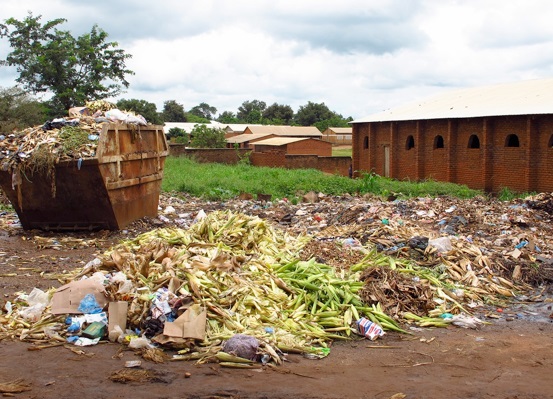
I am looking at the use of compost from municipal waste compost, market waste compost, sewage sludge compost, among others waste materials, on its effectiveness to supply and meet crop demand for phosphorus and also checking that water bodies and soils are being protected from overload of phosphorus and heavy metals from these waste materials. As the concerns of depletion of phosphate rock are growing each passing day I would like to produce the flow diagram of phosphorus flow in Malawi from importation to waste water. Doing this will identify and quantify potential sources for recycling. Currently, I am really into literature review for my research, designing and doing all sorts of preparation for field and lab trials. With guidance from a team of specialists in soils, sanitation and system analysis led by Dr Sakrabani, I will be the principal investigator. I will carry out each step of this research up to the end and field work will start in January 2019. I have talked a lot but none of what I have said (concerning my PhD) would have been possible if it was not for The Sue White Fund. The Sue White Fund is paying for my study here at Cranfield, upkeep, transport and part of the research funds. Thanks to The Sue White Fund for helping me to fulfil my dream while I am contributing to the development of my country and the world at large. So far so good, no challenges to report but the journey has just started, but still we should expect that we may incur some in the near future.

Categories & Tags:
Leave a comment on this post:
You might also like…
The V-conomy: powering the sixth wave of global economic growth
The world could be on the verge of a major surge in economic growth and development, driven by the convergence of AI and clean energy technology. Waiting to ride the K-wave The Russian ...

Get a head start on referencing and plagiarism
We offer a module on Referencing And Avoiding Plagiarism which you can find on your Canvas dashboard. It explains the role and importance of citing references and how to incorporate the work of other authors ...
How Cranfield shaped my journey as an Aerospace Engineer
If I'm being specific about the moment it clicked, it was reading a paper called "On the Role and Challenges of Computational Fluid Dynamics (CFD) in the Aerospace Industry" by two Boeing engineers, P. ...
Introducing Kings Norton Library
Welcome to all our new students! We are looking forward to meeting you soon. You will find Kings Norton Library in the centre of the Cranfield campus, and it is open 24/7 to all staff ...

Setting your research on the right course: Four questions every researcher should ask
Whether you are just beginning your doctoral journey or are already well into your research career, successful research rarely happens by accident. Like any successful mission, it depends on good planning, informed decisions, and getting ...

5 budgeting mistakes students make (and how to avoid them)
Good financial planning isn't about how much money you have. It's about the habits you build. We asked Dr Lakshmy Subramanian, Course Director for the Banking, Economics and Finance MSc, about the budgeting mistakes ...