


My MDes journey…
25/06/2021
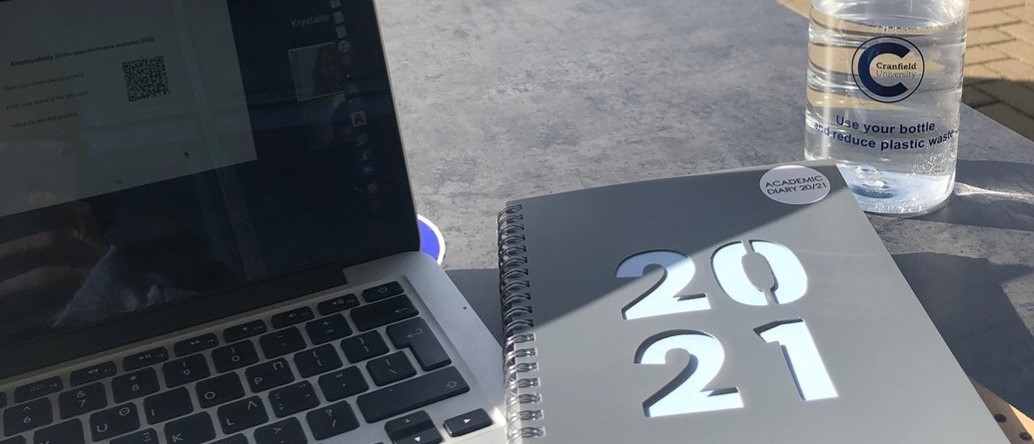
Looking back over my Design Thinking MDes year, it was filled with a lot of happy memories both academically and socially. The course was so varied in terms of content and delivery; some of which were very familiar and some which were very new – I cannot recall one moment of it whereby I did not take away something from a task or challenge.
Tell us a bit about you and what you study
Hi, I am Krystallia Klonara. I’m currently a Design Thinking MDes student and I’m very satisfied with my choice. My background is in architecture and engineering, yet I have a genuine passion for entrepreneurship, sustainability and strategic design which are all highly connected with the design thinking course.
So why did you choose Cranfield?
As you know, Cranfield is a solely postgraduate university, which comes with a lot of benefits, such as its very strong links with industry. The students tend to be very job oriented but at the same time, research oriented, as Cranfield has an excellent research reputation. We have access to cutting edge facilities and amazing staff, both administrative and academic, which support us every step of the way.
Moreover, one of Cranfield’s strongest elements for me was its location. It is a wonderful place to live where the quality of life is exceptionally high. You feel connected with nature and at the same time you are in a strategic location to have access to big cities and industrial areas. Lastly, Milton Keynes, which is one of the nearby cities is only 30 minutes away from London by train.
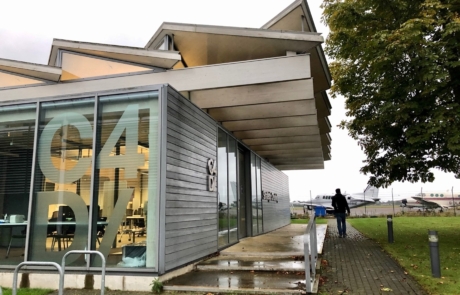
When it comes to the Centre for Competitive Creative Design, I believe that is a truly unique place. It resembles an innovation hub, in which you are constantly surrounded by passionate individuals within an inspiring environment. It has strong links with industry as it acts as a design and business innovation consultant for its commercial partners.
Can you share a few things about your course and its industry connections?
The Design Thinking course is divided into 3 parts. The first one is that of the taught modules. During that time, I had the chance to learn and practice design thinking principles. So, instead of being limited to “lifeless” case studies we often had the chance to work with industry partners on real challenges that they currently face. For example, in the consumer trends module we created a solution for Anglian Water, one of the largest water companies in the UK.
Then I moved into the group project phase which lasts for approximately three months. I was working with Autoglym, a British manufacturer of premium car care products sold in more than 45 countries. Our group was formed by students from different courses and backgrounds, which ensured knowledge transfer from various fields and exciting outcomes for our commercial partner and supervisors!
Then going into the master thesis project phase, which I’m currently undertaking, with the Unilever Global Ice Cream team. Hope I could share more but at Cranfield we make sure we keep our commercial partner’s secrets safe.
Behind all those companies and all those commercial projects are always people. The relationships that I built here on campus with students from other courses, first on modules and then in the group project phase, have helped me enrich my perspective and find my role as part of a diverse team.
Which were the highlights of your year?
When it comes to my highlights it’s truly impossible to choose and I’m being 100% honest when I say that. It’s been a challenging and yet amazing year with so many different things happening, shifting from face to face, to online, to then being back on campus.
One of the most exciting things that took place this year is my collaboration with Unilever. It started way before my thesis, when I took part in the Unilever Innovation Accelerator here at Cranfield. Apart from those three main phases of my course that I described, Cranfield offers a lot of things in between.
So, we formed a team of five students from five completely different courses and departments. Some from School of Management, School of Water, Energy and Environment and even Manufacturing. Our hard work paid off and we ended up winning the competition! Then some of us decided to extend our collaboration with Unilever into the thesis phase.

Is there any advice you would like to give to prospective students?
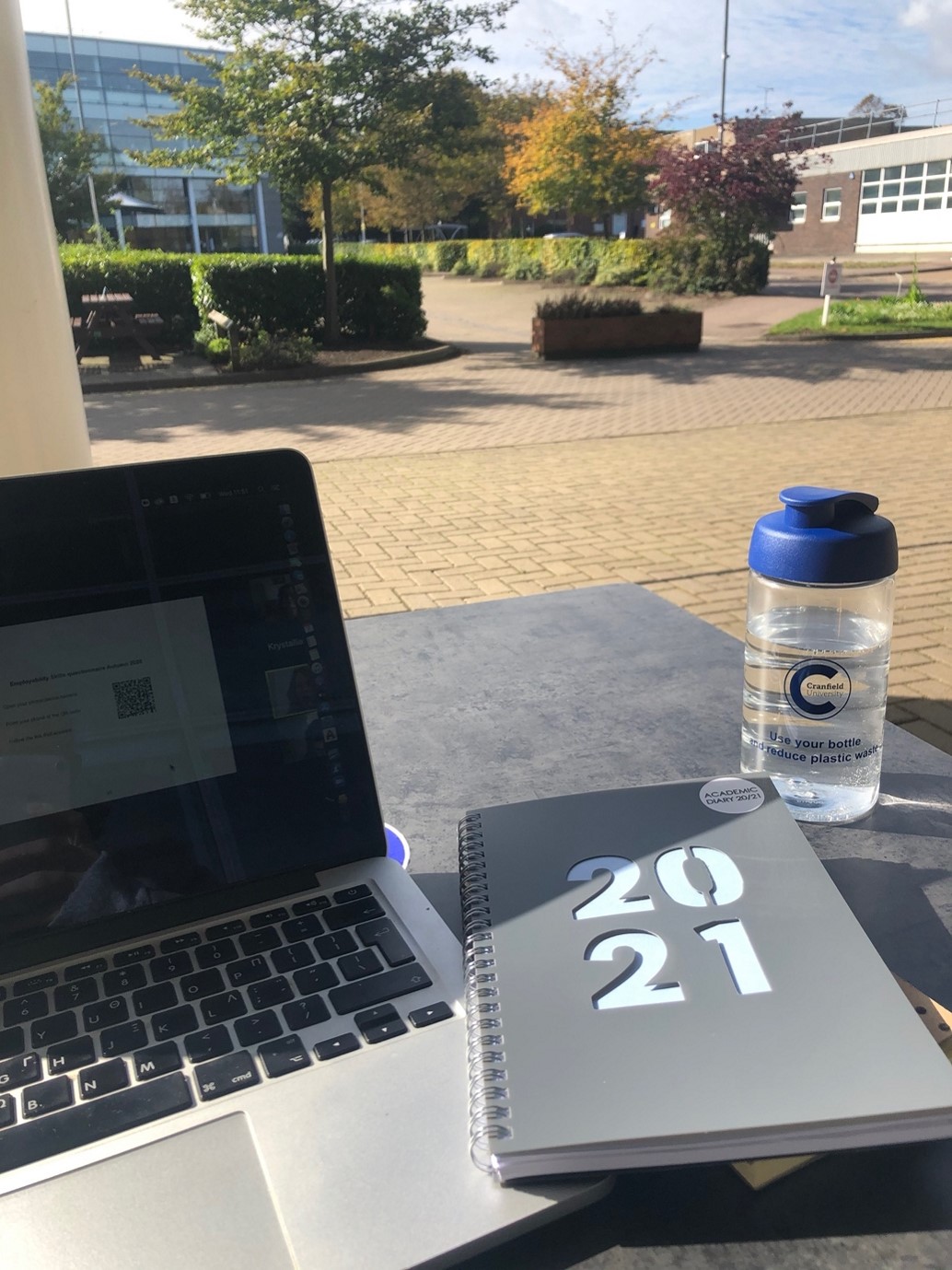
Here at Cranfield advice is always in abundance as everyone is willing to help. What I would say to prospective master students is that this year is to explore. Take this time to discover what you like, and of course what you don’t like, but always stay very open minded stepping into your master’s studies. The Design Thinking course is all about this exploration, so you will be able to touch upon so many different themes and categories.
Then the second thing I would advise would be to speak up. What I mean by that is, if you have any questions, if you need help with something, if you’re struggling with something, speak up. As I said in the beginning, you will find all the help you need here, and this is something that I mention from personal experience.
And the last piece of advice from me would be to stay passionate and that means be present and always approach things with. Take advantage of all that is being offered here at Cranfield. In the beginning it might seem a bit overwhelming but trust me, when time passes by, you will look back and feel very, very happy and satisfied with your choice.
My advice to anyone thinking of applying for the Design Thinking MDes course is to just do it! It is a year full of exciting tasks and experiences that you can tailor to suit your own specialism or interest!

Categories & Tags:
Leave a comment on this post:
You might also like…

Moving to the UK to study? How to plan for banking, exchange rates and transfers
Currency and banking are two of the most practical parts of financial planning for international students. They are also often the most overlooked. We asked Dr Lakshmy Subramanian, Course Director for Cranfield University's Banking, ...

Cranfield: an environment where innovation thrives
The latest Knowledge Exchange Framework rankings from UK Research and Innovation (UKRI) gives an insight into the real and meaningful impact that UK universities have. The seven categories that make up KEF6 cover everything ...
How Cranfield accelerated my career in Logistics and Supply Chain Management
After graduating from the MSc in Logistics and Supply Chain Management at Cranfield University, I've been reflecting on the experiences that made my journey so valuable and the impact it has had on my ...

Mendeley: a powerful tool to organise and manage your references
Are you looking for a way to manage your references, create in-text citations and reference lists for your assignments or thesis? If so, you may wish to consider using Mendeley. What is it? Mendeley is ...

Keen to develop your study skills?
Alongside the technical skills and academic knowledge that you will gain on your course, as a Cranfield student you have the opportunity to develop a range of other skills that can enhance your learning experience. ...

The V-conomy: powering the sixth wave of global economic growth
The world could be on the verge of a major surge in economic growth and development, driven by the convergence of AI and clean energy technology. Waiting to ride the K-wave The Russian ...