

First months as a Design Thinking MDes student
13/12/2018

I was previously a student in a French engineering school, and I specialised in materials and mechanical engineering. For my last year of studies, I wanted to find alternatives as I wanted to work in a more creative atmosphere, and I couldn’t do that by staying in my current University so I looked into studying abroad.
It has always appealed to me because I enjoy discovering new countries and new cultures. I had several options, including Erasmus exchanges but I decided to come to Cranfield University as part of a double degree programme. I realised that I wanted to steer my career in a more creative direction rather than in the technical domain offered by my engineering background.
Among the hundreds of master’s degrees offered at Cranfield University, I found the one which perfectly fits me, Design Thinking MDes. This master’s would enable me to get all the skills and tools to create a product or a service. Going through five modules, like Consumer Trends, Technology and Prototyping or Whole System Design, shows that this course covers wide areas and gives us all the keys to better understand how a product is designed.
First steps at the Centre for Competitive Creative Design (C4D)
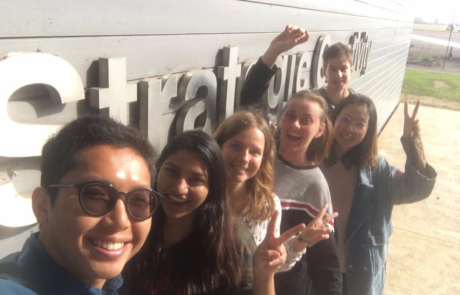
At the beginning of autumn, I took my first steps in C4D with my five other classmates, I quickly appreciated having lectures in a very small group. The teachers would sit with us around a table and tell us stories, which is much more interesting than a lecture in an amphitheatre. For some modules, other master’s students joined us, but after 3 months, there have never been more than 20 of us during a class!
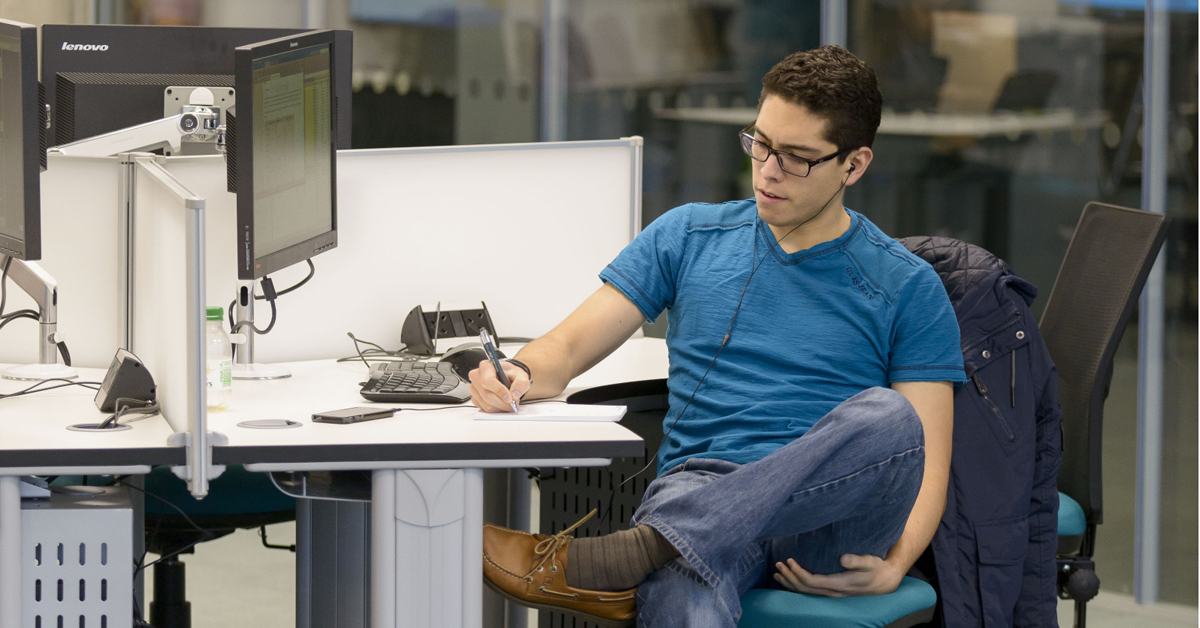
C4D is a very peaceful, safe and quiet environment in which I love working. The building is almost brand new and offers a large open area to assist with lectures, work on projects or put the lessons into practice. However, we usually prefer to use the conference room for lectures when we are in a small group, as it is cosier.
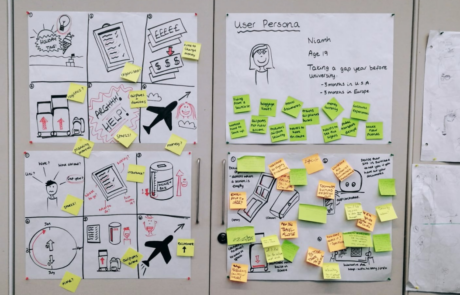
Being in a design studio is something that I really enjoy as it is quite a unique teaching environment, instead of having whiteboards we write on windows! We put post-it notes everywhere and sometimes during group projects, we work sitting on beanbags, which are more comfortable than classic chairs. I have never worked this way before, but it is much more attractive!
What about classes?
During my undergraduate, I got used to a class with 45 other students, and being six of us changes everything. We can have a real exchange with teachers to have interactive classes. We always do activities to put into practice what we have just learnt, followed by pitches which are very good training! During each module, we usually have several guest speakers from industry who share their experience. Among them, IDEO, Kingfisher and John Lewis, which gave us the opportunity to think about their current challenges.
The Design Thinking modules are not just lectures with a teacher standing in front of us. It is a sharing experience between students, professionals, and researchers. All the examples, activities, or visits bring life to this course and that will enable us to become great designers! My first three months at the C4D have been very exciting, and the time has gone by very quickly!


Categories & Tags:
Leave a comment on this post:
Comments are closed.
You might also like…

Moving to the UK to study? How to plan for banking, exchange rates and transfers
Currency and banking are two of the most practical parts of financial planning for international students. They are also often the most overlooked. We asked Dr Lakshmy Subramanian, Course Director for Cranfield University's Banking, ...

Cranfield: an environment where innovation thrives
The latest Knowledge Exchange Framework rankings from UK Research and Innovation (UKRI) gives an insight into the real and meaningful impact that UK universities have. The seven categories that make up KEF6 cover everything ...

How Cranfield accelerated my career in Logistics and Supply Chain Management
After graduating from the MSc in Logistics and Supply Chain Management at Cranfield University, I've been reflecting on the experiences that made my journey so valuable and the impact it has had on my ...

Mendeley: a powerful tool to organise and manage your references
Are you looking for a way to manage your references, create in-text citations and reference lists for your assignments or thesis? If so, you may wish to consider using Mendeley. What is it? Mendeley is ...
Keen to develop your study skills?
Alongside the technical skills and academic knowledge that you will gain on your course, as a Cranfield student you have the opportunity to develop a range of other skills that can enhance your learning experience. ...

The V-conomy: powering the sixth wave of global economic growth
The world could be on the verge of a major surge in economic growth and development, driven by the convergence of AI and clean energy technology. Waiting to ride the K-wave The Russian ...
Hi~Does this major have only 6 students per session?