


A week of firsts…
09/12/2021
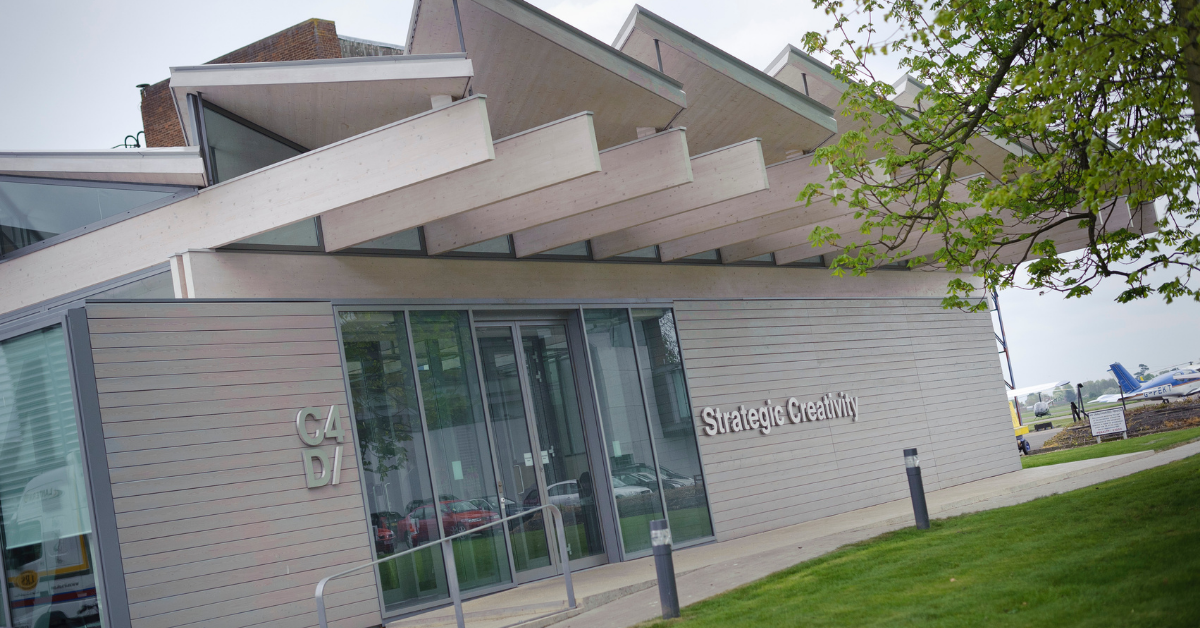
How was my first week studying at Cranfield?
My first week studying a master’s at Cranfield involved a lot of nerves and excitement! I am a mature student returning to study part-time, after a very long break. I left my husband at home with a superb excel spreadsheet to help navigate looking after the kids for the week! A whole big change: new town, people, place to live and of course, my course MDes Design Thinking course.
What is Design Thinking?
Design Thinking is a process and a mindset for creative problem solving with a human-centred base. It blends analytical and creative thinking which is a key skill for the 21st century, one of the key reasons why I chose it. Cranfield is the only place in the country to offer this course at this level, so it’s unique with a wide international reputation.
Because of Covid, I hadn’t even visited the site, which would explain my nerves, but I had nothing to worry about. Once I found the stunning Centre for Competitive Creative Design (C4D) building, I received a warm welcome from Paul Lighterness (the course leader) and his team. C4D itself is a centre of excellence headed by Professor Leon Williams, who was currently involved with the Bill & Melinda Gates Foundation, so there was lots of project work going on with lots of prototype creation and project meetings. We worked daily alongside lecturers and PhD students, so there were lots of engaging discussions and networking going on. Everyone was very friendly and happy to help with any questions as we settled in.
What was it like learning after lockdown?
There were very clear instructions on campus, everyone was wearing masks with well-spaced working areas, so no problem there. The first week was full of general and course specific inductions – important information that had to be covered, but wisely they recorded it, so if you missed any you could recap at any time. This was important for anyone having to self-isolate from abroad or as a late starter to courses. Cranfield recorded the sessions and definitely prepared for flexible learning!
C4D inductions helped us to get familiar with Design – starting with how to visualise our ideas, with a great warm-up session of drawing top-tips from Paul. Then we went to an induction at the workshops which was like a labyrinth of tools. We were set a mini project to make a kid’s truck using the 3D machines and laser cutter to warm us up gently. The 3D machines were fascinating. After demos, we set them up and in under four hours, we produced perfect tyres for our model. The very next week we had a guest lecturer, Vaiva Kalnikaita from her company Dovetail, who showed her innovative work with 3D food printing, demonstrating Cranfield’s great links with industry. Then we were taught how to set up the laser, based on pre-drawn cutter guides and produce the parts the body. A fun afternoon getting stuck into our first prototype.
My Design Thinking journey has just started, and I am launching myself fully into this experience. You are never too old to learn new things – I thoroughly recommend rising to the challenge. I will take it as a compliment being mistaken as a lecturer at the bus stop!

Categories & Tags:
Leave a comment on this post:
You might also like…

Mendeley: a powerful tool to organise and manage your references
Are you looking for a way to manage your references, create in-text citations and reference lists for your assignments or thesis? If so, you may wish to consider using Mendeley. What is it? Mendeley is ...

Keen to develop your study skills?
Alongside the technical skills and academic knowledge that you will gain on your course, as a Cranfield student you have the opportunity to develop a range of other skills that can enhance your learning experience. ...

The V-conomy: powering the sixth wave of global economic growth
The world could be on the verge of a major surge in economic growth and development, driven by the convergence of AI and clean energy technology. Waiting to ride the K-wave The Russian ...

Need help using the Python programming language?
We know some of our students are currently trying to learn Python, so we wanted to make you aware of some great LinkedIn Learning videos that can help. But don't you have to pay for ...

What does it really take to become a Chevening Scholar?
Say “Turkmenistan” to most people and you’ll get a blank look. That was true when I left Ashgabat for the UK to study an MSc in Logistics and Supply Chain Management at Cranfield University ...

Get a head start on referencing and plagiarism
We offer a module on Referencing And Avoiding Plagiarism which you can find on your Canvas dashboard. It explains the role and importance of citing references and how to incorporate the work of other authors ...
Comments are closed.