

The Result You Got Today Is Not The Result You’d Get Today!
11/10/2019
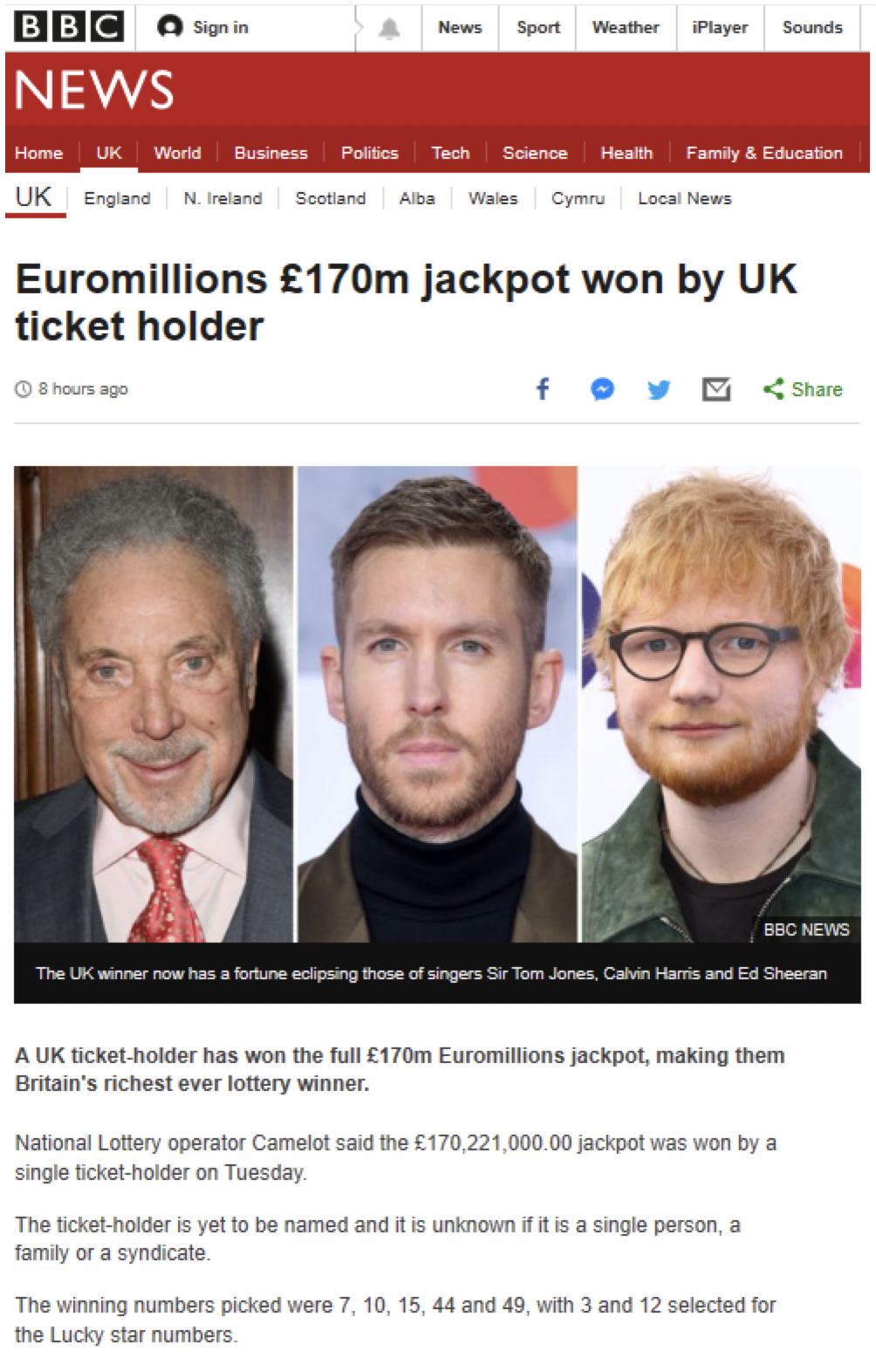
Interesting isn’t it? The General Public accept that the winning numbers in the Lottery are pure luck! The probability of 7, 10, 15, 44, 49 with 3 and 12 Lucky Stars winning is finite and can be calculated and it’s very small (for the EuroMillions it’s 1 in 139,838,160).
What’s more interesting is that if those balls all started in exactly the same positions (let’s call them starting conditions) and the Lottery machine was started over again (which we’ll assume hasn’t been changed in any way) then would the General Public expect to get the same results 7, 10, 15, 44, 49 with 3 and 12 Lucky Stars? I suspect (but I have no evidence) most people would probably say not, and they’d be right!.
So “Here’s the Thing”:
Why do the News, Executives, Police Officers, Hospital Managers, etc. – as well as most of the General Public – think it is worth comparing an isolated result (e.g. Sales or Crime Figures or People who got sick) in one month with a previous result in some other month? The problem is, that if you got 7,237 (who cares whats) in September 2019, and you started September 2019 again at one second after midnight on 01 September with exactly the same starting conditions in a VUCA (Volatile, Uncertain, Complex and Ambiguous – see previous blog on this if interested) world – most people act as if they think they’d still get 7,237 at the end of September!
So “Here’s the Next Thing!”:
The world out there is incredibly more complex (not complicated, but complex – see another previous blog on this if interested) than the Lottery (which, by the way, operates in a highly controlled environment) – so the 7,237 result in September was actually an accident.
Yet we keep on going around comparing a latest result versus a previous result and declare “it’s getting worse” or “it’s getting better”, as if these results have significant meaning! And making decisions based on this! And eventually getting into a lot of trouble as a result! Einstein had a word to say about this:
INSANITY!
There is another way!

Categories & Tags:
Leave a comment on this post:
You might also like…

Moving to the UK to study? How to plan for banking, exchange rates and transfers
Currency and banking are two of the most practical parts of financial planning for international students. They are also often the most overlooked. We asked Dr Lakshmy Subramanian, Course Director for Cranfield University's Banking, ...

Cranfield: an environment where innovation thrives
The latest Knowledge Exchange Framework rankings from UK Research and Innovation (UKRI) gives an insight into the real and meaningful impact that UK universities have. The seven categories that make up KEF6 cover everything ...

How Cranfield accelerated my career in Logistics and Supply Chain Management
After graduating from the MSc in Logistics and Supply Chain Management at Cranfield University, I've been reflecting on the experiences that made my journey so valuable and the impact it has had on my ...

Mendeley: a powerful tool to organise and manage your references
Are you looking for a way to manage your references, create in-text citations and reference lists for your assignments or thesis? If so, you may wish to consider using Mendeley. What is it? Mendeley is ...

Keen to develop your study skills?
Alongside the technical skills and academic knowledge that you will gain on your course, as a Cranfield student you have the opportunity to develop a range of other skills that can enhance your learning experience. ...

The V-conomy: powering the sixth wave of global economic growth
The world could be on the verge of a major surge in economic growth and development, driven by the convergence of AI and clean energy technology. Waiting to ride the K-wave The Russian ...