


Data Visualisation, Fantastic Beasts and Where to Find Them
28/11/2018

Data Visualisation, Fantastic Beasts and Where to Find Them
Wikipedia: Data visualisation is viewed by many disciplines as a modern equivalent of visual communication. It involves the creation and study of the visualrepresentation of data. According to Friedman (2008) the “main goal of data visualisation is to communicate information clearly and effectively through graphical means”.
CGI in films today pushes data visualisation to its limits, and many graphical presentation tools today allow even the most unskilled to develop “killer” presentations. But Friedman goes on to say “….. yet designers often fail to achieve a balance between form and function, creating gorgeous data visualisations which fail to serve their main purpose — to communicate information”. So in business, we’re not here to entertain (although there are exceptions!), but to use information to make decisions.
Wiki goes on to describe Visual Control: Visual control is a business management technique employed in many places where information is communicated by using visual signals instead of texts or other written instructions ….. Visual control methods aim to increase the efficiency and effectiveness of a process by making the steps in that process more visible …. Another aspect of visual control is that everyone is given the same visual cues and so are likely to have the same vantage point … A visual control system must have an action component associated with it … therefore, visual controls must also have a component where immediate feedback is provided to workers.
What does a Visual Control System look like?
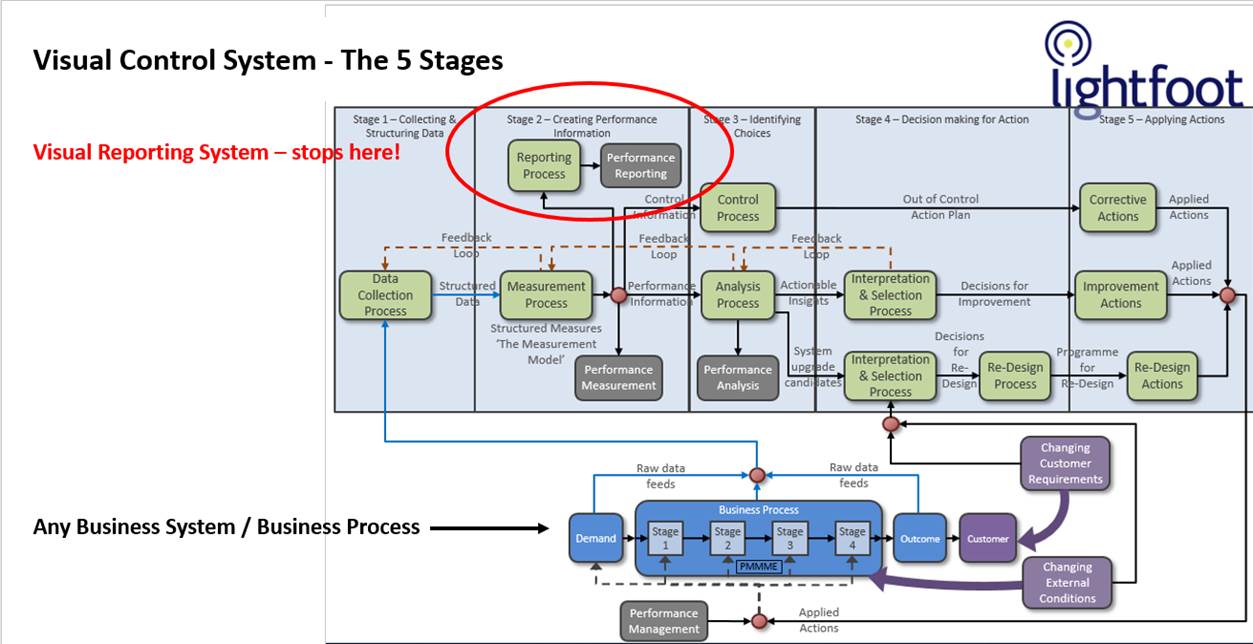
A Visual Control System – some prefer the term “Gantry View” or “Cockpit View” – comprises 5 key Stages, namely: 1. Data Collection and Structuring of Data; 2. Creating and Visualising Performance Information; 3. Identifying Choices (of Action); 4. Decision-making (for Action); 5. Applying Action. And Performance Management is where the “rubber meets the road” – so to speak. It’s actually applying the agreed actions to the business process. Where is Feedback on the success or otherwise of the Action taken in all this? Well that comes back in the form of data from whatever the business process is that you are expecting to improve. Hence, we have a closed-loop (not the Matthew Syed definition) – a Visual Control System.
The problem with most organisations is that they stop at delivering a Visual Reporting System, with no clear linkages to managing performance of the system or processes. But creative Visual Reporting – “generating gorgeous data visualisations” – can consume many resources, can be highly entertaining and can generate much activity, rather like Fantastic Beasts – but is that really the main purpose?

Categories & Tags:
Leave a comment on this post:
Comments are closed.
You might also like…

Moving to the UK to study? How to plan for banking, exchange rates and transfers
Currency and banking are two of the most practical parts of financial planning for international students. They are also often the most overlooked. We asked Dr Lakshmy Subramanian, Course Director for Cranfield University's Banking, ...

Cranfield: an environment where innovation thrives
The latest Knowledge Exchange Framework rankings from UK Research and Innovation (UKRI) gives an insight into the real and meaningful impact that UK universities have. The seven categories that make up KEF6 cover everything ...
How Cranfield accelerated my career in Logistics and Supply Chain Management
After graduating from the MSc in Logistics and Supply Chain Management at Cranfield University, I've been reflecting on the experiences that made my journey so valuable and the impact it has had on my ...

Mendeley: a powerful tool to organise and manage your references
Are you looking for a way to manage your references, create in-text citations and reference lists for your assignments or thesis? If so, you may wish to consider using Mendeley. What is it? Mendeley is ...

Keen to develop your study skills?
Alongside the technical skills and academic knowledge that you will gain on your course, as a Cranfield student you have the opportunity to develop a range of other skills that can enhance your learning experience. ...

The V-conomy: powering the sixth wave of global economic growth
The world could be on the verge of a major surge in economic growth and development, driven by the convergence of AI and clean energy technology. Waiting to ride the K-wave The Russian ...
Thank you David. I do enjoy these, thank you for sending them.
Chris