


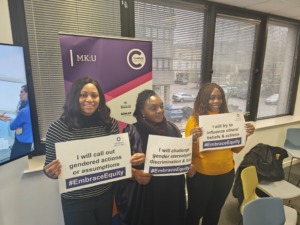
Global Women’s Entrepreneurs Roundtable 2023 #EmbraceEquity
11/07/2023
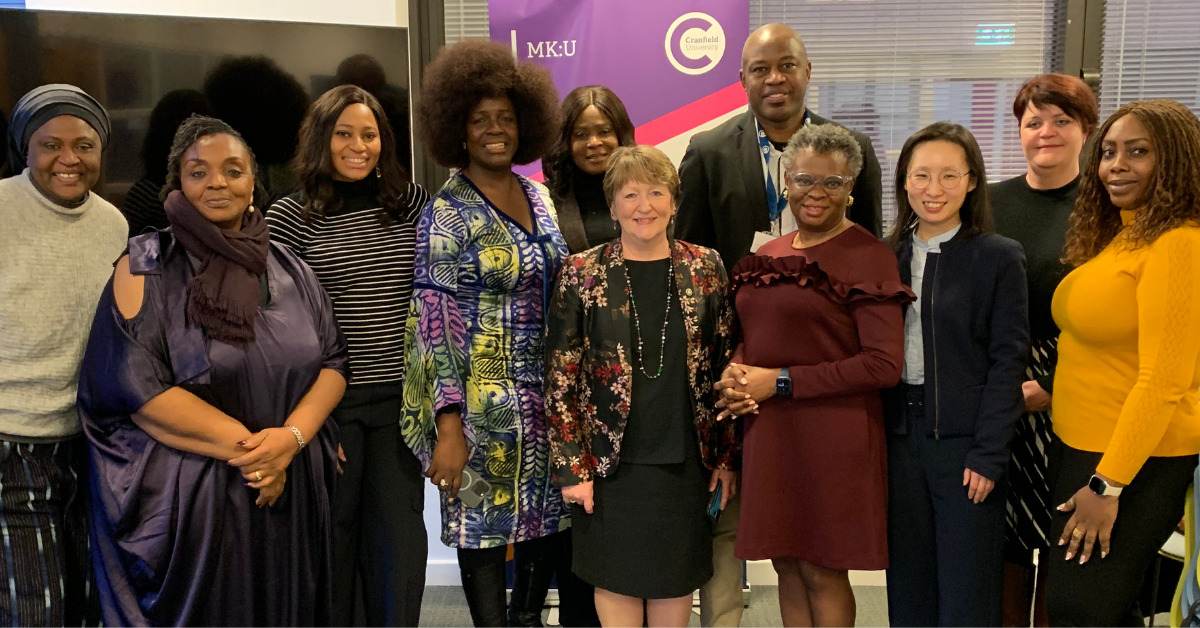
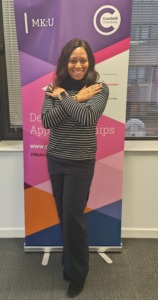
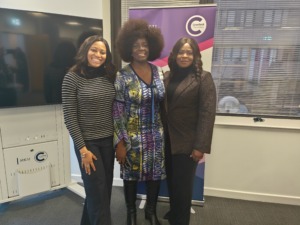
On 9th March 2023, Cranfield University joined the world to commemorate International Women’s Day through a Global Women’s Entrepreneurship Roundtable #EmbraceEquity. The hybrid event which was jointly organized by the Gender Leadership and Inclusion Research Centre (GLIC) and Bettany Centre for Entrepreneurship held at the Milton Keynes Innovation Hub MK: U and alongside virtual participation from individuals from various countries including the USA, Nigeria, Switzerland, and Uganda.
Commencing at 1 pm GMT and ending with a networking session, the event featured an impressive array of speakers. Dr. Akintoye Akindele, Chairman of Platform Capital, an investment firm, delivered the keynote address. He stressed the importance of investing in female-owned businesses and cited statistics indicating that over 40% of startups globally have female founders. Dr. Akindele also noted that many female entrepreneurs equally focus on profitability, social responsibility, and environmental sustainability in their businesses. He maintained that “the future is feminine,” and investors cannot ignore female-owned businesses within their portfolios. As a student in the MSc Management and Entrepreneurship programme, I was thrilled to hear his views which aligned with the concepts taught in the Entrepreneurial finance module by Dr. Stephanie Hussels, Director of the Bettany Centre for Entrepreneurship,
The panel discussion had several esteemed panellists, including Ms. Debbie Lewis, the Regional Ecosystem Manager at NatWest; Ms. Yemi Keri, founder of Heckerbella, a digital transformation company and co-founder of Rising Tide, a female-focused angel investment network. Other notable panellists included Ms. Pauline Koebl, Founder & Managing Partner of ShEquity, an Africa-focused gender lens fund, and Ms. Michelle Theuma, owner of Onyx Recruitment. The discussion was moderated by Dr. Deirdre Anderson, Director of the GLIC at Cranfield School of Management. Other speakers were Ms. Claire Banwell Spencer, Head of the Entrepreneurship Growth Portfolio at the Bettany Centre for Entrepreneurship, and Ms. Thelma Ekiyor, an impact investor, doctoral student of the GLIC, and lead organizer.
During the panel discussion, the speakers highlighted various challenges faced by female entrepreneurs, including gender biases, and cultural, ethnic, and geographic barriers that hinder the growth of their businesses. According to Debbie, “through accelerators, there is a higher likelihood of success for 80% of female-owned businesses.” She also emphasized the efforts NatWest is making to address the issues of diversity and representation through its programmes. Michelle spoke at length about the initiatives undertaken by her organization to motivate, mentor, and support female entrepreneurs. Claire shared research conducted by Beauhurst, a UK-based research company, which indicated that in 2022, for every £1 invested, only 2p was invested in an all-female founding team, emphasizing the funding gap faced by female entrepreneurs. Furthermore, according to Pauline and Yemi, many female entrepreneurs lacked the confidence required for attracting investments, however, their organizations were implementing investment readiness programmes activities to address the issues.
It was stated that investment readiness programmes, networking opportunities, and coaching and mentoring sessions have empowered more female entrepreneurs, leading to positive outcomes. However, startup founders must deliberately seek out relevant coaching, mentoring, and business capability development opportunities. The panellists all agreed that having more female representation within investor networks would provide support, encouragement, and positive networking experiences for female entrepreneurs.
Overall, the event was a huge success in achieving its objectives of educating, inspiring, and supporting female entrepreneurship. I found the discussions to be both enlightening and practical, as they not only highlighted the challenges faced by female entrepreneurs but also provided solutions. Three things I took from the session were the importance of visioning, goal setting, and networking in entrepreneurship. On a final note, as women encounter various barriers, and biases, both conscious and unconscious biases, they require equity to succeed in entrepreneurship.


Categories & Tags:
Leave a comment on this post:
You might also like…

Moving to the UK to study? How to plan for banking, exchange rates and transfers
Currency and banking are two of the most practical parts of financial planning for international students. They are also often the most overlooked. We asked Dr Lakshmy Subramanian, Course Director for Cranfield University's Banking, ...

Cranfield: an environment where innovation thrives
The latest Knowledge Exchange Framework rankings from UK Research and Innovation (UKRI) gives an insight into the real and meaningful impact that UK universities have. The seven categories that make up KEF6 cover everything ...

How Cranfield accelerated my career in Logistics and Supply Chain Management
After graduating from the MSc in Logistics and Supply Chain Management at Cranfield University, I've been reflecting on the experiences that made my journey so valuable and the impact it has had on my ...

Mendeley: a powerful tool to organise and manage your references
Are you looking for a way to manage your references, create in-text citations and reference lists for your assignments or thesis? If so, you may wish to consider using Mendeley. What is it? Mendeley is ...

Keen to develop your study skills?
Alongside the technical skills and academic knowledge that you will gain on your course, as a Cranfield student you have the opportunity to develop a range of other skills that can enhance your learning experience. ...

The V-conomy: powering the sixth wave of global economic growth
The world could be on the verge of a major surge in economic growth and development, driven by the convergence of AI and clean energy technology. Waiting to ride the K-wave The Russian ...
Comments are closed.