

NERC Digital Environment programme – Webinar series launched
11/11/2020
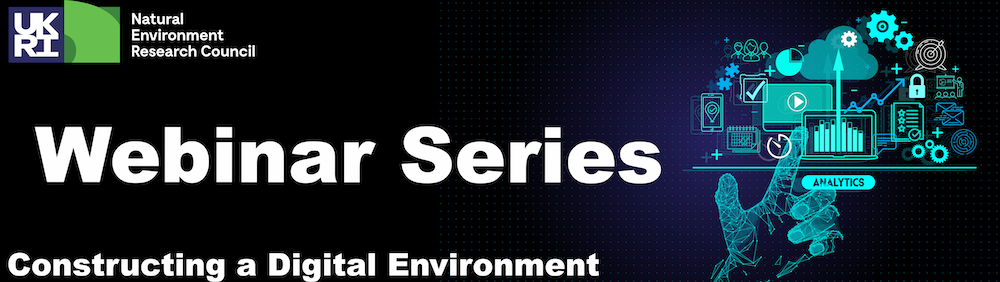
Announcing a series of open webinars organised by the NERC Digital Environment programme. The Constructing a Digital Environment programme are running a series of online Webinars, to be held every three weeks, aiming to develop the digitally enabled environment to benefit scientists, policymakers, businesses, communities and individuals.
The CDE webinars seek to showcase the latest expertise in digital technology and methodologies applied to the environment, illustrating the ‘arc’ from data gathering, its management and curation, analysis and presentation to decision makers, covering topics such as distributed networks of sensors, new sensor technology, novel forms of data informatics (e.g. data lakes, data cubes), data analytics, uncertainty, data labs, apps, skins and tools to support decision makers across the society. The first events are:
- Thursday 12th November 15:00 GMT – The value of information and how to decide what you and how much you should be measuring – Douglas W Hubbard
- Thursday 3rd December 15:00 GMT – The Flaw of Averages and How to Cure It – Professor Sam L Savage
- Thursday 17th December 15:00GMT – Why Big Data and AI machine learning will never work for critical problems of risk assessment – causal reasoning and knowledge to the rescue – Professor Norman Fenton
Please pass on to all and sundry! Flyer for events are attached on weblink.
Web page and ongoing registration details here https://digitalenvironment.org/cde-webinar-series/

Categories & Tags:
Leave a comment on this post:
You might also like…

Cranfield: an environment where innovation thrives
The latest Knowledge Exchange Framework rankings from UK Research and Innovation (UKRI) gives an insight into the real and meaningful impact that UK universities have. The seven categories that make up KEF6 cover everything ...
How Cranfield accelerated my career in Logistics and Supply Chain Management
After graduating from the MSc in Logistics and Supply Chain Management at Cranfield University, I've been reflecting on the experiences that made my journey so valuable and the impact it has had on my ...

Mendeley: a powerful tool to organise and manage your references
Are you looking for a way to manage your references, create in-text citations and reference lists for your assignments or thesis? If so, you may wish to consider using Mendeley. What is it? Mendeley is ...

Keen to develop your study skills?
Alongside the technical skills and academic knowledge that you will gain on your course, as a Cranfield student you have the opportunity to develop a range of other skills that can enhance your learning experience. ...

The V-conomy: powering the sixth wave of global economic growth
The world could be on the verge of a major surge in economic growth and development, driven by the convergence of AI and clean energy technology. Waiting to ride the K-wave The Russian ...

Need help using the Python programming language?
We know some of our students are currently trying to learn Python, so we wanted to make you aware of some great LinkedIn Learning videos that can help. But don't you have to pay for ...