


#CDE22 – views from the ‘Constructing a Digital Environment’ Conference
18/07/2022
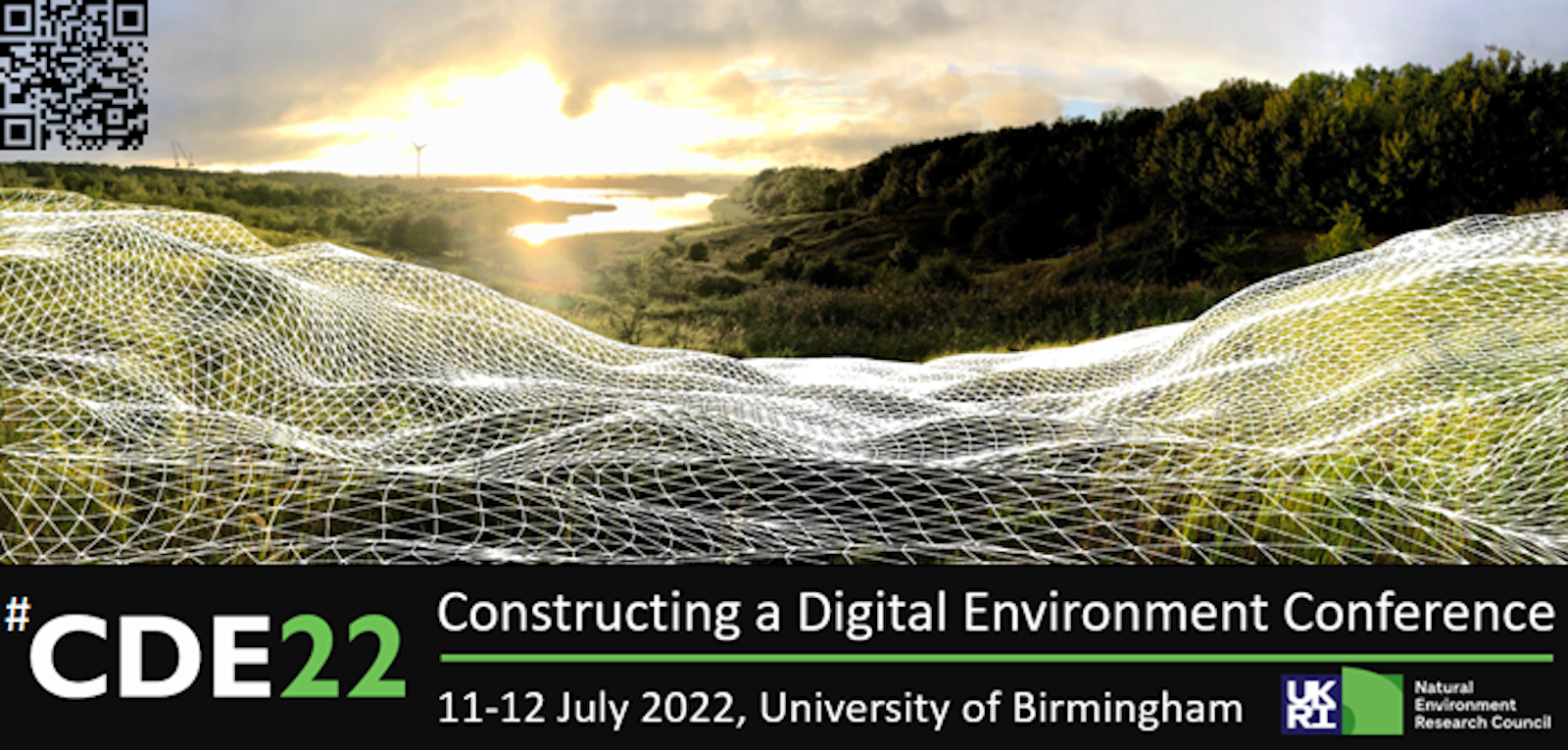
The first NERC ‘Constructing a Digital Environment’ (CDE) conference and hackathon ‘#CDE22’ has just finished, running over the past few days at the University of Birmingham. The Hackathon commenced on 10th July, then the conference itself ran on from Monday 11 to Tuesday 12 July. The event has been the culmination of the work underway in the NERC CDE programme since its inception in 2019. That start date had almost exactly coincided with the COVID pandemic which impacted early programme plans to run annual conferences – so it was then particularly special to gather in the University of Birmingham for this event. We ran the conference in a hybrid format and were delighted to have 105 delegates register to attend in person and 168 register to join in remotely. We used the participatory tool ‘Slido‘ to help the delegates interact with speakers and each other, with delegates contributing to audience questions, poll entries and general points raised.
The #CDE22 conference sought to bring together the NERC research community to highlight the increasing role of digital technologies in environmental research, including spotlighting outcomes from the Digital Environment Projects, which explored methodologies and tools for assessing, analysing, monitoring and forecasting the state of the natural environment at higher spatial and temporal resolutions than previously possible, and the activities of the Digital Environment Expert network. The conference goals were to spark new collaborations, new ideas and innovative approaches to utilising technology and digital resources in environmental research. There were four overarching ‘themes‘ for the conference; ‘Analytical tools & data management for environmental science’, ‘Data digitisation, rescue, & re-purposing for environmental decision making’, ‘Sensing the Environment’ and ‘Law and Ethics in the Digital Environment’.

The conference provided a key platform for NERC to discuss the recently published ‘NERC Digital Strategy‘. The strategy itself represented a first for the Council, providing a strategic direction for ‘digital’ going forward to 2030. The strategy touches on a number of themes, ‘Next-generation Environmental Sensing Systems’, ‘Computational Resources for Environmental Science’, ‘Enhanced Data Services’, ‘Pioneering Computer Science’, ‘Data Science Tools and Techniques’, ‘Development of People and Skills’, and ‘Facilitating Confidence and Trust in Digital Research’. The Strategy discussion comprised firstly a presentation from Dr Anna Angus-Smyth, Associate Director of Digital Environment, Infrastructure and Data in NERC. This was followed by a facilitated panel discussion then joined by Prof Tim Broyd of UCL, Prof. Stephen Mobbs, Executive Director of NCAS, Dr Liz Bagshaw of Cardiff University and Prof. Richard Kingston of Manchester University, with each panel member sharing their own commentary as to the milestone the strategy represents and addressing questions from delegates.
We were able to run a wide range of activities during the conference, commencing with fantastic keynote presentations from leading experts in the field, Prof. Tim Broyd of UCL, Charles-Albert Helleputte of Steptoe and Johnson LLP, Brussels, Prof. Lindsey Beevers from the University of Edinburgh and Dr David Green, Program manager for NASA’s Earth Science Applied Sciences Wildfires program area.
Our Oral presentations spanned the four themes of the CDE programme, with some 24 talks from national and international experts, sharing their research with delegates in areas including digital twins, decision support systems, modelling and data driven insights, trusted research environments, and HPC, and across disciplines including environmental science, ecology, geomorphology, agronomy, engineering, oceanography, and hydrology!

A key theme of the conference focussed on Law and Ethics in the Digital Environment, and how this impacts upon and shapes environmental data science. It was particularly good to integrate this into the conference as these themes are really essential in developing trusted research environments in data-oriented science. Using Slido, delegates were able to vote for the ‘Conference Best Oral Presentation’ and runner up. These awards were won as follows:
First place: “The DECIDE Project: Adaptive sampling for precision citizen science for biodiversity monitoring” Dr Michael Pocock
Second place: “Smart-pebbles” in geomorphological studies: the sky and the limits” by Dr Georgios Maniatis
We also held a series of rapid-fire ‘Spotlight-on-Science’ presentations, where ten minutes were allocated for speakers to convey key topical issues from their research – this proved very successful and an effective means for delegates to quickly gather information on the ‘state-of-art’ in these disciplines and the pressing issues.

The conference also had a poster exhibition, where presenters were able to share with delegates key elements and outcomes of their research. Posters are an effective means of communicating science, and using Slido, delegates were able to vote for the ‘Conference Best Poster’ and runner up. These awards were won as follows:
First place: “DataLabs: A Vehicle of Methods Reuse in Environmental Data Science Research” Dr Maria Salama, Professor Gordon Blair
Second place: “Data-Driven Design for Water Neutral Urban Development at Different Scales” Pepe Puchol-Salort, Dr Stanislava Boskovic, Dr Barnaby Dobson, Dr Maarten van Reeuwijk, Prof. Jennifer Whyte, Dr Ana Mijic
Another great addition to the conference programme were Masterclass Workshops run firstly by Prof. Abbe Brown, University of Aberdeen, on ‘Clashing norms and practicalities – sharing and controlling data’, and by Dr Hua Zhong of Nottingham Trent University and colleagues on ‘Digital Twins in the Built Environment’. These allowed the experienced convenors to showcase these two areas in detail to the delegates with interactive discussion and demonstrations. The conference also included a display of Cranfield University’s Virtual Reality environment, a collaborative ‘VR-cave’ which was showcasing digital representations of coastal erosion in Suffolk, UK.
Finally, we ran in parallel a hackathon event, seeking to bridge data sciences and the public with art. Contestants interacted with a wide range of multi-sourced environmental data, developing a wide range of artistic expressions representing the data in a number of formats. Winners for this will be announced in the near future.

Overall it was an excellent conference with fascinating talks, posters and presentations, a great chance for networking and for many a welcome end (hopefully) after the strictures of COVID. The event also provided the perfect forum to gather together the CDE Expert Network members. The organisers were most grateful to the University of Birmingham who helped with all the logistical complexities!
Our Twitter posts of the many events went out tagged #CDE22.

Categories & Tags:
Leave a comment on this post:
You might also like…

Keen to develop your study skills?
Alongside the technical skills and academic knowledge that you will gain on your course, as a Cranfield student you have the opportunity to develop a range of other skills that can enhance your learning experience. ...
The V-conomy: powering the sixth wave of global economic growth
The world could be on the verge of a major surge in economic growth and development, driven by the convergence of AI and clean energy technology. Waiting to ride the K-wave The Russian ...

Need help using the Python programming language?
We know some of our students are currently trying to learn Python, so we wanted to make you aware of some great LinkedIn Learning videos that can help. But don't you have to pay for ...
What does it really take to become a Chevening Scholar?
Say “Turkmenistan” to most people and you’ll get a blank look. That was true when I left Ashgabat for the UK to study an MSc in Logistics and Supply Chain Management at Cranfield University ...

Get a head start on referencing and plagiarism
We offer a module on Referencing And Avoiding Plagiarism which you can find on your Canvas dashboard. It explains the role and importance of citing references and how to incorporate the work of other authors ...
How Cranfield shaped my journey as an Aerospace Engineer
If I'm being specific about the moment it clicked, it was reading a paper called "On the Role and Challenges of Computational Fluid Dynamics (CFD) in the Aerospace Industry" by two Boeing engineers, P. ...
Comments are closed.