


Putting astronautics and space engineering into practice with the CranSEDS rocket launch
04/08/2016
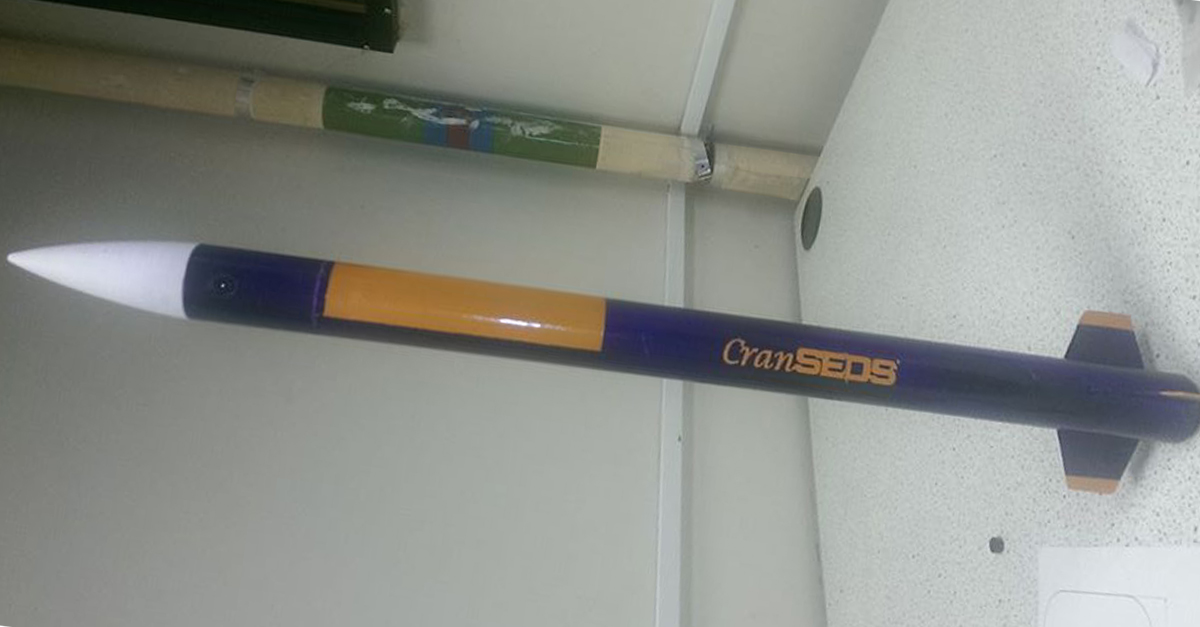
As well as studying MSc Astronautics and Space Engineering at Cranfield University, I am also currently treasurer of CranSEDS – Cranfield Students for the Exploration and Development of Space. As part of this society, our president Robert Sandford, Aqeel Shamsul, Rosario Lopez Estergaard Jacobsen and I undertook a project to build a small, solid motor rocket. This was in conjunction with the UKSEDS rocketry competition.
In the photo above you can see the finished rocket, completed and ready for launch, which we did on 10 July this year. The payload included an altimeter and a small, low resolution camera to record the duration of the flight.
The rocket was a simple singular deployment, solid motor vehicle. This means that the rocket was designed such that the nose cone (white) and payload section (section above the orange) were one unit which, when the parachute was deployed, would separate from the main body tube, or engine section (the main part of the rocket, seen with the Cranseds logo, in orange).
The rocket was successfully launched by myself and Giulia Serra, reaching an altitude of over 1200ft! The camera recorded the flight, including successful deployment of the parachute that allowed for a soft landing in the fields around Norton-Juxta Twycross. This was in association with Midland Rocketry club who were kind enough to allow us to launch our rocket at one of their monthly events at this launch site.
The rocket will be ready to launch again in the future and is just one of the many projects which CranSEDS has undertaken this year. The projects range from rocketry to atmospheric studies using high altitude weather balloons. These projects are really important practical applications of the theory learned during the aerospace and aeronautical courses here at Cranfield University.
—
Find out more about CranSEDS and aerospace courses at Cranfield…

Categories & Tags:
Leave a comment on this post:
You might also like…

Keen to develop your study skills?
Alongside the technical skills and academic knowledge that you will gain on your course, as a Cranfield student you have the opportunity to develop a range of other skills that can enhance your learning experience. ...

The V-conomy: powering the sixth wave of global economic growth
The world could be on the verge of a major surge in economic growth and development, driven by the convergence of AI and clean energy technology. Waiting to ride the K-wave The Russian ...

Need help using the Python programming language?
We know some of our students are currently trying to learn Python, so we wanted to make you aware of some great LinkedIn Learning videos that can help. But don't you have to pay for ...

What does it really take to become a Chevening Scholar?
Say “Turkmenistan” to most people and you’ll get a blank look. That was true when I left Ashgabat for the UK to study an MSc in Logistics and Supply Chain Management at Cranfield University ...

Get a head start on referencing and plagiarism
We offer a module on Referencing And Avoiding Plagiarism which you can find on your Canvas dashboard. It explains the role and importance of citing references and how to incorporate the work of other authors ...
How Cranfield shaped my journey as an Aerospace Engineer
If I'm being specific about the moment it clicked, it was reading a paper called "On the Role and Challenges of Computational Fluid Dynamics (CFD) in the Aerospace Industry" by two Boeing engineers, P. ...