

My PhD in Aerospace Engineering
17/05/2021
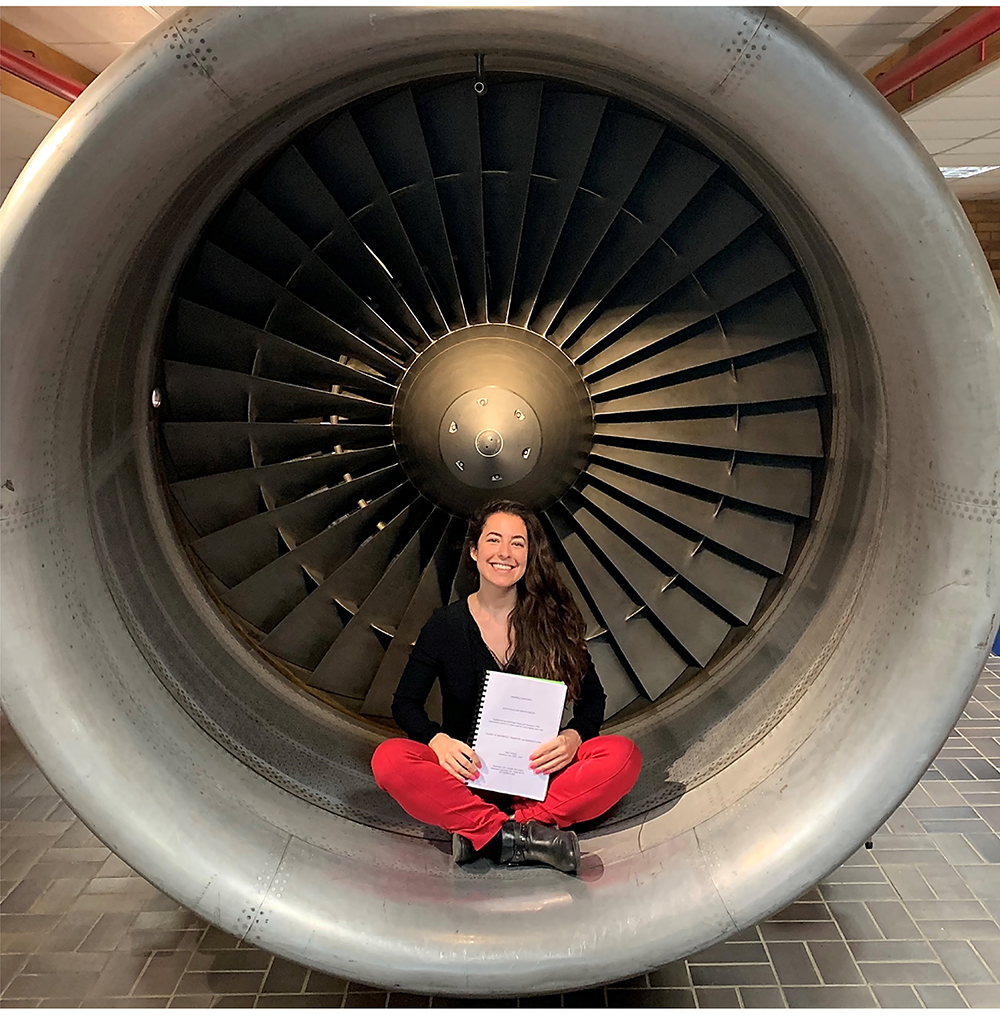
My name is Diana, I’m a PhD in aerospace engineering and fuelled by innovation and human interactions. I find the numerous challenges in the field of aerospace propulsion are nothing but exciting – the number of possibilities is countless! However, meaningful progress in technology cannot take place in isolation.
Before embarking on a PhD, I enrolled in the Thermal Power MSc at Cranfield. As part of my studies, I was given the chance to undertake my MSc project within Rolls-Royce’s University Technology Centre (UTC) in Aero Systems Design, Integration, and Performance. The topic investigated – and the nature of the project sparked my interest in – industry-oriented research and deepened my knowledge of future propulsion systems.
The opportunity to apply for a PhD at Cranfield came up toward the end of my MSc studies. I earned a research grant from the European Commission to fully fund my PhD research alongside the industry-led project DEMOS (Developing advanced Engine Multi-disciplinary Optimization Simulations) under the Innovative Aircraft Architecture technology stream of the European research programme Clean Sky 2.
Within project DEMOS, I led two work packages and contributed to two others on a plethora of topics, ranging from novel gas turbine component developments and lifing modelling to aircraft performance evaluation, and direct operating cost estimation. The involvement in such a project gave me the chance to directly present my research advances to Airbus and the European Commission and acquire a global vision of future developments in the aerospace sector.
In parallel to project DEMOS, I undertook my PhD research on the Multidisciplinary Preliminary Design and Integration of the Transmission System in a Pusher Geared Contra-Rotating Open Rotor. In my research, I demonstrated and assessed the integration effects of the main transmission components on the propulsion system as a percentage change in overall performance, increase in mass, changes in gas path, and effect on lifing characteristics. During my PhD research, I collaborated with fellow researchers from local and international institutions and key international companies in the aerospace sector.
As part of the PhD experience at Cranfield, I got the chance to supervise and support 6+ MSc students to complete projects on a variety of topics. I want to use this opportunity to thank the MSc students I have closely worked with for showing me the pleasure of learning through teaching.
However, not everything is based around research at Cranfield…
I’m a very sociable person and during my time at Cranfield, I have made incredible friends from all around the world. At the start of the second year in my PhD project, I co-created Cranfield’s International Dance Club. The cultural diversity at Cranfield made it a unique opportunity to learn more about each other through dance, generate bonds and discover new people. This and other activities where I could interact with other students at Cranfield brought me a lot of joy. I deeply cherish the friendships I have built during my time at Cranfield. Talking to everyone and being open-minded has allowed me to make strong connections with very diverse and interesting people and create an invaluable network of friends and colleagues.
After these wonderful years at Cranfield, my future project involves a career development in the aerospace industry, where I can continue contributing to the change of the sector. I have deeply enjoyed working in a multicultural environment, partaking in innovative international research projects, and linking industry with academia.
There is a need for greener technologies, new ideas, and the motivation of the youth.
I want to be part of that change. I choose to challenge.
Diana San Benito
Find out more about the Thermal Power MSc, and aerospace PhD opportunities.

Categories & Tags:
Leave a comment on this post:
You might also like…

Mendeley: a powerful tool to organise and manage your references
Are you looking for a way to manage your references, create in-text citations and reference lists for your assignments or thesis? If so, you may wish to consider using Mendeley. What is it? Mendeley is ...

Keen to develop your study skills?
Alongside the technical skills and academic knowledge that you will gain on your course, as a Cranfield student you have the opportunity to develop a range of other skills that can enhance your learning experience. ...

The V-conomy: powering the sixth wave of global economic growth
The world could be on the verge of a major surge in economic growth and development, driven by the convergence of AI and clean energy technology. Waiting to ride the K-wave The Russian ...

Need help using the Python programming language?
We know some of our students are currently trying to learn Python, so we wanted to make you aware of some great LinkedIn Learning videos that can help. But don't you have to pay for ...

What does it really take to become a Chevening Scholar?
Say “Turkmenistan” to most people and you’ll get a blank look. That was true when I left Ashgabat for the UK to study an MSc in Logistics and Supply Chain Management at Cranfield University ...

Get a head start on referencing and plagiarism
We offer a module on Referencing And Avoiding Plagiarism which you can find on your Canvas dashboard. It explains the role and importance of citing references and how to incorporate the work of other authors ...