

Lockdown Learning – My Cranfield MSc
30/03/2021
Welcome back to reading my next post of my series of blogs! In this post, I will tell you about my MSc experience during the Christmas 2020 lockdown period, and the advanced tools I have been using throughout the modules taught on the Computational and Software Techniques in Engineering MSc.
As of 18th March 2021 – Happy New Year’s Everyone 😉 – I have just finished all my taught modules. I have also just finished building my first ever Neural Machine Translation model (think of Google Translate, but homemade) for a language I cannot even speak!
This entire period during lockdown has been a challenging yet rewarding experience. Working on all my assignments from home rather than a dedicated study space or library was a new experience for me. My lecturers have played an essential role in making this transition much smoother by offering their support to us at all times. This final stretch of the teaching period has also been the busiest period during the course so far, by covering over four full modules and completing six assignments over the span of just over three months. I have gained so many skills across different specialities during this time, and I would like to share some of my accomplishments – which I am quite proud of :)- with you.
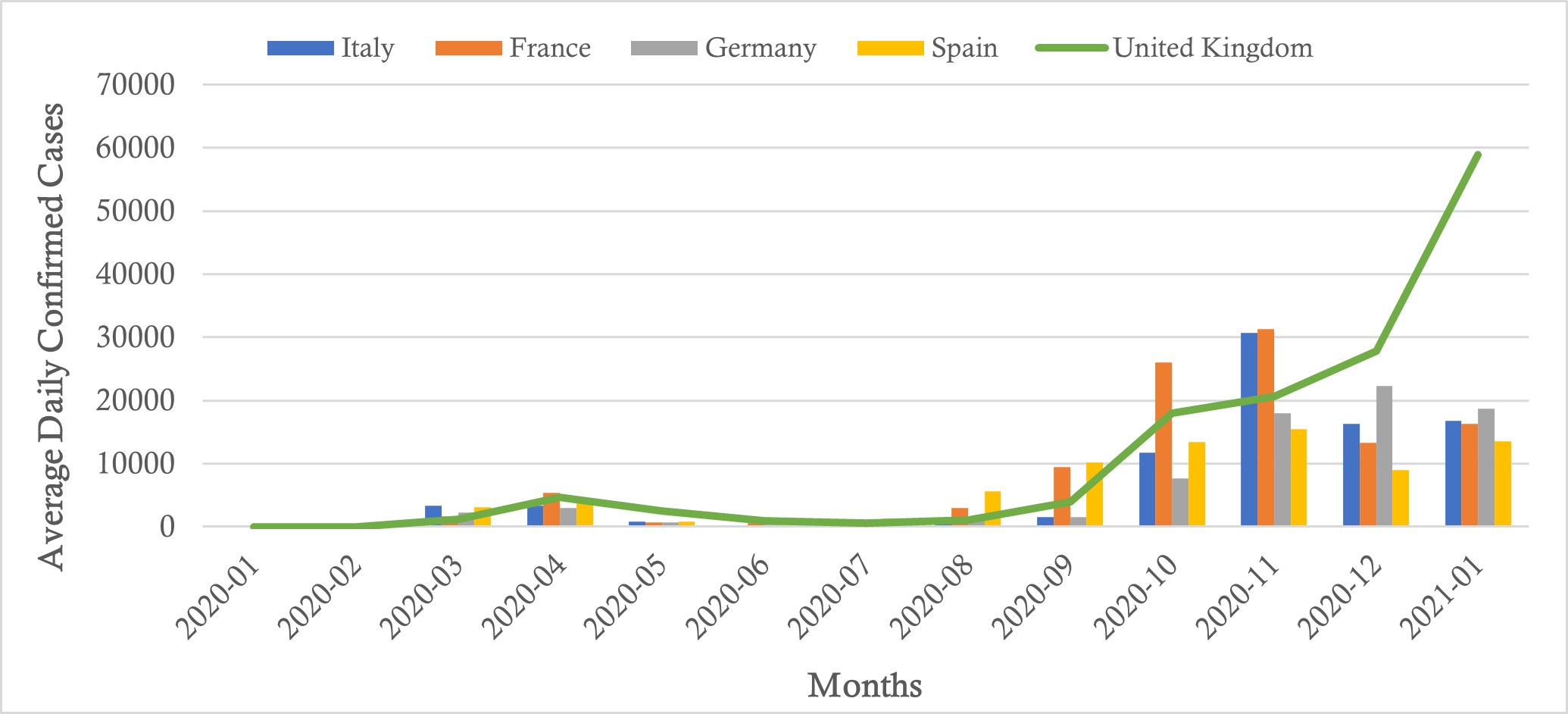
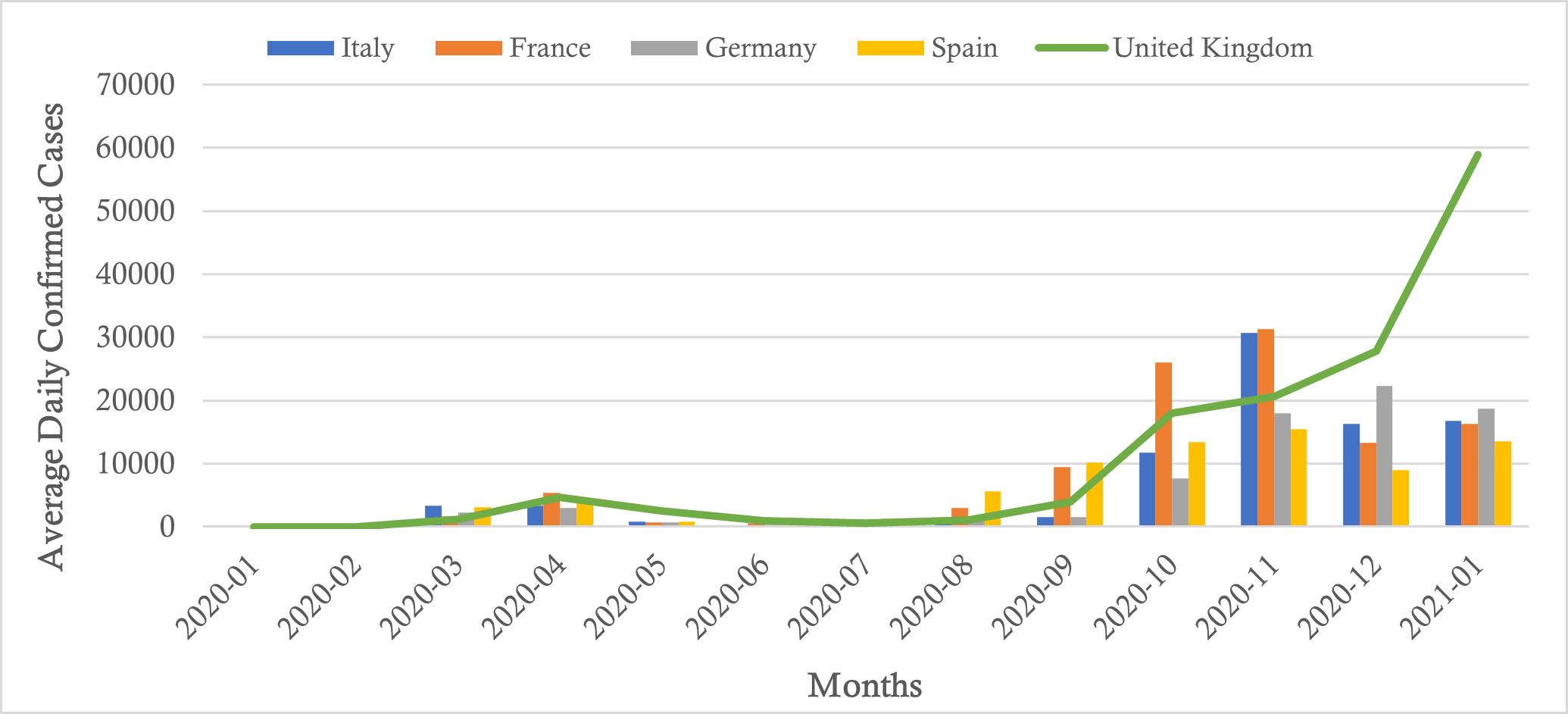
The first assignment of the year was for the module ‘Machine Learning and Big Data’ and taught us how to use the Spark processing engine to help us process daily COVID cases data from John Hopkins University. It was an enlightening task, as we used newly acquired skills to perform real-world data analytics operations on the very same data that scientists and analysts across the world were working on. One of the graphs I generated as part of the report can be seen below and shows the steep rise in COVID cases across the UK compared to other countries in Europe.
The first taught module we had after classes reopened after Christmas was ‘Management for Technology’. Now, my past experiences from management modules haven’t been very exciting, and because of that, I was really not looking forward to starting my studies in 2021 with a management module! However, I have to admit, this module has vastly changed my view on management on the whole, and I am actively looking forward to more management opportunities in the future. The module comprised of working as board members of a simulated company as part of a team and making planned decisions to spearhead the business’s growth on the simulation! It was a brand new experience for me and gave me a completely new outlook on the role of management in technology.
Moving on, the following two modules were much more technical, starting off with ‘Cloud Computing’. During this module, I utilised the most popular cloud infrastructure, Amazon Web Services (AWS), to build a program to analyse data-streams in real-time. I built a model using AWS and Spark streaming to work on an international data-science problem for New York City taxis. The model was used to analyse real-time data from taxi trips and show the most popular taxi routes for every 30-minute interval. It was a fantastic assignment, as I got to appreciate how apps like Twitter and YouTube are able to provide real-time analytics to users while processing massive amounts of data every second!
And finally, I would like to talk about my most recent and probably the most enjoyable module, ‘Artificial Intelligence’. Before this module, the most complex machine learning task I had ever completed was multivariant linear analysis, which is similar to plotting trendlines for data points, but in more than two dimensions. However, by the end of this module, I have now successfully built a Deep Neural Network, which can be used for translating an African language Yoruba into English! It was a very, very challenging task, I have to admit, and the accuracy was only around 60% (which is well above average even for commercial translation tools), but I am still very proud of how I have been able to teach a computer to speak a language in just two weeks, a language I have never spoken before.


We have now successfully concluded all of our taught modules and are actually already three weeks into our 40 credit group project as well. I can definitely say that this will be just as great of a learning experience, if not better, and can’t wait to share more about the group project with you guys.
In my next blog, I will reveal how much fun it was to combine the complex field of Computational Fluid Dynamics (CFD) with the rapidly evolving machine learning techniques!
Read my previous blog: A beginner’s guide to online learning.

Categories & Tags:
Leave a comment on this post:
You might also like…

Mendeley: a powerful tool to organise and manage your references
Are you looking for a way to manage your references, create in-text citations and reference lists for your assignments or thesis? If so, you may wish to consider using Mendeley. What is it? Mendeley is ...

Keen to develop your study skills?
Alongside the technical skills and academic knowledge that you will gain on your course, as a Cranfield student you have the opportunity to develop a range of other skills that can enhance your learning experience. ...

The V-conomy: powering the sixth wave of global economic growth
The world could be on the verge of a major surge in economic growth and development, driven by the convergence of AI and clean energy technology. Waiting to ride the K-wave The Russian ...

Need help using the Python programming language?
We know some of our students are currently trying to learn Python, so we wanted to make you aware of some great LinkedIn Learning videos that can help. But don't you have to pay for ...

What does it really take to become a Chevening Scholar?
Say “Turkmenistan” to most people and you’ll get a blank look. That was true when I left Ashgabat for the UK to study an MSc in Logistics and Supply Chain Management at Cranfield University ...

Get a head start on referencing and plagiarism
We offer a module on Referencing And Avoiding Plagiarism which you can find on your Canvas dashboard. It explains the role and importance of citing references and how to incorporate the work of other authors ...