


ESDU – a fantastic resource for engineers!
07/12/2016

This is the first of a series of blog posts in which we will highlight some of our more specialist resources for engineers.
This one is all about ESDU. If you’re the kind of person who needs to find out how to calculate the strength of lugs under oblique load, or the lift-curve slope of swept and tapered wings, ESDU is the resource for you. It really is one of our ‘hidden gems’. It’s one of my favourite resources as it has helped me answer many tricky enquiries, and it gets such a great response when customers find the solution to their engineering design problem on it.
When I first started my Cranfield working life in the Kings Norton Library, ESDU stood for ‘Engineering Sciences Data Unit’ and comprised thousands of ‘data sheets’ which were filed away in hundreds of ring binders. Each time there was an update to a data sheet, ESDU sent us a new one and we would laboriously find the old version, throw it out and replace it with the new. Thankfully times have moved on and the service is now available online and is always up to date.
It contains fantastic information for engineers that really isn’t available elsewhere, and certainly not for free via a Google search. It’s a great place to go if you have an engineering problem that you want to solve, and it can save you lots of time and research by providing methods, worked examples and data. Its work is overseen by independent committees of technical experts (some of whom work at Cranfield), and is endorsed by the Royal Aeronautical Society, the Institution of Mechanical Engineers and the Institution of Chemical Engineers.
It contains equations, interactive graphs and software organised into 18 series. Experience has shown me that the best way to find what you need is to select the ‘Explore the ESDU series’ option and then browse to the information that you need.
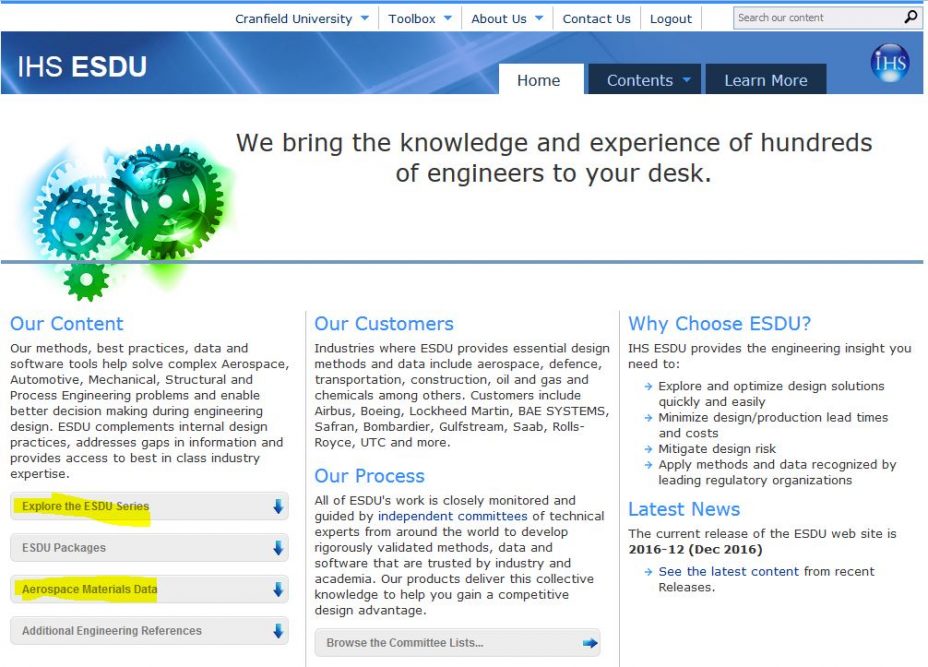
‘Explore the ESDU Series’ and ‘Aerospace Materials Data’ options highlighted on the ESDU home page
The series are: aerodyamics, aircraft noise, composites, dynamics, fatigue – endurance data, fatigue – fracture mechanics, fluid mechanics (internal flow), fluid mechanics (internal flow – aerospace), heat transfer, mechanisms, performance, phyiscal data (chemical engineering), stress and strength, structures, transonic aerodynamics, tribology, vibration and acoustic fatigue and wind engineering.
Alongside the data sheets is another handy resource. The Metallic Materials Data Handbook (MMDH) can be found behind the ‘Aerospace Materials Data’ link and is a great source of metals property data for aerospace engineers, bringing lots of information that has been evaluated and meets design requirements together in one place.
ESDU itself provides videos and help and I am always happy to advise you and answer your questions. Contact me at e.turner@cranfield.ac.uk.
Public domain image from Unsplash.com

Categories & Tags:
Leave a comment on this post:
You might also like…

Engineering problem to solve? Let Knovel help you find a solution
Did you know that Knovel provides you with more than just eBooks? Knovel is a key database for many engineering, mechanical and materials courses here at Cranfield University, and contains content from an extensive range ...

What happens when female scholars meet influential leaders?
On the 5 March 2026, our British Council Women in STEM Scholars had the privilege of sitting down with two excellent role models of industry and academia: Professor Dame Karen Holford, ...

From MSc to CEO: Igniting a research revolution
For many, a master’s degree is achieving a big milestone. Kilyan Ocampo, Computational Fluid Dynamics alumni shares how studying at Cranfield helped launch his career in the energy sector. Today, Kilyan ...

Commuting, collaborating and growing: My first term experience at Cranfield
My first term at Cranfield University has been an extremely positive and rewarding experience. While the course has been intense at times, it has pushed me in the best possible way and allowed me ...

Sourcing country analysis – a guide to Library sources
For those researching a country, you will find that country information tends to take two forms: Analysis - country reports are descriptive reports covering most areas of interest on a country. They contain an analysis ...

The degree that launched my marketing career
Insights from Tayo George, Strategic Marketing MSc Alumni I chose the Strategic Marketing MSc at Cranfield because I wanted a programme that combined academic rigour with practical, commercial relevance. The emphasis on applied learning, ...