


Aerospace systems engineer
04/11/2020
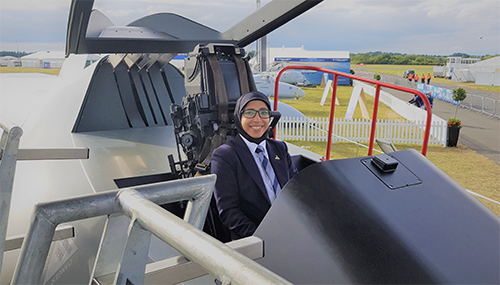
When I was about 12 years old, I saw a documentary on TV about aircraft and one of those aircraft was an F-16 Fighting Falcon. A few days later I had a dream that an F-16 has landed on top of my house, I got into the aircraft and I flew off. The dream was so vivid and exciting that since then, I decided that I wanted to learn about different systems in an aircraft. This has led to me working in my current role as an Aerospace Systems Engineer at Leonardo.
I spent my early teens researching and reading lots of books about aircraft. I knew that I needed to be good at maths and sciences at school to be able to study aerospace engineering at university. My mother used to help me with my homework when I was younger. My parents and siblings fully supported me in pursuing my dreams. I remember my siblings and I would play with toys like Meccano and build all sorts of crazy things!
I did a master’s degree at Cranfield University in Autonomous Vehicle Dynamics and Control, where I studied the technology behind unmanned air and ground vehicle systems. This led me to a career where I have worked on some of the most iconic modern day aircraft. Some of the projects I have worked on have included combat aircraft ejection systems, UAV systems, helicopters, human powered aircraft and autonomous cars.
At Leonardo, I am currently working within Team Tempest. I use my engineering knowledge and experience to help develop futuristic radar and sensors technology. This is one of the most exciting engineering projects to be taking place over the coming decades and I am very proud to be part of it!
I believe that anyone can become an engineer to make sci-fi a reality for the better world of the future!

Categories & Tags:
Leave a comment on this post:
You might also like…
Engineering Tomorrow. Part two: Can we move around the world without emissions?
Moving people and goods around the world is essential to modern life. But every journey has an environmental cost, and reducing the emissions associated with transport is one of the major engineering challenges of ...
Following in the footsteps of aerospace pioneers
I came to Cranfield to understand how aircraft stay in the sky. Months later, I was measuring the performance of aircraft engines in flight aboard the National Flying Laboratory Centre's Saab 340B. My ...
From looking up at jet engines to powering the future of flight
From flying aboard Cranfield's Saab 340B flying classroom to rebuilding a gas turbine component by component, Jouni Kailouh's journey shows how specialist, hands-on experience can turn a fascination with propulsion into a future career ...
Engineering Tomorrow. Part one: Can we power the future without costing the Earth?
The world needs energy. To power homes, industries, transport and the technologies shaping our future. But as demand grows and the pressure to reduce emissions increases, how do we generate the energy we need ...
Looking ahead: Building foresight skills for a more sustainable future
As sustainability challenges become more complex and uncertain, organisations need people who can look beyond today's pressures and think strategically about the future. From changing regulations and emerging technologies to supply chain disruption and ...
Brazil to Cambridge: How Cranfield helped me build a career in data analytics
I was hungry for something bigger. Before Cranfield, I was living in São Paulo, Brazil, working as a Data and Market Intelligence Analyst in the trading division of Raízen. My background is actually ...