


The Future of Operational Performance Management – Part 2
20/02/2017

The first post on this subject was posted on 9th January, which, some readers reminded me, promised answers to the questions asked. It compared Financial Performance Management (500 years and more of history) with Operational Performance Management (50 years of history – maybe). But first, we continue to hear every day about the trials and tribulations of the NHS. One report quoted an NHS “Chief Executive” as stating they didn’t have enough beds – as if that was the critical problem. There are several critical issues about the NHS, but one is that they make the same mistakes as almost every organisation we come across in our journey, namely they measure the Wrong Things from an improvement perspective, and the Care Quality Commission doesn’t help!
Back to our blog: What questions did we pose about what a standard way of reporting Operational Performance Management might look like, comparing this with standard accounting ways of assessing an organisation’s Financial Performance Management?
- Would it contain just a standard set of measures?
- Would it be presented in a standard way?
- Would it be presented on a monthly basis?
We’ll focus on the first bullet in this post, and the answer is yes, and it is no more than 10! To see this, we’ll introduce a fundamental concept – critical Generic Processes – that we believe is as important to Operational Performance Management as the concepts of Profit & Loss, Balance Sheet etc., when they were created in the mists of time by the accounting profession.
The Operational Performance Management equivalents to Profit & Loss, Balance Sheet etc. – Generic Processes
In assessing Financial Performance, there are some standard critical “objects” that are looked at, for example, Profit & Loss Sheet, Balance Sheet etc.
In Operational Performance Management, the author together with some colleagues has identified 4 critical Process Types (Processes were introduced in our previous Systems-Thinking blogs), and we see between 1 and all 4 of these in every organisation we work with. These are Operational Performance Management equivalents to P&L, Balance Sheet etc., and they are the core objects to which we will apply our standard sets of measures. What are these 4 critical processes?
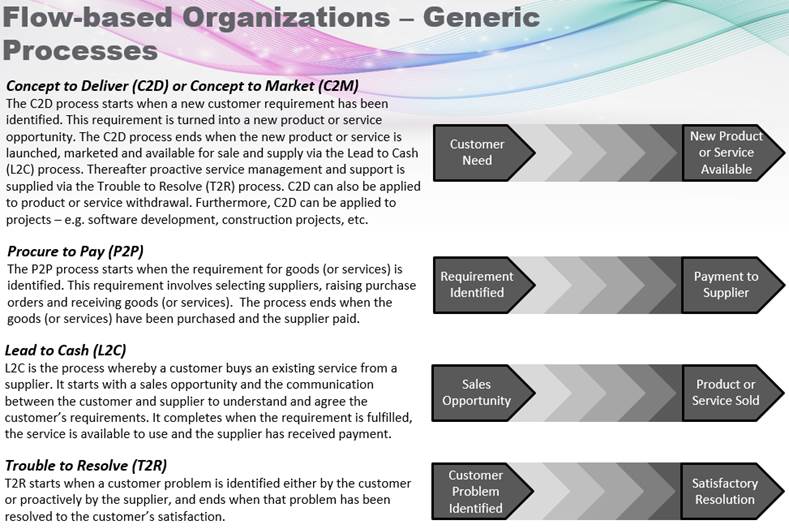
There will, of course, be Supporting Processes and Technical/Financial Processes, but they are not core to the organisation. Let’s look at some examples:
- Police: Generically speaking, their main process is T2R – the Public has a Problem, and the Police are required to solve it or prevent it (Trouble to Resolve)
- Ambulance: Generically speaking, also T2R – a patient has a problem, and needs help to recover or transport to a facility where they can be cured/cared for until resolved (Trouble to Resolve)
- Insurance: Generically speaking their main activities are L2C – a customer requires a quote/policy, pays premium, monies collected via direct debit (Lead to Cash) and T2R – a customer has an accident and requires some sort of resolution (Trouble to Resolve)
- Pharmaceutical Companies: As well as L2C and T2R, they operate C2M – laboratories around the world come across new diseases/complaints and they develop new drugs which must go through development, pre-clinical and clinical testing before they come to market (Concept to Market or Concept to Deliver)
- And so on…
These are like the fundamental building blocks of physics. You might say, what about Supply-chain? Well, Supply-chain is a combination of L2C and P2P. What about Asset/Infrastructure Management? This is a combination of L2C and T2R.
Having introduced these 4 fundamental generic processes we see everywhere, the P&L and Balance sheet equivalents of Financial Performance Management, we can now definitively consider what has to be measured in order to improve them.
This will be the subject of the next blog…

Categories & Tags:
Leave a comment on this post:
You might also like…

Moving to the UK to study? How to plan for banking, exchange rates and transfers
Currency and banking are two of the most practical parts of financial planning for international students. They are also often the most overlooked. We asked Dr Lakshmy Subramanian, Course Director for Cranfield University's Banking, ...

Cranfield: an environment where innovation thrives
The latest Knowledge Exchange Framework rankings from UK Research and Innovation (UKRI) gives an insight into the real and meaningful impact that UK universities have. The seven categories that make up KEF6 cover everything ...

How Cranfield accelerated my career in Logistics and Supply Chain Management
After graduating from the MSc in Logistics and Supply Chain Management at Cranfield University, I've been reflecting on the experiences that made my journey so valuable and the impact it has had on my ...

Mendeley: a powerful tool to organise and manage your references
Are you looking for a way to manage your references, create in-text citations and reference lists for your assignments or thesis? If so, you may wish to consider using Mendeley. What is it? Mendeley is ...

Keen to develop your study skills?
Alongside the technical skills and academic knowledge that you will gain on your course, as a Cranfield student you have the opportunity to develop a range of other skills that can enhance your learning experience. ...

The V-conomy: powering the sixth wave of global economic growth
The world could be on the verge of a major surge in economic growth and development, driven by the convergence of AI and clean energy technology. Waiting to ride the K-wave The Russian ...