


From looking up at jet engines to powering the future of flight
26/11/2026

From flying aboard Cranfield’s Saab 340B flying classroom to rebuilding a gas turbine component by component, Jouni Kailouh’s journey shows how specialist, hands-on experience can turn a fascination with propulsion into a future career in industry.
Where it all started
I’ve loved engines for as long as I can remember. As a kid it was cars, bikes and planes: anything with a motor and a bit of noise. For years my interest stayed close to the ground. But the more I learned, the more I found myself looking up at aircraft and wondering what was going on inside a jet engine.
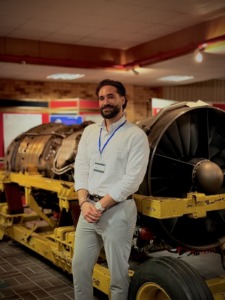
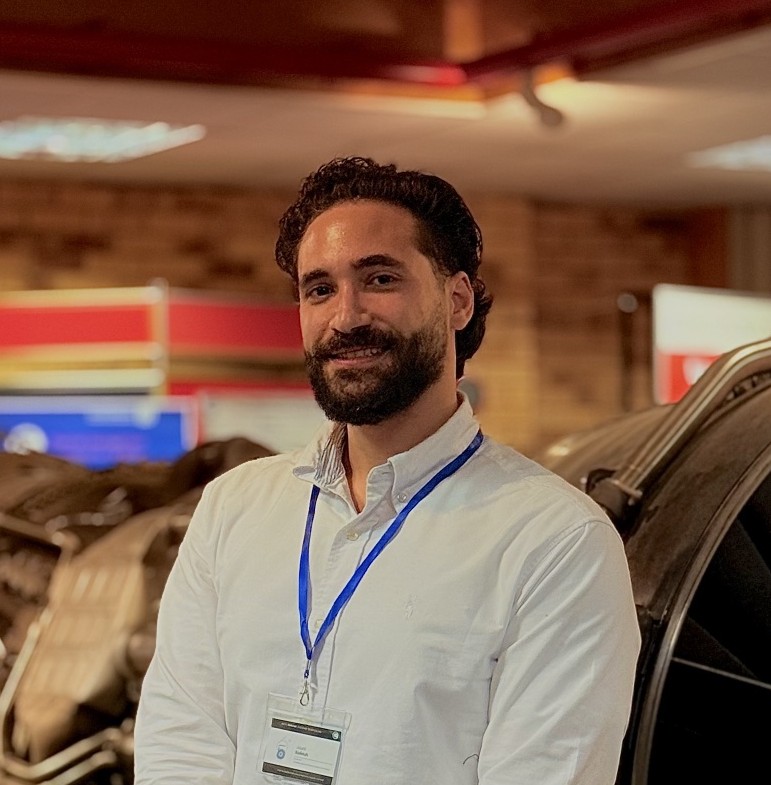
With the famous Olympus engine at Cranfield
I studied for my BTech in Mechanical Engineering at the Australian University in Kuwait, working and studying at the same time, and graduated in December 2025. By then I knew I wanted to dig deeper into the world of engines and energy.
The turning point came when I met someone who had studied at Cranfield. They told me about their journey and about Cranfield’s leading role in gas turbine engineering. A conversation with Dr Igie made the decision easy, and I couldn’t wait to join.
Moving to a new country was thrilling and a little nerve-wracking. But the people here were so welcoming that Cranfield quickly felt like home.
Life on the course
Days here pass in a blink with lectures, lunch with friends from the cohort, and plenty of study in between. The workload is intensive, but it’s the good kind of hard.
Every module goes a layer deeper into the gas turbine, one component at a time, and into how it’s actually designed. My favourite has been Gas Turbine Operations and Rotating Machinery, because it focuses on real-life scenarios and gave me a much clearer picture of how engines behave in service.
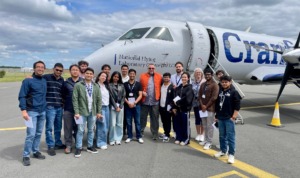
Our cohort with the Saab 340B flying classroom at Cranfield’s National Flying Laboratory Centre
The tools we use have been a big part of that. I took a full course in computational fluid dynamics (CFD), running simulations on Cranfield’s high-performance computing (HPC) cluster. I also used TURBOMATCH, Cranfield’s own gas turbine performance software, to model how engines perform.
My biggest highlight was flying on Cranfield’s Saab 340B flying classroom.
Watching live data and feeling how each manoeuvre affected the engines made everything we’d studied in lectures real.
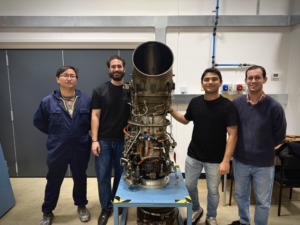
My team after the strip and build class
Another favourite was the strip and build class. In small teams, we took a real gas turbine apart piece by piece, studied each component up close, and then rebuilt it. Holding the parts I’d only seen in diagrams and putting them back together made me understand how every piece works with the next, and it’s one of the moments I’ll remember most from the course.
What surprised me most was the people. We all come from different countries and backgrounds, but we’re here with one thing in mind: gas turbines. That shared passion makes even the toughest weeks feel lighter.
Going beyond the lectures
For my Individual Research Project, I’m studying the air filtration systems that protect gas turbines, looking at how each particle behaves as air is drawn into the engine. The topic is close to home for me. My time in Kuwait showed me how much dust and sand engines have to cope with, and these filters are the first line of defence that keeps the engine running.
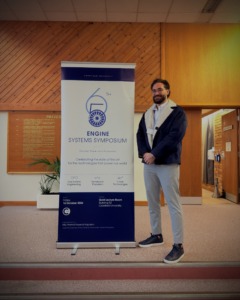
At the 65th Engine Systems Symposium, organised by our MSc cohort
Another experience I didn’t expect was the 65th Engine Systems Symposium, held in October. As a class, we organised the whole event ourselves: inviting guests, preparing the venue and getting everything ready. Then each of us presented on a technology we’d chosen. It was teamwork, event planning and public speaking all in one, and standing up to present my own research to a real audience was a big confidence boost.
Settling in
Milton Keynes has been a great base. It’s close to campus with regular buses, and it blends city life with plenty of green space. Settling in as an international student was easier than I expected. Lecturers are understanding when you need support, and student services go out of their way to help new arrivals find their feet.
Outside study, I head to the gym or go for a run to clear my head. Whenever I can, I visit a new UK city to see more of the country.
What’s next
Over the coming months, my focus is on finishing my degree, graduating, and taking my first steps into my career. I’d like to work in the gas turbine industry in project management or consultancy. Either way, the knowledge, skills and connections I’ve gained here have given me a strong foundation.
My advice to anyone thinking about applying: do it, you won’t regret it. Between what you learn and the people you meet, from classmates to industry professionals, Cranfield is an amazing place to grow.
Whether your ambition is to design, analyse or optimise the propulsion systems of the future, Cranfield gives you the knowledge, facilities and industry connections to take the next step.
Discover the Thermal Power and Propulsion MSc and start powering what’s next.

Categories & Tags:
Leave a comment on this post:
You might also like…

Engineering Tomorrow. Part two: Can we move around the world without emissions?
Moving people and goods around the world is essential to modern life. But every journey has an environmental cost, and reducing the emissions associated with transport is one of the major engineering challenges of ...

Following in the footsteps of aerospace pioneers
I came to Cranfield to understand how aircraft stay in the sky. Months later, I was measuring the performance of aircraft engines in flight aboard the National Flying Laboratory Centre's Saab 340B. My ...
From looking up at jet engines to powering the future of flight
From flying aboard Cranfield's Saab 340B flying classroom to rebuilding a gas turbine component by component, Jouni Kailouh's journey shows how specialist, hands-on experience can turn a fascination with propulsion into a future career ...
Engineering Tomorrow. Part one: Can we power the future without costing the Earth?
The world needs energy. To power homes, industries, transport and the technologies shaping our future. But as demand grows and the pressure to reduce emissions increases, how do we generate the energy we need ...

Looking ahead: Building foresight skills for a more sustainable future
As sustainability challenges become more complex and uncertain, organisations need people who can look beyond today's pressures and think strategically about the future. From changing regulations and emerging technologies to supply chain disruption and ...

Brazil to Cambridge: How Cranfield helped me build a career in data analytics
I was hungry for something bigger. Before Cranfield, I was living in São Paulo, Brazil, working as a Data and Market Intelligence Analyst in the trading division of Raízen. My background is actually ...