

From wave tank to ocean: seeing my work come to life in Indonesia
19/05/2026
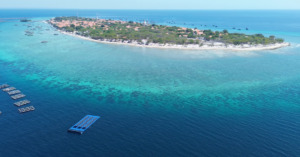
Gili Ketapang is a small island in East Java, Indonesia. Around 2% of the population of Indonesia lives without access to electricity but the InnovateUK-funded Solar2Wave project aims to make sure 100% of the Indonesian population has access to electricity within 10 years.
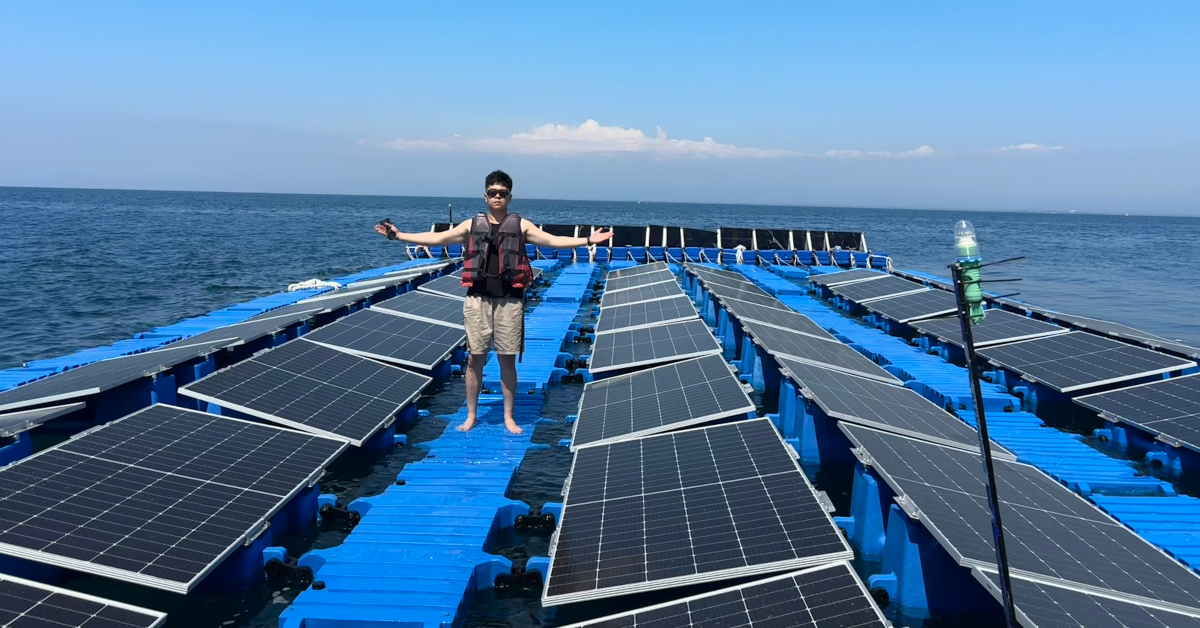
Cranfield University is part of Solar2Wave, and PhD research student Chenhao Mi spent over a month on Gili Ketapang to witness a floating solar platform he designed and prototyped get deployed in the sea. Here he talks about his experience there, the challenges he saw, and how this work could solve energy problems elsewhere in the future.
Gili Ketapang is around 8km from the Java mainland. The comparatively remote location means it faces several practical energy challenges, the most obvious being that it isn’t connected to the main electricity supply and depends on diesel generators. That means electricity supply is expensive, and often unreliable, especially during busy evening hours.
At the same time, the island has a hot tropical climate and strong solar resources, but access to cooling and affordable power remains limited. With a growing community and minimal land available, the floating solar farm offers a practical way to bring cleaner energy to residents without placing extra pressure on valuable land space.
The system works thanks to solar panels sitting on a floating structure, around 400m offshore. Those panels convert the solar energy into electricity which is then stored in a battery system, ready to be used on the island for whatever is needed.
What makes this project unique is that it’s the first offshore floating solar farm in Indonesia. As a pilot project it’s not only testing new technology, but also showing what may be possible in other locations around the country – which is particularly important for Indonesia as it’s made up of over 17,000 islands.
Compared with diesel generators, floating solar can generate electricity with almost no direct emissions during operation, and very little air or noise pollution. For island communities, this means a more sustainable energy solution that can reduce dependence on fossil fuels and support a healthier environment.
From theory to reality
For the past two years of my PhD, I’ve been working in the wave tank at Cranfield, creating controlled and challenging wave conditions to test floating solar platforms and understand how they might perform in real marine environments. After all that work, visiting Gili Ketapang and seeing one in reality was both exciting and deeply moving for me.
In the lab, everything is carefully designed, measured and repeatable. But arriving in Indonesia and standing in front of the real sea and knowing that our prototype would be deployed there, it felt completely different. It was the moment when my research stopped being about something confined to experiments and started to feel connected to real people and their lives.
I spent more than a month living on Gili Ketapang, and that experience changed the way I understood the project. At first, island life was not easy to adapt to. There was no stable running water and even basic daily routines, such as bathing, required scooping water from a tank. But as time passed, I gradually started to adjust to the rhythm of life there. I began to put my phone down more often, slow my pace, enjoy conversations with the locals, and appreciate the quiet beauty of the island at night.
“What stayed with me most was the feeling that this project was not only about technology. It was about bringing something meaningful to a community and seeing why the work we are doing matters.”
Seeing the project finally succeed was such a powerful moment for me. After spending so much time developing, testing an optimising the platform, watching it being deployed at sea and knowing it was working felt incredibly emotional.
#OnlyAtCranfield
Cranfield has provided me with the facilities, training, and research environment to contribute to projects like this. Using the Cranfield wave tank and the established data acquisition systems in the PSE laboratory, I’ve been able to gain experience in prototype testing and data analysis.
I’m also working with colleagues on simulation and AI-drive digital twin approaches, which has broadened the way I look at floating solar systems. Thanks to all this, my supervisor – Dr Luofeng Huang – trusted me to support the project and carry out prototype testing in a real marine environment. This move from lab-based experiments to real-world deployment has been one of the most valuable and rewarding parts of my PhD.
Going forward, we’ll build on what we’ve learned by analysing the real sea data and using it to improve future designs. Personally, I hope to continue to develop floating solar platforms that are more reliable, more adaptable to changing offshore conditions, and better suited to long-term use.
I believe floating solar could play a very important role in the future energy mix, especially in places where land is limited but solar resources are strong. It offers a way to expand renewable energy generation without directly competing for land space needed for housing, farming or other infrastructure. It has the potential to be especially valuable for coastal and island regions, not only for clean power but also as part of more flexible and localised energy systems.

Categories & Tags:
Leave a comment on this post:
You might also like…
Introducing Barrington Library
Welcome to all our new students! Barrington Library supports all the students and staff at Cranfield Defence and Security on the Shrivenham site. We are looking forward to meeting you all soon, in person or ...

About to start your journey at Cranfield? We’re here to help!
Congratulations on accepting your offer to study at Cranfield! If you’re keen to get a head start before your course begins, our Library Services team is here to support you every step of the way. ...

Bank holiday hours for Library Services: Monday 31 August
Library Services staff will be taking a break on Monday 31 August for the bank holiday. You will still be able to access all the resources and help you need via our library website. The 24/7 ...

The real cost of studying in the UK – what international students need to budget for
Moving overseas to pursue a postgraduate degree is one of the most exciting investments you can make in your future. It's also one of the most significant financial commitments you and your family will ...
Seven things you should definitely prepare for before studying at Cranfield University
You're thinking about Cranfield. Maybe you've done the virtual tour, read through the course pages, spoken to the course director or attended a webinar. Now, you're trying to figure out what life here is ...

From insurance to aerospace: why I chose to study a PhD with Cranfield
My path to studying for a PhD wasn't exactly a straight line. I had just graduated with an MEng in Aerospace Engineering from the University of Surrey and, like a lot of people, wasn't ...