


The Sustainability Imperative: How to turn concern into action
17/01/2023
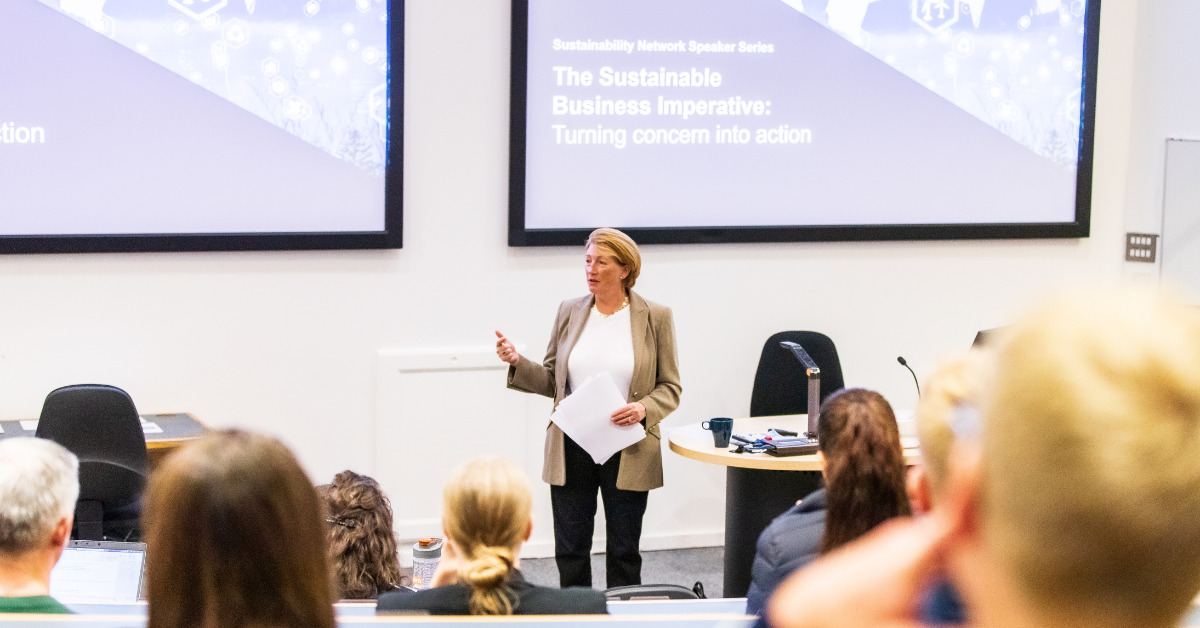
Our first Sustainability Network Speaker of this Academic year – 2022-23 – was the inspirational Cranfield Visiting Fellow, Sue Garrard. Sue has had an outstanding career as an advocate for sustainability, spanning both private and public sectors. From government she joined global giant Unilever as Executive Vice-President, Sustainable Living, supporting growth through building brands with purpose, fostering employee engagement and future-proofing the business. By the end of 2019 Unilever’s ‘sustainable living brands’ were growing 67% faster than its other brands, and represented 70% of the company’s growth. Sue now runs her own consultancy business, advising clients such as Mars and Danone on developing sustainability strategies and aligning these with their business objectives.
Sue gave her talk amidst a backdrop of environmental and political turbulence. Large areas of the world are afflicted variously by floods, droughts, the war in Ukraine and the ensuing disruption to global supply chains. Inflation in major economies is rampant and governments are struggling for solutions. At least, with the exception of China, the planet seems to be emerging finally from the scourge of Covid. Nonetheless, many environmentalists fear that the sustainability gains of recent years may be lost or abandoned. Instead of a bounce-back from the retreat of Covid, in the face of a cost of living crisis many businesses are looking to cut back wherever they can and sustainability, sadly, is in their sights.
The question arises, who will lead us out of this? It is Sue’s view that we cannot simply wait for government. Business must assume the mantle of leadership, and the rising generation of sustainability leaders must step up to the challenge. Consequently her talk addressed three major themes:
– why action now makes sense
– the common factors that define best practice
– and tips for converting concern into action
Why act now?
Business alone has the ability to effect rapid change on the ground. Capitalism may be imperfect, but it’s the system that we have and we must work with it. Leaving to one side the overwhelming moral arguments for action, the shift to sustainable business practices takes years to develop and implement. The sooner we start, then, the better. Companies that do not or cannot make a fundamental change to their business models face the prospect of extinction, like Kodak: once a household name, its failure to transform itself for the digital age consigned it to history. The war for talent provides another compelling reason. Covid has accelerated people’s need to find meaning and purpose in their work. The employees of the future are looking to work for companies that mirror their own values and will take to task businesses that fall short. And then there are customers. They may not necessarily pay a sustainability premium, or may opt for an inferior product, but equally they will not accept greenwashing or a company’s failure to conduct due diligence: the presence of pesticide in Evian mineral water, owned by Danone, even at levels harmless to human health, caused considerable and costly reputational damage to the brand.
The common features of best practice
Sue’s experience has shown how remarkably similar best practice is across geography and industrial sectors. Decisive sustainability leadership cuts across all functions and activities of an organisation. In its absence, businesses will move at the pace of the slowest. Unfortunately, not everyone grasps this fact and is ready to commit to it. Just as important is a recognition that sustainability is business strategy, not a mere nice-to-have to be side-lined when times get difficult. And it’s not CSR, which is too frequently a smokescreen of tokenistic activity behind which businesses hide. True sustainability runs throughout the business, not just at the fringes, which creates a challenge for business leaders contemplating an average tenure of five years and quarterly shareholder reports.
This underscores the importance of making the business case for sustainability, identifying not just the need to quantify and manage risks, but also articulating the long-term costs of taking no action versus acting promptly and responsibly. A strong business case raises the levels of trust among all stakeholders and creates opportunities to make companies more competitive. Everyone – the firm, its people, its consumers and the planet – wins. This is where the business case and the moral case meet, creating a powerful force for change.
To drive this forward requires the appropriate level of ambition. The best in class do what the science says needs to done. In the case of carbon, that means a reduction of 50% against the 2010 levels [as defined by the IPCC]. It’s a challenging goal which entails highly-stretching targets to deliver step changes in performance right across the value chain. Those at the leading edge of best practice also recognise that the changes needed are systematic, that they cannot do this alone. Thus they form partnerships and alliances across traditional industry sector boundaries to drive critical mass faster across entire markets.
Sue’s top tips
- Start with the “why”: why answers the basic human need for purpose.
- Break binary thinking: it’s not a case of either/or, but both/and.
- Build the business case: harness the growing evidence that sustainable businesses outperform their peers.
- Understand your customer: after all, your customer could well be your strongest advocate.
- Focus on a few big priorities: do not spread yourself too thinly. The big wins are the crucial ones.
- Limit what you publish: support your priorities with high-quality advocacy.
- Put accountability in place: be absolutely clear about where the buck stops.
- Focus on impact: you will be judged ultimately by your actions.
In conclusion
Every one of you can make a difference. Everyone has to. You need to be courageous, determined and clear-thinking.

Sue delivered this talk as part of the MSc Sustainability programme taught here at Cranfield University. You can listen to the full recording of this Sustainability Network Speaker series event via our Sustainable Business webpage.

Categories & Tags:
Leave a comment on this post:
You might also like…

How Cranfield shaped my journey as an Aerospace Engineer
If I'm being specific about the moment it clicked, it was reading a paper called "On the Role and Challenges of Computational Fluid Dynamics (CFD) in the Aerospace Industry" by two Boeing engineers, P. ...
Introducing Kings Norton Library
Welcome to all our new students! We are looking forward to meeting you soon. You will find Kings Norton Library in the centre of the Cranfield campus, and it is open 24/7 to all staff ...

Setting your research on the right course: Four questions every researcher should ask
Whether you are just beginning your doctoral journey or are already well into your research career, successful research rarely happens by accident. Like any successful mission, it depends on good planning, informed decisions, and getting ...

5 budgeting mistakes students make (and how to avoid them)
Good financial planning isn't about how much money you have. It's about the habits you build. We asked Dr Lakshmy Subramanian, Course Director for the Banking, Economics and Finance MSc, about the budgeting mistakes ...

Finding your reading materials
Use Library Search Library Search is the first place to start when you are trying to find academic sources for your work. This is the search box on the library website homepage. It allows you ...

Formula 1 was the dream and Cranfield was the conduit
I still remember the exact moment Formula 1 (F1) got its hooks into me. I was in my first year of an aerospace undergraduate engineering degree when I watched a video about the sport ...
Comments are closed.