

Air Transport Management MSc student Matthieu Deudon reflects on his first semester
07/12/2021
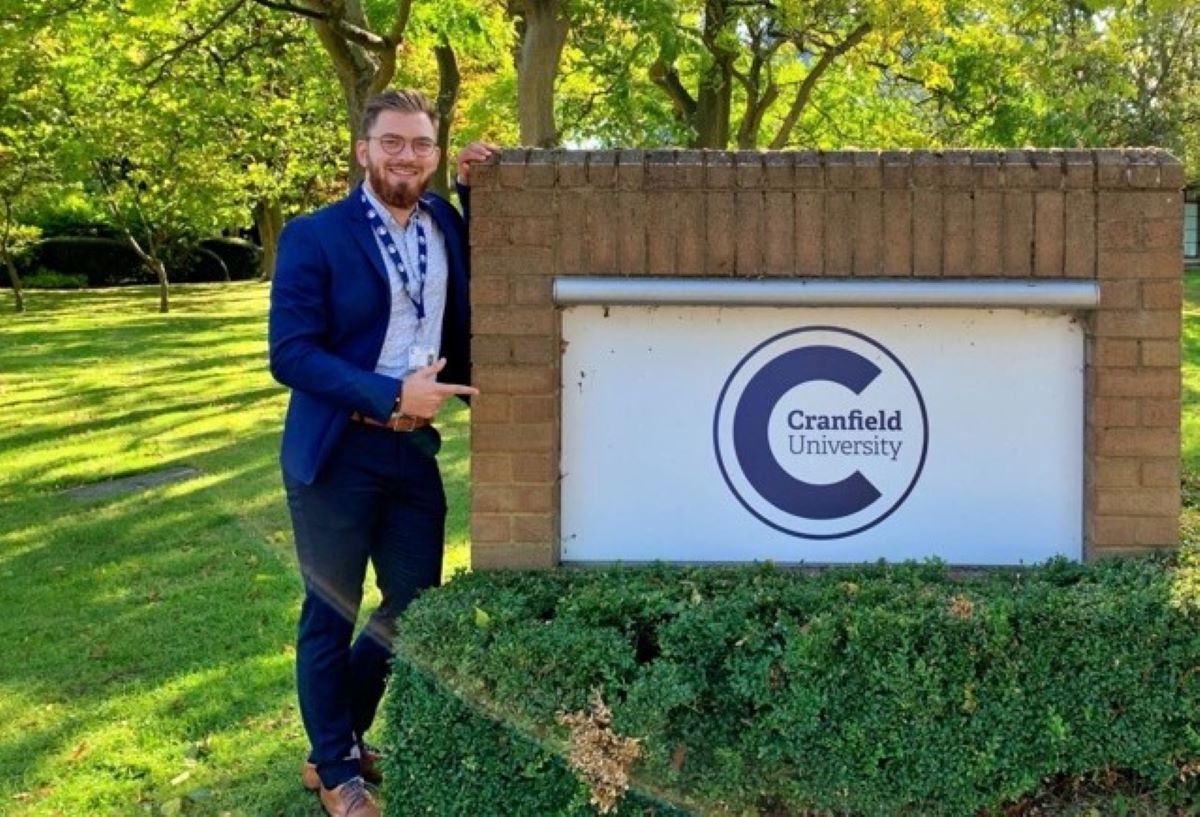
Having originally studied at the French National Aviation University (Ecole Nationale de l’Aviation Civile – ENAC) in Toulouse, I have acquired a strong engineering background. Over there, I could specialise in air operations and safety and start to obtain some knowledge in economics and airport operations.
Through the Air Transport Management (ATM) MSc at Cranfield University, I wanted to go deeper into the management part of the air transport industry, to complement my engineering skills. I find it important and interesting as a future stakeholder of the field to know the stakes, the hurdles, and the available means to achieve the goal of a future sustainable aviation industry.
As I am writing this little review, it’s been almost a month and a half since my fellow students and I started the MSc. As we’re all from different backgrounds, we started with a week of introduction about the air transport industry, especially in relation to the COVID-19 context that the field will have to cope with. We also had the opportunity to tackle several articles of air law convention and to understand the principles of air transport economics and airlines’ financial strategy.
The way of teaching is quite different from my previous experiences. Unlike pure theoretical modules, most lectures are open discussions between students and lecturers. These lectures give us the foundations to be able to complete our research for our assignments. This way of learning is interesting as it invites you to be curious about the history and evolution of aviation but also to be attentive to the latest news at the same time. This finally gives you the opportunity to broaden your vision of the whole air transport industry.
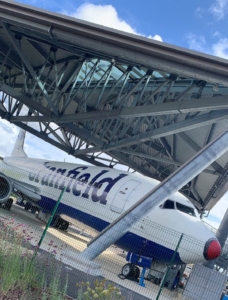
Up to now, these have been the top highlights of my experience in Cranfield. First is when you see the campus for the first time. It is like a small village with each single place having its particularity. At one end you have this beautiful Boeing 737 aircraft, at the other the beautiful lecture room of Mitchell Hall. In the middle, you discover some F1 cars and jet engines, and, in some places, you have this amazing view of Cranfield Airport!
Second is the first time you meet with your fellow international students. The language barrier is quickly not a problem, and you realise that living this experience in English will be a plus for improving your skills.
Finally, the first assignment is surely the point from which you feel your experience is real. Starting with a white page and finishing it after hours of research and curiosity creates such a feeling of accomplishment.
Fortunately, we started the MSc in a period where the restrictions related to the COVID-19 pandemic were easing. As a result, we could have all meetings face-to-face, obviously with the safety measures required. The University is also well-equipped to offer the possibility for self-isolating students to follow the course off-campus. Unfortunately, it seems that winter will bring challenges but I am confident for the pedagogical continuity as Cranfield has shown resilience from the first waves of the pandemic.
Aviation will also have to show resilience. The industry has demonstrated it for past crises, there is no doubt it will for this one. But in the light of COP26, the stakes are higher. Usefulness of our industry no longer needs to be demonstrated. The sector now needs to strengthen trust between all the stakeholders. Governments and customers will have a key role to support the industry in its innovations and these are already numerous. Among them we can cite the use of 100% sustainable aviation fuel (SAF) (see Airbus recent tests), the optimisation of air operations (e.g., SESAR) and the several projects of technological improvement of aircrafts like electrification for short-haul flights (e.g., Voltaero, Aura Aero, Boeing) or hydrogen for longer ranges (e.g., Airbus, ZeroAvia).
Obviously, in the short-term, while waiting for these technologies to develop, it is important to question our way of travelling to limit our carbon footprint. But as soon as 2025-2030, aviation should be able to propose a whole new model of networks heading towards a net zero emissions goal.
The ATM MSc should be an opportunity to challenge ourselves in this way. Indeed, the group project scheduled in March 2022 will ask us to develop a whole airline. Its sustainable development will certainly be a key goal to explore.
A second challenge of the MSc will be the thesis following the group project. For this three-month individual research project, I have some ideas in mind, especially related to the adaptation of airlines in the post-COVID-19 context. The intensification of the cargo market, the renewing of fleets, or the limits of the low-cost business model are some of the topics which can be questioned regarding the future. I am curious to look at airlines’ reaction during the coming winter. This will certainly give us an idea of what to expect for the coming years and therefore will help me to define more precisely my subject.
Thinking even beyond the MSc, my wish would be to do my last six-month internship required by the ENAC in an airline. I am quite interested in network planning, business analysis and, more generally, in air operations engineering, studying aircraft performances, or working in the operational control centre!
To finish on a good note, aviation is facing a great future, for sure. Aiming at becoming a net zero emissions field is certainly ambitious but feasible. There will always be crises, but the air transport industry has defined clear goals and is already working hard to achieve them. Our generation of aerospace students is ready to join the workforce to tackle this exciting journey!

Categories & Tags:
Leave a comment on this post:
You might also like…
Mendeley: a powerful tool to organise and manage your references
Are you looking for a way to manage your references, create in-text citations and reference lists for your assignments or thesis? If so, you may wish to consider using Mendeley. What is it? Mendeley is ...

Keen to develop your study skills?
Alongside the technical skills and academic knowledge that you will gain on your course, as a Cranfield student you have the opportunity to develop a range of other skills that can enhance your learning experience. ...
The V-conomy: powering the sixth wave of global economic growth
The world could be on the verge of a major surge in economic growth and development, driven by the convergence of AI and clean energy technology. Waiting to ride the K-wave The Russian ...

Need help using the Python programming language?
We know some of our students are currently trying to learn Python, so we wanted to make you aware of some great LinkedIn Learning videos that can help. But don't you have to pay for ...

What does it really take to become a Chevening Scholar?
Say “Turkmenistan” to most people and you’ll get a blank look. That was true when I left Ashgabat for the UK to study an MSc in Logistics and Supply Chain Management at Cranfield University ...

Get a head start on referencing and plagiarism
We offer a module on Referencing And Avoiding Plagiarism which you can find on your Canvas dashboard. It explains the role and importance of citing references and how to incorporate the work of other authors ...
Comments are closed.