


Industry-academia: addressing the climate crisis by working together
05/11/2021
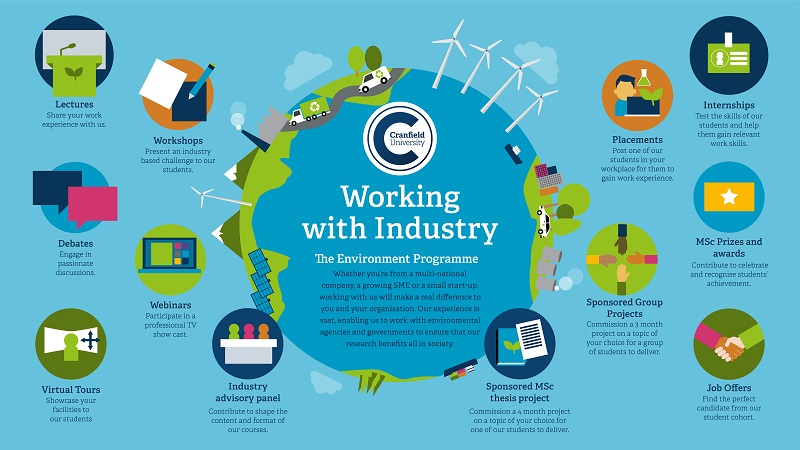
If there’s one thing everyone involved with tackling climate change agrees on, it’s the need for collaboration globally. Partnerships of all shapes and sizes, a coming together of governments, business, industry regulators and the third sector to set the agenda for new, sustainable ways of life. But even that’s not going to be enough — because the nature of that collaboration really matters.
What we can’t have is co-operation based around mutually convenient answers. Short-cuts. Superficial solutions. Decision-making that is based solely on vested interests, whether that’s financial gain or public popularity. Otherwise, all of the huge energy and efforts across sectors, the involvement of populations in changing their behaviours, will be mis-directed. Worse, it has the potential to lead whole societies along pathways that result in further problems for the environment.
This is exactly why the network of Higher Education institutions internationally can be such an important glue for both extending collaboration and making real progress on COP26 goals. The impartiality and independence of HE means researchers and academics working alongside partners in business and government can keep their eyes trained on the complexity involved. They are able to keep the full picture of factors in mind — the impact of new technologies, business models and legislation on societies and cultures — as well as their all-important implications for climate change.
We need to navigate this kind of complexity together in order to ensure there is good decision-making. Because wherever we look, whatever sector, there are no silver bullets — but a great deal of simplistic thinking. When it comes to my area, sustainable agriculture, for example, there are popular pressures on meat eating. We could reduce the scale of livestock farming: but what does that mean for local ecosystems and the nutrient cycle for soils in grasslands? And how will our landscape need to change with increasing demand for both energy and food crops? So again, we need to find the best balance, and be wary of plans to hit only carbon emission targets. The standard perception is that meat is bad because of the methane produced by livestock, a greenhouse gas 28 times more potent than CO2. But as recent studies involving Dr Michelle Cain at Cranfield have demonstrated [https://www.nature.com/articles/s41612-021-00169-8.pdf?origin=ppub], methane is a relatively short-term issue, it dissipates in the atmosphere in a way that CO2 doesn’t. So, again, we need to find the best balance and be wary of plans to hit greenhouse gas emission targets by reducing methane rather than CO2. Seemingly straightforward measures like labelling products with their ‘food miles’ have been exposed as misleading. As Dr Adrian Williams at Cranfield’s Centre for Environmental and Agricultural Informatics has pointed out, food miles might indicate the amount of miles travelled, but nothing about the much bigger issues of how the food was produced and the carbon footprint involved.
HE needs to keep evolving in order to fulfil its potential as the climate change collaboration glue. COP and Sustainable Development Goals should be further integrated into teaching. HE needs to be open to more people in all parts of the world. In popular debate there is a great deal of attention paid to young people in schools, the next generations and their passion and commitment to changing the world. Awareness and enthusiasm is a brilliant start. But it’s at HE level that those people will really have the chance to deliver, to work on the nuts and bolts and contribute to ideas that have an impact. In economically developing nations, areas like sub-Saharan Africa, levels of participation in HE are only around 8% — meaning huge opportunities for more involvement, new talent. For the emerging new green economies we will need upskilling and new skills and that will mean making sure there can be universal access to HE, minimising barriers for students such as taking on large debts. Universities need to build on and make more use of their partnerships with industry. They can also be doing more to use campus infrastructure and buildings a ‘living lab’ and model of sustainable practices.
Cranfield is unusual in having its own airport, meaning more challenges when it comes to achieving net zero. But why not? Aviation is the most important example of a sector that is dependent on immediate change to secure its future viability; where there isn’t a simple technological solution; where global collaboration is a necessity. A sector which is working closely with HE internationally, where governments, regulators, manufacturers and operators are running to get ahead of CO2 targets and potential restrictive legislation — and which has the potential to be a role model of what purposeful, open-eyed co-operation can actually deliver.

Categories & Tags:
Leave a comment on this post:
You might also like…

The real cost of studying in the UK – what international students need to budget for
Moving overseas to pursue a postgraduate degree is one of the most exciting investments you can make in your future. It's also one of the most significant financial commitments you and your family will ...
Seven things you should definitely prepare for before studying at Cranfield University
You're thinking about Cranfield. Maybe you've done the virtual tour, read through the course pages, spoken to the course director or attended a webinar. Now, you're trying to figure out what life here is actually ...
From insurance to aerospace: why I chose to study a PhD with Cranfield
My path to studying for a PhD wasn't exactly a straight line. I had just graduated with an MEng in Aerospace Engineering from the University of Surrey and, like a lot of people, wasn't ...

How to build a business that keeps growing
Ask any business owner about their ambitions and "growth" will almost certainly feature near the top of the list. More customers, higher revenues, larger teams and new markets are often seen as signs of ...

Three practical ways SMEs can build resilience in a challenging business environment
Economic uncertainty, shifting customer expectations and rapid technological change have become part of everyday business. While no organisation can predict every challenge, small and medium-sized enterprises (SMEs) can improve their resilience by focusing on ...

Six reasons students fall in love with Cranfield University
If you ask a Cranfield student what makes the University special, you won’t just get the usual “great teaching” answer. You’ll hear stories about industry projects that feel like real jobs, friendships built with ...