


Engaging citizens in Sub Saharan Africa on air quality for improved public health and environmental sustainability
17/09/2019

Air pollution according to the United Nations kills 800 people every hour around the globe1 and majority of these deaths occur in low and middle income countries specifically Africa and Asia2. Addressing the deteriorating air quality in Ghana and many parts of sub-Saharan Africa however is challenging3 due to data gaps as a result of limited air quality monitoring stations in Ghana and many parts of Sub-Saharan Africa(SSA)4. Further to this, the available scanty air quality data is poorly communicated and only found in governmental reports5 which are difficult to access. Consequently, citizens are not able to make informed decisions and to plan their daily activities to avoid/ limit exposure to atmospheric emissions.
In recent years, advancement in environmental sensing technology offers the opportunity to undertake air quality monitoring with miniaturized low-cost tools in environments previously difficult to monitor for example in Ghana and wider SSA. Most of these commercially available low-cost tools are robust, user-friendly, rely on low-power supply, able to collect fast and in near real-time high resolution in-situ data and do not require huge infrastructure6,7.
Though there are published and ongoing studies to improve the quality of data that these devices acquire, the capability of low-cost tools to collect high spatiotemporal data offers governmental agencies, civil society organizations and interested stakeholders to develop new approaches in communicating air quality data to the general public in SSA and similar environments. This in part is due to the ability of these devices to use inbuilt general packet radio service / internet connectivity to transmit populated data onto internet based platforms. These innovative approaches will enable responsible agencies and civil society organizations to engage, educate and empower citizens on air quality and its impact on human health. This will in the long-term ease the work of the responsible agencies to develop and implement air pollution mitigation policies as well as integrate behavioral changes with air quality monitoring in such environments.
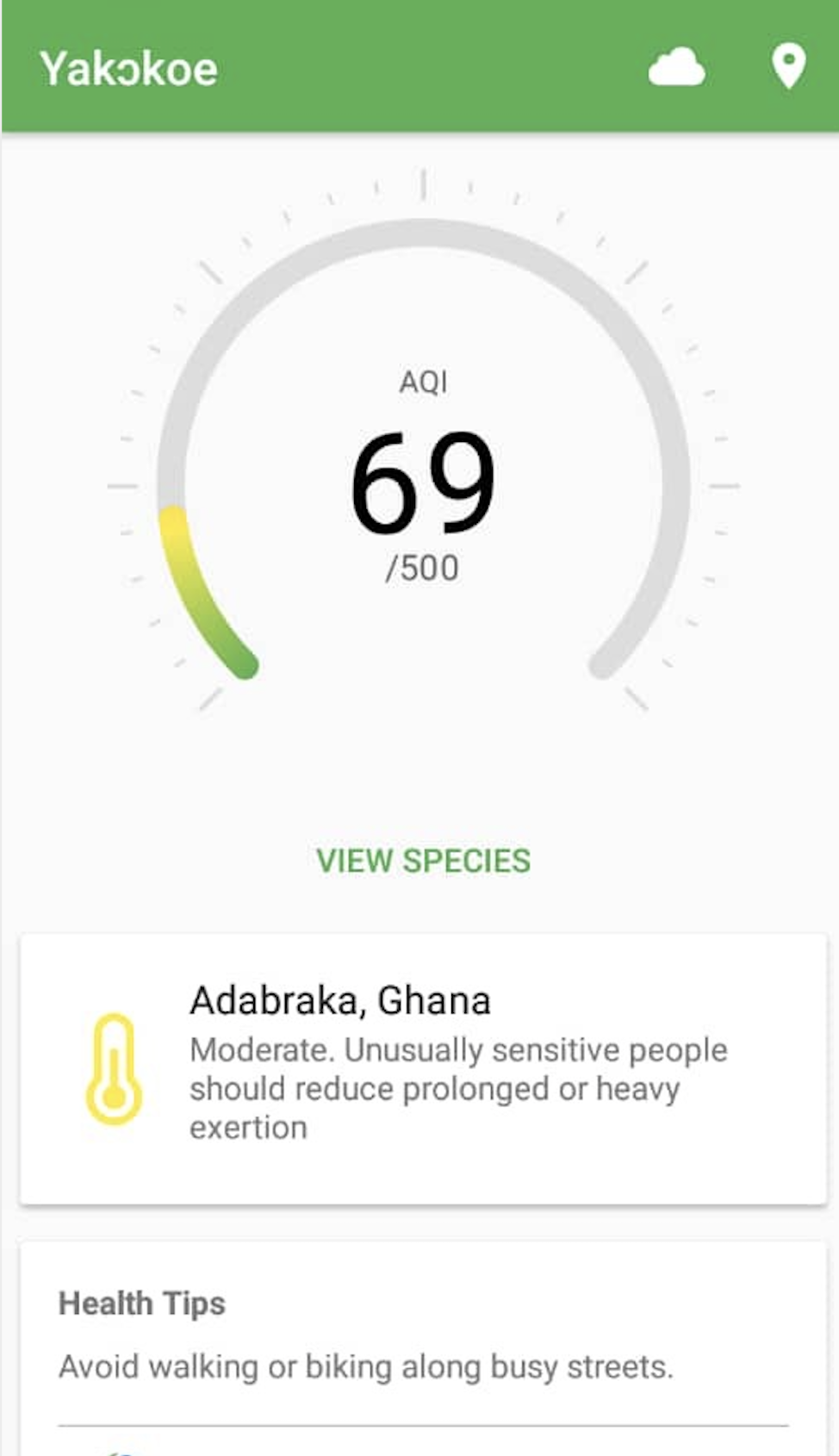
Clean Air One Atmosphere (CAOA), a Ghanaian based non-profit is piloting such a concept to democratize air quality monitoring in Ghana and potentially wider SSA. Currently, CAOA feeds on user-friendly and accessible open source data from the Purpleair map and meaningfully communicate it using the USAQI via the android mobile application Yakokoe. Yakokoe updates subscribers on air quality levels in near real-time based on geographical locations of sensor installations. Advices are given to subscribers based on the air quality levels and some information on basic actionable steps that individuals can engage in to both reduce exposure to and reduce atmospheric pollution.
CAOA hope to establish a dense network of such and/ or low-cost sensors firstly in Accra to inform decision-making and extend this project to other parts of Ghana and SSA. Currently, Yakokoe covered sensor locations not only in Ghana but South Africa, Democratic Republic of Congo, Angola, Nigeria, The Gambia, Sierra Leone and Algeria. Yakokoe is currently run as a prototype and at a pilot phase. It forms part of Collins’ PhD studies and a form of knowledge transfer as well as conceptualizing his research work. Yakokoe can be downloaded from the google play store via this link https://play.google.com/store/apps/details?id=com.cleanairghana.yakokoe&hl=en
Yakokoe is a movement to revolutionize air quality monitoring in Ghana and wider SSA. Join us by following our twitter or liking Facebook handles @CleanAir1ATM.
1http://funnycor.com/detail?newsId=1942426 (accessed 12 June 2019)
Health Effects Institute. 2019. State of
Global Air 2018 Special Report. Boston, MA: Health Effects Institute
2http://challengingheights.org/wp-content/uploads/2014/10/National_Analytical_Report2010.pdf, accessed 27/02/2019
3Amegah, A.K.,
Agyei-Mensah, S., n.d. Urban air pollution in Sub-Saharan Africa: Time for
action. Environ. Pollut. doi:10.1016/j. envpol.2016.09.042
4Petkova, E.P., Jack, D.W., Volavka-Close, N.H.,
Kinney, P.L., 2013. Particulate matter pollution in African cities. Air Qual.
Atmosphere Health 6, 603–614. doi:10.1007/s11869-013-0199-6
5Schwela, D., 2012a. Review of urban air quality in Sub-Saharan
Africa region - air quality profile of SSA countries (No. 67794). The World
Bank
6Mead,
M.I., Popoola, O.A.M., Stewart, G.B., Landshoff, P., Calleja, M., Hayes, M.,
Baldovi, J.J., McLeod, M.W., Hodgson, T.F., Dicks, J., Lewis, A., Cohen, J., Baron,
R., Saffell, J.R., Jones, R.L., 2013. The use of electrochemical sensors for
monitoring urban air quality in low-cost, high-density networks. Atmos.
Environ. 70, 186–203. doi:10.1016/j.atmosenv.2012.11.060
7Snyder, E.G., Watkins, T.H., Solomon, P.A., Thoma, E.D., Williams, R.W.,
Hagler, G.S.W., Shelow, D., Hindin, D.A., Kilaru, V.J., Preuss, P.W., 2013. The
changing paradigm of air pollution monitoring. Environ. Sci. Technol. 47, 11369-11377

Categories & Tags:
Leave a comment on this post:
You might also like…

Mendeley: a powerful tool to organise and manage your references
Are you looking for a way to manage your references, create in-text citations and reference lists for your assignments or thesis? If so, you may wish to consider using Mendeley. What is it? Mendeley is ...

Keen to develop your study skills?
Alongside the technical skills and academic knowledge that you will gain on your course, as a Cranfield student you have the opportunity to develop a range of other skills that can enhance your learning experience. ...

The V-conomy: powering the sixth wave of global economic growth
The world could be on the verge of a major surge in economic growth and development, driven by the convergence of AI and clean energy technology. Waiting to ride the K-wave The Russian ...

Need help using the Python programming language?
We know some of our students are currently trying to learn Python, so we wanted to make you aware of some great LinkedIn Learning videos that can help. But don't you have to pay for ...

What does it really take to become a Chevening Scholar?
Say “Turkmenistan” to most people and you’ll get a blank look. That was true when I left Ashgabat for the UK to study an MSc in Logistics and Supply Chain Management at Cranfield University ...

Get a head start on referencing and plagiarism
We offer a module on Referencing And Avoiding Plagiarism which you can find on your Canvas dashboard. It explains the role and importance of citing references and how to incorporate the work of other authors ...