

Meet Cranfield Defence and Security, 3MT competition winner
29/07/2019
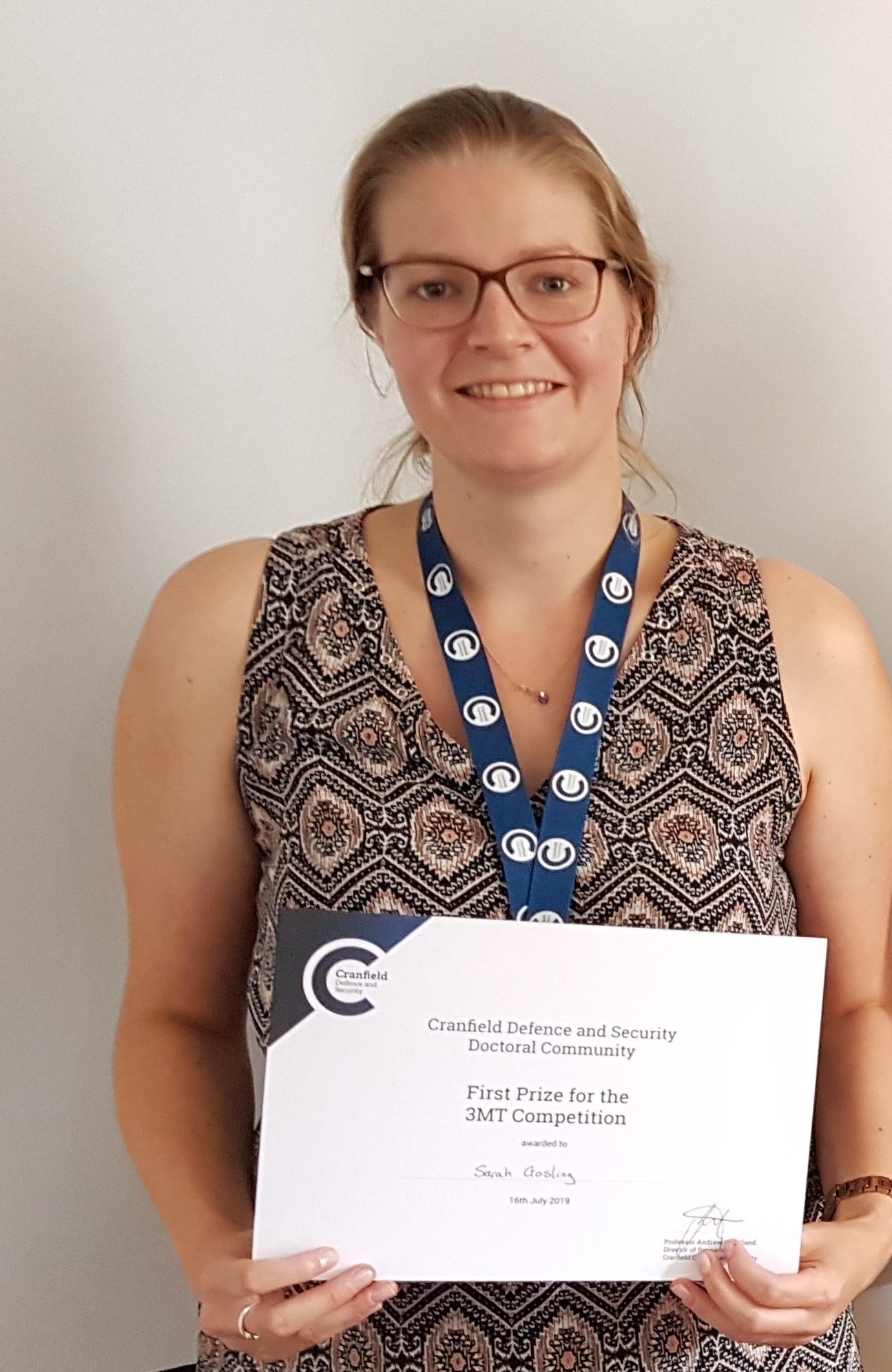
An interview with Cranfield Defence and Security 3MT competition winner, PhD student Sarah Gosling.
Developed by Queensland University, the 3MT competition challenges research students to concisely articulate their research to a non-specialist audience in just three minutes (using just one static slide). Sarah Gosling, a PhD student at Cranfield Defence and Security, rose to this tough challenge and was awarded first place with her research on breast microcalcifications as biomarkers of tissue pathology. Sarah gave us a little more insight into her research project at Cranfield University.
How did you get into being a PHD student at Cranfield University?
I’ve always been interested in doing cancer research, which is what my topic’s about. I actually came across this PhD by chance. It’s different to what I’ve done before, because I did a biology degree and this is more physics and chemistry and so I thought it looked really interesting so I went for it and I actually fell in love with the PhD.
Can you tell us a bit more about the research you are doing and how you go about gathering it?
I get samples of breast tissue from all over the world and I use very high powered x-rays to look at them and that requires me to go to a separate facility to actually collect all of the data together. It’s often 72 – 96 hours at a time, in a block, which is really hard work at the time. Then I take all of that data and build a model of whether or not the calcifications, which is what I am looking at, are a relevant part of breast cancer.
How long does it take to gather the research?
Because I have to gather the data in blocks at a time, I get lots of data all in one go, but then actually analysing it all will take a few months at a time and looking at whether there are patterns in the data takes a few more months as well.
What’s next for your research?
I have got a big data collection in September so that will be the big start to my research and hopefully coming up with some ideas and draw some conclusions from the data. I think there are lots of things that can be done with the research after my PhD as well because it is quite a new field.
Why did you choose Cranfield University to do your research?
Firstly, the project itself was really interesting and obviously it is based at the Cranfield Defence and Security site which is a very unique place to work and that attracted me as well because of the opportunities that the site offers.

Categories & Tags:
Leave a comment on this post:
You might also like…
Moving to the UK to study? How to plan for banking, exchange rates and transfers
Currency and banking are two of the most practical parts of financial planning for international students. They are also often the most overlooked. We asked Dr Lakshmy Subramanian, Course Director for Cranfield University's Banking, ...
Cranfield: an environment where innovation thrives
The latest Knowledge Exchange Framework rankings from UK Research and Innovation (UKRI) gives an insight into the real and meaningful impact that UK universities have. The seven categories that make up KEF6 cover everything ...
How Cranfield accelerated my career in Logistics and Supply Chain Management
After graduating from the MSc in Logistics and Supply Chain Management at Cranfield University, I've been reflecting on the experiences that made my journey so valuable and the impact it has had on my ...
Mendeley: a powerful tool to organise and manage your references
Are you looking for a way to manage your references, create in-text citations and reference lists for your assignments or thesis? If so, you may wish to consider using Mendeley. What is it? Mendeley is ...
Keen to develop your study skills?
Alongside the technical skills and academic knowledge that you will gain on your course, as a Cranfield student you have the opportunity to develop a range of other skills that can enhance your learning experience. ...
The V-conomy: powering the sixth wave of global economic growth
The world could be on the verge of a major surge in economic growth and development, driven by the convergence of AI and clean energy technology. Waiting to ride the K-wave The Russian ...