


In the spotlight: Sabrina Cipullo
17/09/2018
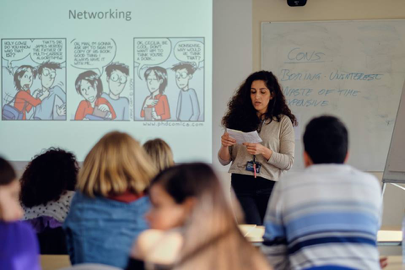
Sabrina Cipullo is a Marie Curie Early Stage Researcher in Environmental Science at Cranfield Water Science Institute, Cranfield University. She has a Masters of Environmental Science and Biotechnology from the University of Milan, and a BSc in Biotechnology. Her PhD (part of REMEDIATE) focuses on environmental chemistry and toxicological approaches to site assessments.
Give us a short overview of your scientific topic
“Over 200 years of industrialisation have left a legacy of contaminants in soil across Europe. Luckily for us, many diverse groups of bacteria are capable of using contaminations (like petrol) as food source, in a process called bioremediation. However, some contaminants are resistant to microbial attack, they are degraded either slowly or not at all. In my work I am studying how to clean-up and de-toxify contaminated soils, combining engineering, chemistry, microbiology, and toxicology.”
Tell us more! Some facts about your events, how you designed the activities, and its impact on young people
“During these three years of my PhD, I took part in multiple exhibitions, talks, debates, and promoted hands-on activities to sparkle a stimulus for change, and to teach (and learn!) more about science. It all started when I showcased my research at the University’s 70th anniversary, Cranfield’s Festival of Flight and Exploratorium in September 2016, an event that aimed at engaging young people from the local area (with over 6,000 participants).
Later on, I was also lucky enough to be shortlisted to take part in European Researchers’ Night (2016), at the fascinating National History Museum in London, with the whole event attracting as many as 30,000 visitors. (Read more here: https://blogs.cranfield.ac.uk/environmental-technology/environmental-outreach-remediation)
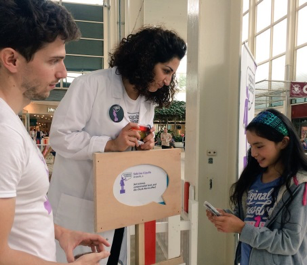
Soapbox Science speaker, Milton Keynes (UK), July 2018
In my second year, I was fascinated by the impact that our research can have on the wider community and I believe that inspiring children and young people is a key part of our work, so I became a volunteer STEM ambassador. I enjoyed going in to different schools and presenting my work to over 200 children in different interactive settings (presentations, lectures, and a Q&A in panel format). Kids were always very curious about recycling, climate change, and contaminations. They also asked a lot of questions about career choices and motivation/drivers to become a scientist. Then in 2017, I was delighted to be selected as a speaker for Soapbox Science Milton Keynes, which aims to promote female scientists by engaging with the public through interactive talks and engaging demonstrations.
I decided I wanted to add a more interactive dimension to my talk, so, in my spare time over the weekend I built props such as:
- Time-lapsed videos of experiments in the lab
- Miniature of remediation strategies
- 3D Molecular models of chemical molecules
- Models of Eco-toxicological tests
- Model of an in-vitro test to assess metal toxicity to humans
- Hands-on activity for kids which involves creating bacteria (from play doh) from pictures of real hydrocarbons degraders.
This year I have been awarded a grant funding to showcase research at Oxford Science Festival from the 12th – 22nd of October 2018 (come and see two Cranfield stands about fatbergs and bioremediation at the Town Hall Explorazone on Saturday 13 October). I also became a scientist pen-pal volunteer with Letters to a Pre-Scientist for the 2018-19 school year. I am very excited about this new opportunity to engage and inspire students of all races, ethnicities, and economic backgrounds to succeed in their science education.”
Sum up why your work is the best
“Because my work successfully enables a diverse audience (from kids to adults) to participate in research conversations, establishing relevance and building trust around complex topics. Hopefully I have inspired some children to be the next Elon Musk, Helen Sharman or Tim Peake.
I have always put a lot of energy and efforts in developing more than just my research. I believe that sometimes PhD students tend to focus only on their topic, forgetting how important networking and engaging with the wider community are.
I think communicating science is of great value both for developing skills in communication and public engagement and also having the chance to develop further creativity, and a sense of global perspectives.”
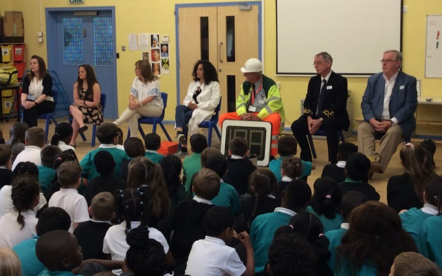
‘Meet the Experts’ at Brooksward School, Milton Keynes (UK), May 2018
“On the 17th July, I was awarded the 2018 Kroto Prize for Science Education of Young People. I want to express my most sincere gratitude to University of Sheffield for choosing me for this prize. I am looking forward to taking part in the researcher showcase on the 24th October.”
Note: Top photo of Sabrina presenting at STEM.

Categories & Tags:
Leave a comment on this post:
You might also like…

The V-conomy: powering the sixth wave of global economic growth
The world could be on the verge of a major surge in economic growth and development, driven by the convergence of AI and clean energy technology. Waiting to ride the K-wave The Russian ...

Get a head start on referencing and plagiarism
We offer a module on Referencing And Avoiding Plagiarism which you can find on your Canvas dashboard. It explains the role and importance of citing references and how to incorporate the work of other authors ...
How Cranfield shaped my journey as an Aerospace Engineer
If I'm being specific about the moment it clicked, it was reading a paper called "On the Role and Challenges of Computational Fluid Dynamics (CFD) in the Aerospace Industry" by two Boeing engineers, P. ...
Introducing Kings Norton Library
Welcome to all our new students! We are looking forward to meeting you soon. You will find Kings Norton Library in the centre of the Cranfield campus, and it is open 24/7 to all staff ...

Setting your research on the right course: Four questions every researcher should ask
Whether you are just beginning your doctoral journey or are already well into your research career, successful research rarely happens by accident. Like any successful mission, it depends on good planning, informed decisions, and getting ...

5 budgeting mistakes students make (and how to avoid them)
Good financial planning isn't about how much money you have. It's about the habits you build. We asked Dr Lakshmy Subramanian, Course Director for the Banking, Economics and Finance MSc, about the budgeting mistakes ...