


Bottleneck – our visit to Sinar Sosro
11/05/2016
TEA TEAM BLOG (Anne, Aleks, Robert)
Visit to Sinar Sosro makers of sweet tea, Indonesia’s most popular drink

Arrival
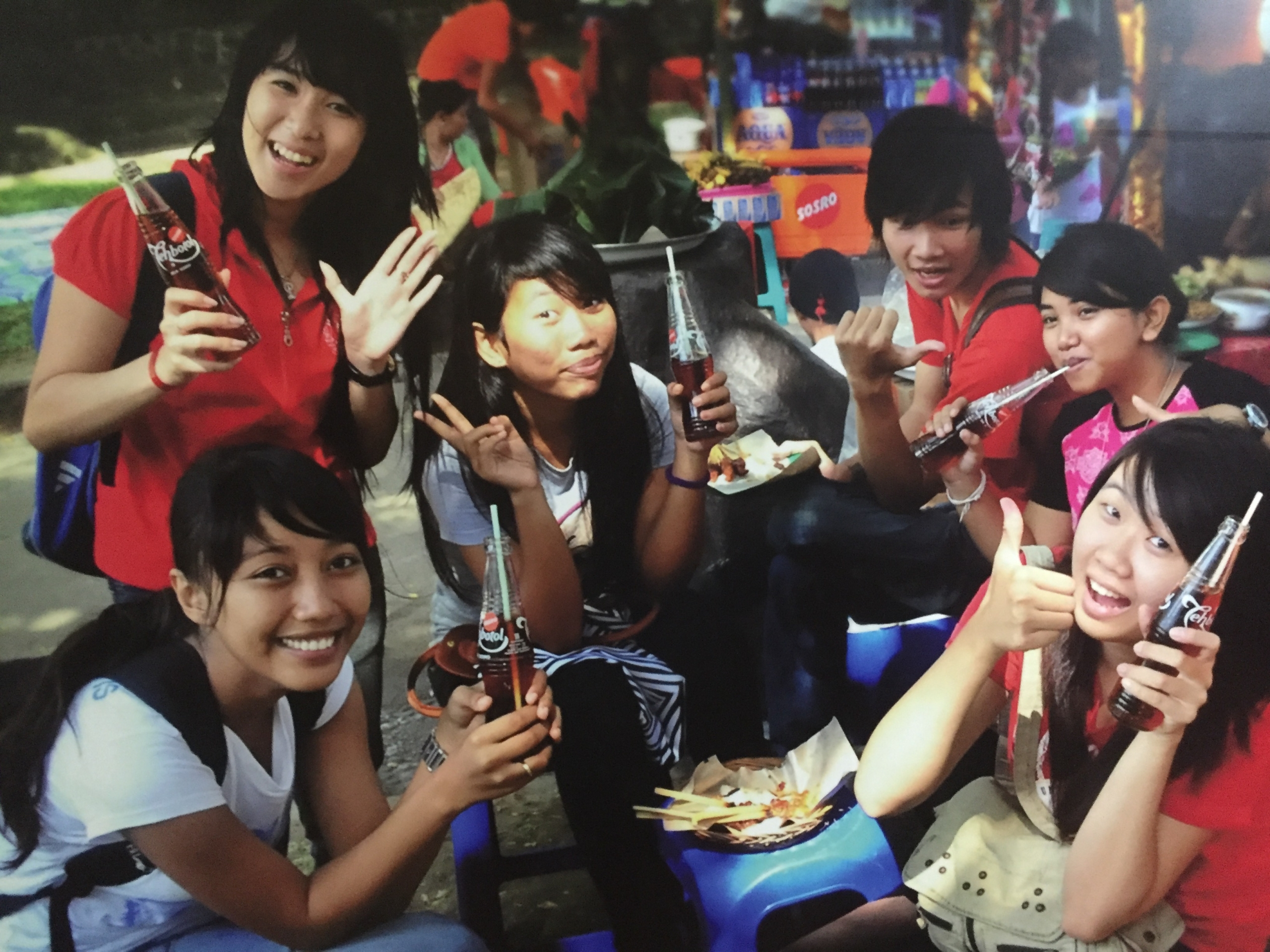
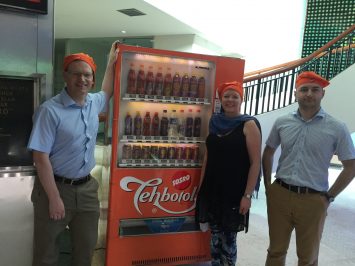
We got to the bottling plant and were welcomed with bottles of fruit tea. After a quick explanation of the history of tea (did you know top world consumers are Turkey and Ireland!) we went up to the main presentation room. Everyone was welcomed, Benny gave a speech, we got a Presentation of Sisar Sosro by Business Development Manager Agus Malyono. Also we watched a video about tea and all (7) plantations in Java. Then we saw an amazing video of tea packers, as Rob says “packing tea faster than a pheasants son picking pheasants till the pheasant’s picking’s done”.
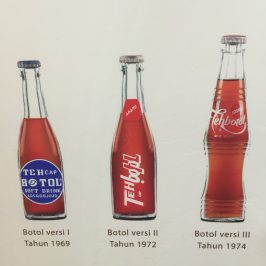
General facts about Sosro production
2.873 employees (82% women and 18% men)
10 factories
Average capacity of a bottling line 25000 / h, the best are doing 60000/ h,
Factory runs on three shifts, no work on Saturday and Sunday.
Inspired by the tea picking it was time to see the operation…
Inside Bottling Plant
We couldn’t take photos (besides this one) but it was really fascinating. The first thing you noticed was the heat. At first we thought this was just the ambient temperature, but it soon became apparent that you need very hot conditions to clean glass bottles and add hot tea. We sort of went the wrong way round, but started seeing the full plastic bottles packed in to cardboard boxes. Then it was on to the glass. Before getting to the plant we had taken guesses on the % of bottles that would be returned, guesses varied from 7 to  92%. As soon as we entered the glass area it was clear that Chris’ 7 % would not be the winning guess. We saw the bottles arrive, lined up on a conveyor built that sorted them through to rows of four. 12 of the rows were then pulled up by what looked like an extended version of a ten pin bowling machine and then transferred to another conveyor to be cleaned. The machine was really impressive, but there appeared to be only one, if there was a problem with the containers entering the system then you really were looking at a bottleneck in more ways than one. We walked on and saw the newly washed bottles traveling on to be filled with new freshly made, delicious (if a bit sweet) tea. The full bottles were very hot (bottled at a temperature of 98C), and contained further on, we guess to have a label and lids going on, but we didn’t see this, it was time to meet the fish!
Water cleaning
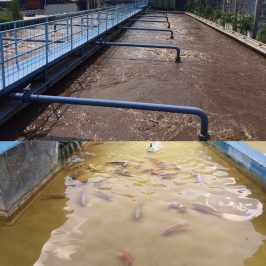
We left the bottling plant, passed a couple of very busy forklift trucks (2.5T Komatsu, Rob sadly observed) and soon found ourselves outsider in some ponds full of fish. Was this a beautiful park full of fish, for the staff to relax during their breaks? No, it was actually a fundamental part of the whole operational process as this was for cleaning up wash and spill water from the process. We saw a series of pools of water, with different levels of cleanliness, most contains a number of very long tailed fish. The “tails” turned out not to be tails…. However these were no ordinary pisceans, they were Goldfish and Koy and they operated like canaries looking for gas in a coal mine. Just as those poor birds would be sacrificed at the first smell of gas, in the same way a dead fish meant dirty water. This water is used for outdoor washing. Water for production comes from a well deep down and goes through a purifying and filtering process before going to finished products.
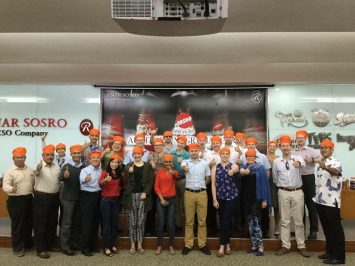
Questions and Answers
After the tour we were offered another drink (guess what!) and then it was time for the questions. Mr. Yuwono was very entertaining and informative and lead the answers. We learnt that the % of plastic bottles has risen from nearly nothing 10 years ago to approximately 30% now. We found out that 50% of trucks are owned by the company and we found out that drivers are paid for the level of deliveries and empties returned, but the key question was: what % of glass bottles are returned? The answer: 90-92%, the winner: Becky. After the emotion of the Q&A Benny and Denyse thanked our hosts, gave them a prestigious Cranfield Globe and then it was time for lunch.

Lunch
We had a delicious variety of Indonesian food, then it was time to pick up a present from our very generous hosts: a clock, a notebook, bottles of tea, boxes of tea and tins of tea – amazingly generous!
Then we went back to the bus and the most prestigious tea related event since the sinking in Boston harbor was over!
Greetings from our blogging Dream Team: Rob, Anne and Aleks

Categories & Tags:
Leave a comment on this post:
You might also like…

Moving to the UK to study? How to plan for banking, exchange rates and transfers
Currency and banking are two of the most practical parts of financial planning for international students. They are also often the most overlooked. We asked Dr Lakshmy Subramanian, Course Director for Cranfield University's Banking, ...
Cranfield: an environment where innovation thrives
The latest Knowledge Exchange Framework rankings from UK Research and Innovation (UKRI) gives an insight into the real and meaningful impact that UK universities have. The seven categories that make up KEF6 cover everything ...
How Cranfield accelerated my career in Logistics and Supply Chain Management
After graduating from the MSc in Logistics and Supply Chain Management at Cranfield University, I've been reflecting on the experiences that made my journey so valuable and the impact it has had on my ...
Mendeley: a powerful tool to organise and manage your references
Are you looking for a way to manage your references, create in-text citations and reference lists for your assignments or thesis? If so, you may wish to consider using Mendeley. What is it? Mendeley is ...
Keen to develop your study skills?
Alongside the technical skills and academic knowledge that you will gain on your course, as a Cranfield student you have the opportunity to develop a range of other skills that can enhance your learning experience. ...

The V-conomy: powering the sixth wave of global economic growth
The world could be on the verge of a major surge in economic growth and development, driven by the convergence of AI and clean energy technology. Waiting to ride the K-wave The Russian ...