


Personal time machine
18/04/2019

Angelisa Allen takes part in a research project into self-driving vehicles and starts imagining what she could do with the extra time they would create on her daily commute.
“What would I do with two extra two hours in my day?” It’s a good question and one that was posed to me by some schoolchildren I met last month at one of our outreach events to explain what my job involves.
As a working mum, fitting everything in is a mighty squeeze, but conjuring up an extra few hours in the day is something that even magical greats like Dynamo would struggle to pull out of the bag. Or is it?
Like most, I have a daily commute. It’s not hours, but I’m in my car for a good chunk of time each day so I can only imagine how I could put that precious time to a different use.
If I could step away from the steering wheel, so to speak, I could have a bit of ‘me’ time, that thing that rarely happens nowadays. I’d probably read a book (the last one’s just taken me many months) or I’d catch up on ‘life admin’.
But maybe, just maybe, my wish isn’t too far off. Self-drive vehicles are no longer things of the movies, they are a reality. I know this because I’m surrounded by great minds who are working to make them happen.
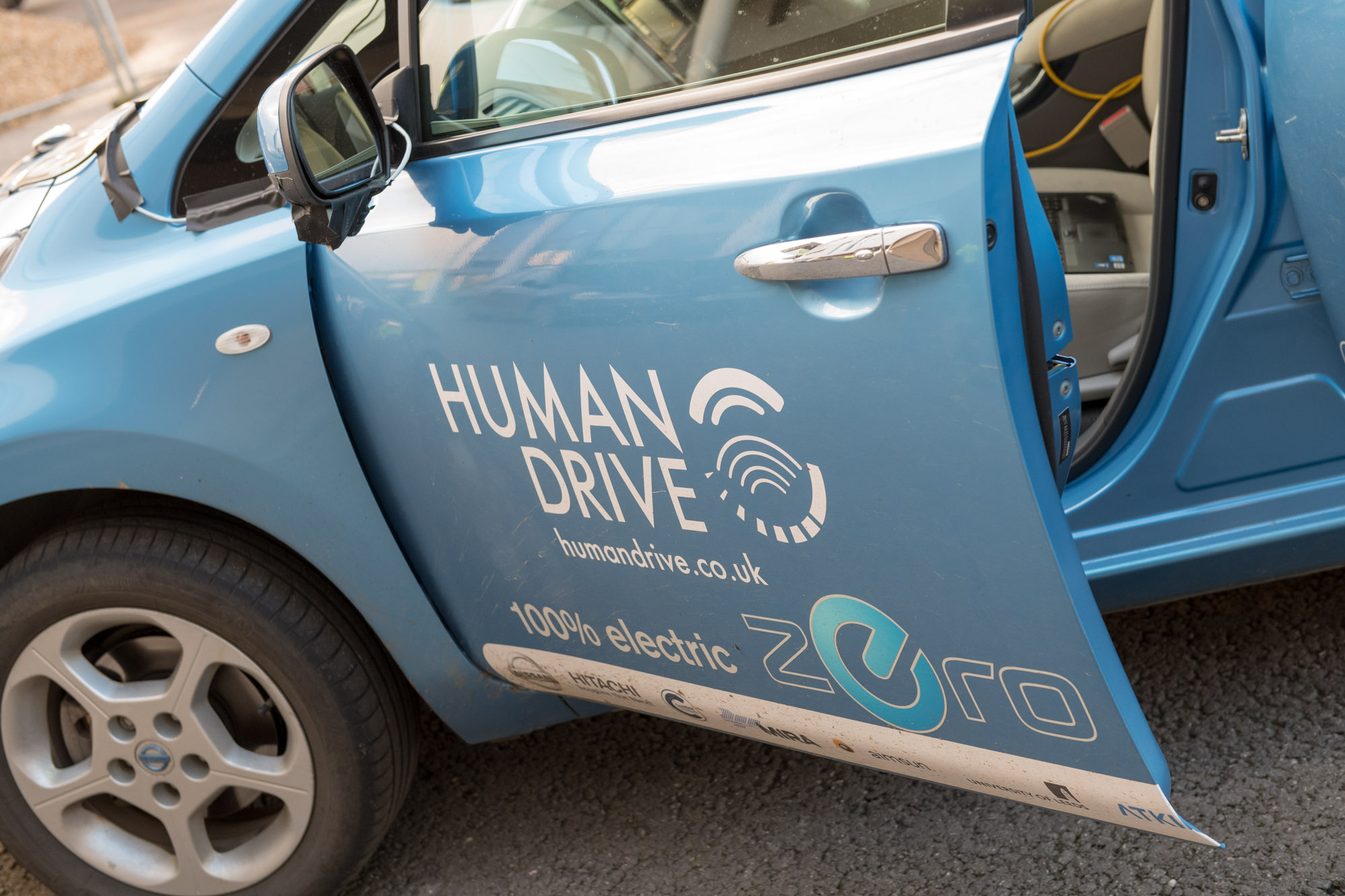
Just a few months ago, I sat in the driving seat of an automatic Nissan Leaf and, sporting a fetching pair of space-age, eye-tracking glasses, I found myself racking up the miles around the Bedfordshire countryside, a good few of which were along Cranfield’s MUEAVI road – a mile of ‘smart’ roadway packed with sensors and other bits of cool kit which can monitor and measure the performance of all types of conventional and autonomous vehicles. Its integration into the campus has essentially created a ‘living lab’ research environment.
As part of the internal communications team, I often promote opportunities for staff and students to participate in our research. This time I thought I’d give it a go, so I put myself forward for the first of many HumanDrive trials.
Having tried for the non-existent clutch a few times before I’d even started, I was relieved to know my actual driving was not being assessed. En route, I turned corners, approached roundabouts and passed other road users. My interaction with the car, eye movements and the vehicle’s performance were continually being tracked. All of this was helping the research team to understand how people behave when they drive, ultimately helping to inform the development of a vehicle that mimics human driver behaviour.
The team is set to unveil its autonomous driving machine informed, in part, by this research. Its inaugural 200-mile ‘grand drive’ across the UK in late 2019 is sure to make headlines as it mingles with mums on the school run, HGVs on highways, motorbikes, taxis and all other types of road users including, I’m sure, the odd tractor. When it finally ventures out, I’m in no doubt that there will be many smiles on the faces of both the developers and future users, me included.
While I’m not a researcher, to be given an opportunity to get involved and to know that I’ve helped, albeit in a small way, towards making this vehicle a reality is super-satisfying. It’s a bit like the old tale of the cleaner who worked at NASA who, when asked what he did, replied with: ‘I am helping put a man on the moon’.
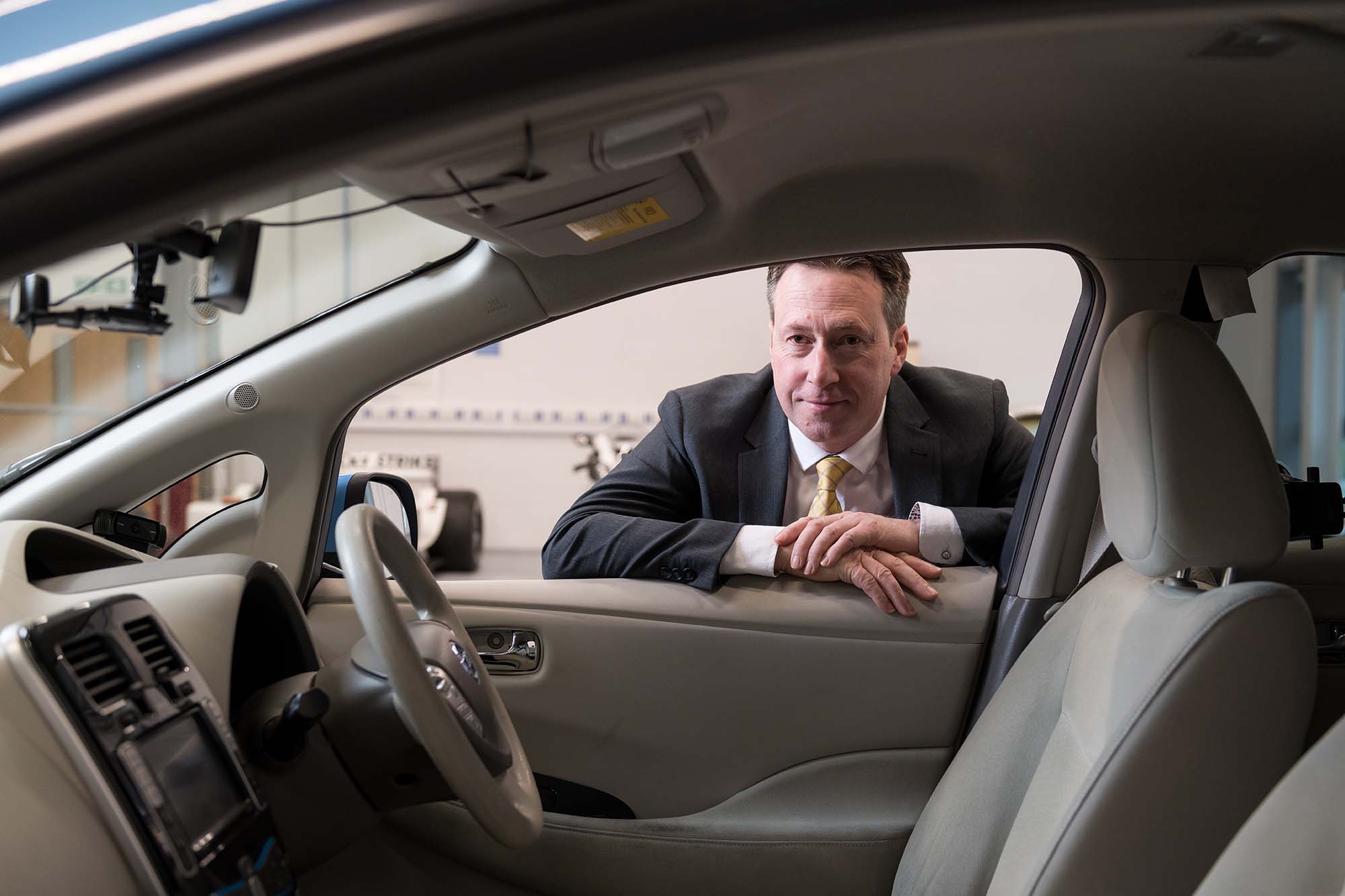
HumanDrive – the facts
- The 30-month, £14 million project, is part funded by the Centre for Connected and Autonomous Vehicles, via Innovate UK.
- Nissan’s European Technical Centre is leading the project.
- Making it happen are project partners: Hitachi, Cranfield (Professors James Brighton and Antonios Tsourdos), Aimsun Ltd, HORIBA-MIRA, University of Leeds, Atkins, Highways England, SBD Automotive Ltd, Transport Systems Catapult.
- The project will take the UK one step closer to having autonomous vehicles on the road, helping the UK Government to fulfil its ambition of seeing fully driverless cars on the road by 2021.
- One of the key innovative aspects of the project will be the development of an advanced vehicle control system, allowing the vehicle to emulate a natural human driving style using machine learning and developing an Artificial Intelligence to enhance the user comfort and experience.
- The ‘grand drive’ will be the most complex journey yet attempted across trhe UK on open roads without driver input. It is also being used to increase public awareness of, and confidence in, autonomous vehicles.
- £28 billion – that’s how much Transport Systems Catapult estimate the UK Connected and Autonomous Vehicles (CAV) market to be worth in 2035.
- By 2035, 1.1 million CAV jobs expected to be created in the UK and 32.2 million globally.
- Read more: www.humandrive.co.uk

Categories & Tags:
Leave a comment on this post:
You might also like…

Moving to the UK to study? How to plan for banking, exchange rates and transfers
Currency and banking are two of the most practical parts of financial planning for international students. They are also often the most overlooked. We asked Dr Lakshmy Subramanian, Course Director for Cranfield University's Banking, ...
Cranfield: an environment where innovation thrives
The latest Knowledge Exchange Framework rankings from UK Research and Innovation (UKRI) gives an insight into the real and meaningful impact that UK universities have. The seven categories that make up KEF6 cover everything ...

How Cranfield accelerated my career in Logistics and Supply Chain Management
After graduating from the MSc in Logistics and Supply Chain Management at Cranfield University, I've been reflecting on the experiences that made my journey so valuable and the impact it has had on my ...

Mendeley: a powerful tool to organise and manage your references
Are you looking for a way to manage your references, create in-text citations and reference lists for your assignments or thesis? If so, you may wish to consider using Mendeley. What is it? Mendeley is ...
Keen to develop your study skills?
Alongside the technical skills and academic knowledge that you will gain on your course, as a Cranfield student you have the opportunity to develop a range of other skills that can enhance your learning experience. ...
The V-conomy: powering the sixth wave of global economic growth
The world could be on the verge of a major surge in economic growth and development, driven by the convergence of AI and clean energy technology. Waiting to ride the K-wave The Russian ...