


Air Transport Management MSc alumnus Augustin Abbas on his time at Cranfield and his career at British Airways
07/06/2024

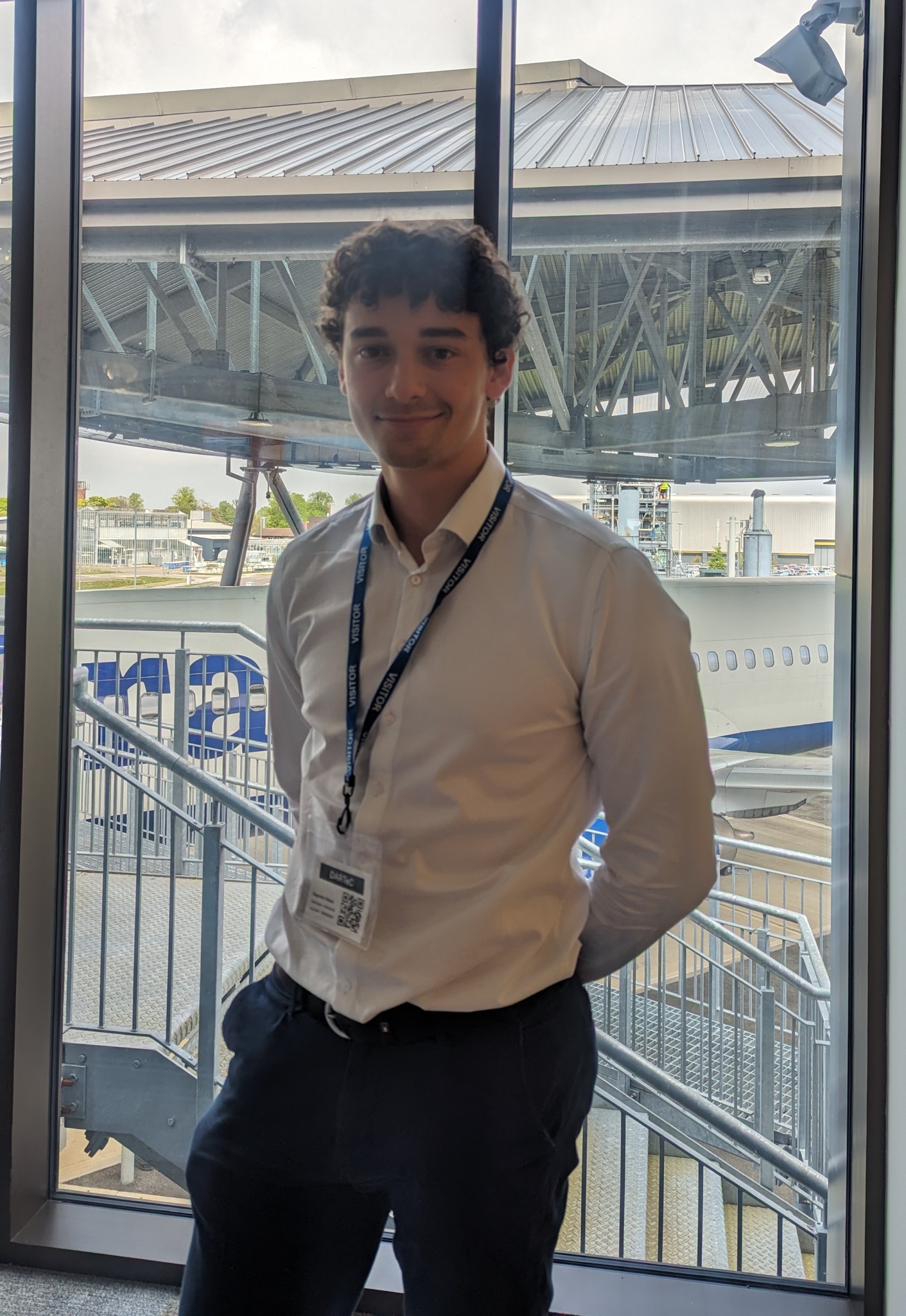
Augustin Abbas is a Fleet Planning Analyst at British Airways. He graduated from Cranfield University with an MSc in Air Transport Management in 2022. Here, Augustin talks about his life-long fascination with aviation, why he would recommend his course to others, and his career so far.
 What sparked your interest in the air transport industry?
I’ve always been fascinated by planes. During one of my first trips, my first long-haul flight when I was a child, I remember arriving at the airport and seeing these big planes and since then I’ve always been captivated. And I’ve always known that I wanted to work in this field, so everything has flowed quite logically for me. I didn’t have many doubts and it was quite easy for me to choose the air transport industry.
You came to Cranfield via our European Partnership Programme (EPP) – can you tell us more about the process?
I started my studies in France at an engineering school (ESTACA), studying aeronautical engineering. My course offered students in their last year the opportunity to move into a double degree and I chose to continue with the Air Transport Management MSc at Cranfield, which effectively counted for my last year in France. My institution has a partnership with Cranfield, so I just had to provide my application to my school, which then approved my application and sent it to Cranfield. It was a smooth and efficient process and I also benefitted from the reduced tuition fees, which was nice!
How did you find the Air Transport Management MSc course? What were the highlights?
I enjoyed the Air Transport Management MSc, and I would definitely recommend it. I think at Cranfield you receive a very high-quality education. The materials that are provided are excellent and the lecturers are very experienced. The buildings are very nice as well. Being in the right environment puts you in a good frame of mind to study and makes you want to perform well.
I think the course was particularly useful and relevant for me coming from an engineering background. Previously, I had always studied technical topics, essentially about how an aircraft flies as a machine. At Cranfield, I was able to learn how to make a business out of it – and all the new skills that come with that. It’s a new way of thinking when you come from a different background and it’s very valuable for your future career if you want to have a diverse profile.
Cranfield has great relationships with some of the top companies, so starting the course is already a first step into the industry.
In terms of highlights, I think the group project was definitely one. Having to complete a large amount of work in such a short amount of time was challenging, but I think we all learned a lot and deepened our skills in specific areas of the airline business.
Of course, I also made friends during the year and have some great memories – for example, we took a trip to Edinburgh, which was amazing.
What has been your career path since graduating?
It was pretty simple! I finished my master’s thesis in August 2022 and then took a short break, before I started to apply for jobs. Then I started my role as a Fleet Planning Analyst at British Airways in February 2023.
I don’t think I would have secured the job without coming to Cranfield. Firstly, because everything I learned during my MSc was very specific to that business and are skills that I use in my day-to-day job.
Cranfield has a very good relationship with British Airways, and they have a lot of trust in the students that come out of Cranfield.
My thesis was on a very current topic, which showcased my skills and helped to differentiate me. It contributed to making me a good fit for the profile that my manager was looking for at that time.
You currently work as a Fleet Planning Analyst at British Airways. Can you tell us more about your role?
In the short term, my role is to make sure we have enough aircraft to fly the network. With all the (often delayed) deliveries, and all the changes in aircraft downtime, maintenance and network requirements which happen on short notice, we constantly have to make changes to the plan to adjust the life of aircraft and manage their entry into service and retirement. We work closely with maintenance planning and finance for lease extensions and/or scrapping aircraft. We have a general picture of a fleet as a simple and fixed number but in reality, it is constantly changing and it can get tricky trying to keep up with all the movements. There are a whole range of different factors at play – it could be related to the crew, new routes that we need to provide aircraft for, or ongoing maintenance projects for a specific sub-fleet. It’s really about adjusting what we have in the fleet, what we need to take out of it and what we want to fly. We are a focal point ensuring that all the stakeholders work together effectively but also make the right tradeoffs when required.
In the long term, we think about the future of the fleet and network. We are largely involved in the process of choosing which aircraft we will need to have in the future to replace the ageing fleet and achieve our growth ambitions. This involves a lot of very wide-reaching, analytical projects, in which I work on data and models to support our decisions. As part of our role, we lead the work on identifying the need for new aircraft, designing the cabin size, or choosing the right aircraft options, for example.
What does a typical week look like for you?
We have regular weekly meetings, where we interact with a lot of different stakeholders, to help to inform our fleet plans. I also work on several projects which could be related to all sorts of different topics – for instance, we’re currently reviewing the future short-haul fleet and modelling the addition of aircraft that we don’t currently have. A good amount of my week is dedicated to more in-depth time to fix the fleet plans, work on the models, and also catching up with all my key stakeholders.
What would you say to someone who wants in the air transport industry?
I think it’s a very exciting area and a lot of people are very passionate about the air transport industry. If you have that passion, you will know it. I also don’t think you would be closing any doors by joining this industry as all profiles can find a place in it – whether your thing is engineering, finance, or law – anything is possible!
What do you think the future holds for the aviation industry?
I think the future of the aviation industry will be very exciting because of how much it needs to shift. In the coming years, we will see a general move towards more sustainable aviation and enter more of an “action” phase rather than a “thinking” or “planning” phase as has been the case for quite some years now. As we all know, aviation is one of the most difficult sectors to decarbonise. A lot of uncertainty still exists and seeing how everything develops and the results of that will be very exciting: new technologies, new infrastructure, new customer behaviours.
What else should we know about you?
I love spicy food!



Categories & Tags:
Leave a comment on this post:
You might also like…

Mendeley: a powerful tool to organise and manage your references
Are you looking for a way to manage your references, create in-text citations and reference lists for your assignments or thesis? If so, you may wish to consider using Mendeley. What is it? Mendeley is ...

Keen to develop your study skills?
Alongside the technical skills and academic knowledge that you will gain on your course, as a Cranfield student you have the opportunity to develop a range of other skills that can enhance your learning experience. ...

The V-conomy: powering the sixth wave of global economic growth
The world could be on the verge of a major surge in economic growth and development, driven by the convergence of AI and clean energy technology. Waiting to ride the K-wave The Russian ...

Need help using the Python programming language?
We know some of our students are currently trying to learn Python, so we wanted to make you aware of some great LinkedIn Learning videos that can help. But don't you have to pay for ...

What does it really take to become a Chevening Scholar?
Say “Turkmenistan” to most people and you’ll get a blank look. That was true when I left Ashgabat for the UK to study an MSc in Logistics and Supply Chain Management at Cranfield University ...

Get a head start on referencing and plagiarism
We offer a module on Referencing And Avoiding Plagiarism which you can find on your Canvas dashboard. It explains the role and importance of citing references and how to incorporate the work of other authors ...
Comments are closed.