


Why rising sea levels are a problem for today, not just tomorrow
02/11/2021
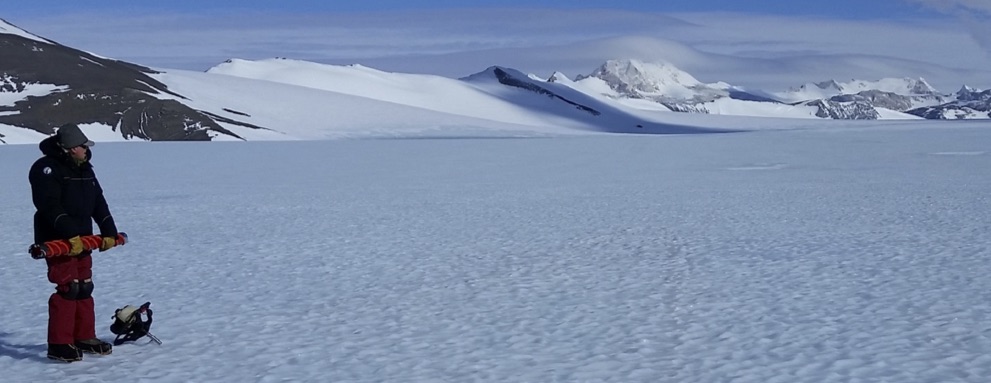
Much of my research has been carried out in the middle of the Antarctic or Greenland ice sheets. I’ve sat in a freezing tent studying the impact of climate change on sea levels – isolated thousands of miles away from where the serious consequences of rising waters are being seen and suffered by people in their everyday lives.
In terms of how we think about climate change, this image helps to illustrate the problem. Distance. Detachment. As scientists we identify and weigh up the relevant evidence and provide careful, peer-reviewed interpretations. But the data itself, no matter how alarming, can leave people feeling unmoved. Predictions around rising sea levels can look like tomorrow’s problem, something we just need to bear in mind as part of future scenarios.
Meanwhile, in a country like Bangladesh — with a population which has contributed far less, relatively-speaking, to CO2 emissions and global warming — the realities of climate change are with them every day. Sea water floods into fields used for agriculture. Flooding is threatening homes, livelihoods, food supplies and access to fresh water. There, climate change is not a sci-fi scenario but an imminent threat to people’s lives in the region.
Globally, this challenge is particularly acute across the Asia-Pacific region and its low-lying island communities, where millions of people are living within metres of the current sea level. Elsewhere there are many other low-lying coastal regions under threat – significant centres of population and national infrastructure, such as New York. It was this potential for international crisis that led me to develop new programmes, working with networks here in the UK and internationally, to develop better regional sea-level projections. And, perhaps more crucially, to also work with communities based in some of the areas that are on the frontline of sea level rise.
Over the past century, global mean sea level (GMSL) has risen by about 16 cm (i.e. an average rate of 1.6 mm per year). Recently this rate has increased to over 3 mm per year, an effective doubling of the rate, which has been largely due to a combination of thermal expansion (water volume grows in response to temperature increases) and the melting of glaciers world-wide.
There is, however, considerable uncertainty around these global projections, and worryingly, the situation may be worse than we think. Recent research has suggested that our current predictions may be significant underestimates of what’s happening. This is in a large part to due to our incomplete understanding of how the Earth’s ice sheets will respond to climate forcing, which is what much of my own research relates to. There are also many other factors that make predictions difficult: regional sea-level rise is highly variable due to the combination of climate, the vertical movement of land, variations in the Earth’s gravitational field (due to varying water distribution across the oceans), and the storage of water on land (affected by damming and hydrological changes), as well as changes in ocean circulation and shifting weather patterns. So despite marked advances in our understanding of the physical processes driving contemporary sea-level rise, there is always the potential for catastrophic surprises in the form of extreme regional sea-level rises. Robust adaptation plans are needed urgently.
At Cranfield, the School of Water, Energy and Environment (SWEE), is working on a host of projects aimed at helping nations to adapt to climate change, and, critically, to do it now. For example, that includes trials of crops that are tolerant to saline soil conditions. Work also involves making sure we understand the nature of particular impacts on people as individuals – human faces, not amorphous groupings of ‘unfortunate’ victims.
An excellent example here at Cranfield is the work of Silsoe Aid for Appropriate Development (SAFAD), which was founded in 1969 by Postgraduates at Silsoe and has gone on to continue to work with communities around the world. Another example is ‘Drowning World’, led by Professor Deirdre McKay from Keele University and myself, in collaboration with the University of Liberal Arts in Bangladesh. This project works with Bay of Bengal communities in low-lying coastal and island areas, including Monpura and Nijhum Dwip, where storm surges and saline intrusion have already been displacing people from their homes. Drowning World integrates the arts, science and social science approaches needed to see and understand the impacts of the climate crisis in a rounded way – and most importantly, what needs to be done to mitigate the problems and help communities to adapt. Our partner in Bangladesh, Dr Samiya Selim, has drawn together support from local artists and filmmakers to run arts workshops, arrange soil data collection and collect citizen science data tracking salinity in soils and ground water. All of this is helping to inform long-term planning and increase community engagement. The stories from community members living on the front line of climate change, the assembly of testimonials, pictures and video logs, are being turned into a striking, easily navigable, bilingual (Bangla/English) resources on the realities of living with sea-level rise in 2021.
While changing the whole nature of our relationship to the planet’s environment is the overall mission of COP26, it’s critical we aren’t distracted by grand principles and future schemes. Climate change has already happened, and work is needed now on mitigating the effects and helping people live with those problems today.

Categories & Tags:
Leave a comment on this post:
You might also like…

Moving to the UK to study? How to plan for banking, exchange rates and transfers
Currency and banking are two of the most practical parts of financial planning for international students. They are also often the most overlooked. We asked Dr Lakshmy Subramanian, Course Director for Cranfield University's Banking, ...
Cranfield: an environment where innovation thrives
The latest Knowledge Exchange Framework rankings from UK Research and Innovation (UKRI) gives an insight into the real and meaningful impact that UK universities have. The seven categories that make up KEF6 cover everything ...
How Cranfield accelerated my career in Logistics and Supply Chain Management
After graduating from the MSc in Logistics and Supply Chain Management at Cranfield University, I've been reflecting on the experiences that made my journey so valuable and the impact it has had on my ...
Mendeley: a powerful tool to organise and manage your references
Are you looking for a way to manage your references, create in-text citations and reference lists for your assignments or thesis? If so, you may wish to consider using Mendeley. What is it? Mendeley is ...
Keen to develop your study skills?
Alongside the technical skills and academic knowledge that you will gain on your course, as a Cranfield student you have the opportunity to develop a range of other skills that can enhance your learning experience. ...
The V-conomy: powering the sixth wave of global economic growth
The world could be on the verge of a major surge in economic growth and development, driven by the convergence of AI and clean energy technology. Waiting to ride the K-wave The Russian ...