


How do I reference… a conference paper in the APA7 style?
29/08/2023

Many of you will be using conference papers in your work. Some of these will also have been published as articles in the traditional way – but others are not. So, how do you go about referencing a conference paper in your work?
First of all, you need to collect together the following ‘elements’ to build your reference:
- Author or authors – in the format Surname, Initials.
- Date(s) of conference in full – in the format (Year, Month Day(s)).
- Title of conference paper [followed by type of paper],
- Title of conference, Location of conference.
- URL or DOI (if available online)
Each element of the reference needs to be separated from the next by a full-stop and a space.
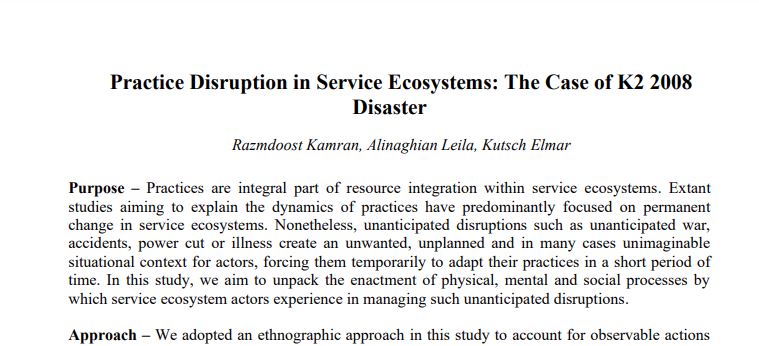
Conference paper image taken from https://naplesforumonservice.com/wp-content/uploads/2021/09/Razmdoost.pdf
So, if we were using this conference paper in an assignment or an article, its bibliographic reference would look like this:
Razmdoost, K., Alinaghian, L. & Kutsch, E. (2021, September 6-9). Practice disruption in service ecosystems: the case of K2 2008 disaster [Conference paper]. 7th Naples forum on service, Naples, Italy.
Remember that APA7 references should all be formatted with a hanging indent.
Your in-text citations (where you refer to the work within your own text) would simply include the authors’ surnames and the year of publication so they would be…
Razmdoost, Alinaghian & Kutsch (2021) or, where you were quoting directly, Razmdoost, Alinaghian & Kutsch (2021, p3).
Any questions about referencing? Consult our Referencing and Plagiarism pages or drop us an email here.
Please note: Cranfield supports two different referencing styles – APA7 (Author-date) and Numbered (NLM). Please make sure you use the style preferred by your supervisor or lecturer. The advice above relates only to the APA7 style. If you have any questions about referencing, please contact the Library.
Feature image from Pixabay. Available at: https://cdn.pixabay.com/photo/2016/06/01/06/26/open-book-1428428_960_720.jpg

Categories & Tags:
Leave a comment on this post:
You might also like…

Mendeley: a powerful tool to organise and manage your references
Are you looking for a way to manage your references, create in-text citations and reference lists for your assignments or thesis? If so, you may wish to consider using Mendeley. What is it? Mendeley is ...

Keen to develop your study skills?
Alongside the technical skills and academic knowledge that you will gain on your course, as a Cranfield student you have the opportunity to develop a range of other skills that can enhance your learning experience. ...
The V-conomy: powering the sixth wave of global economic growth
The world could be on the verge of a major surge in economic growth and development, driven by the convergence of AI and clean energy technology. Waiting to ride the K-wave The Russian ...

Need help using the Python programming language?
We know some of our students are currently trying to learn Python, so we wanted to make you aware of some great LinkedIn Learning videos that can help. But don't you have to pay for ...

What does it really take to become a Chevening Scholar?
Say “Turkmenistan” to most people and you’ll get a blank look. That was true when I left Ashgabat for the UK to study an MSc in Logistics and Supply Chain Management at Cranfield University ...

Get a head start on referencing and plagiarism
We offer a module on Referencing And Avoiding Plagiarism which you can find on your Canvas dashboard. It explains the role and importance of citing references and how to incorporate the work of other authors ...