


How do I reference financial data… in the APA7 style?
08/09/2022

We all know how to cite and reference from books, journals, the internet and even blog posts, but what about financials? Just like information from other sources, data retrieved from a specialist finance resource should be acknowledged in the same way.
The format for referencing financials in APA7 style – whether a set of financial data, accounting or financial dataset – is essentially the same.
Here’s what you need to include in your reference:
- Author or authorising organisation.
- (Date of publication include day and month if available).
- Title or section of report OR Title of data extract in italics. Follow this with a description of the work in square brackets, e.g. [Financial Data].
- Platform or website where the materials are located.
- URL – include a URL if the materials are available online (only include if the material has come from a platform that will be available to the reader of your work) – or Retrieved Month, Date, from database/source name.
And how your references should look:
Bloomberg L.P. (2017). Tesco PLC daily share price (2011-2016) [Financial Data]. Retrieved March 2, 2017, from Bloomberg terminal.
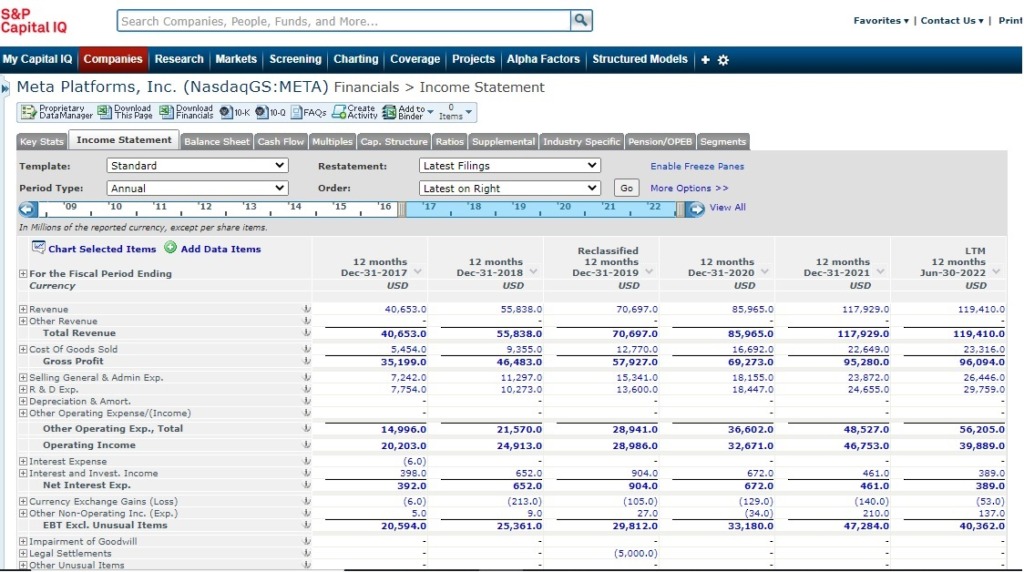
S&P Capital IQ (2022). Meta Platforms, Inc. annual income statement 2017 to 2022 [Financial Data]. Retrieved August 11, 2022, from S&P Capital IQ platform.
What about your in-text citations?
Where you make reference to these in your text, follow the normal ‘name and date’ conventions and simply follow any mention with (Bloomberg, 2017) or (S&P Capital IQ, 2022) or a variation thereon.
Any questions?
As always, if you have any questions about referencing, please contact the Library.
Please note: Cranfield supports two different referencing styles – APA7 (Author-date) and Numbered (NLM). Please make sure you use the style preferred by your supervisor or lecturer. The advice above relates only to the APA7 style. If you have any questions about referencing, please contact the Library.
Feature image from Pixabay. Available at: https://pixabay.com/photos/business-stock-finance-market-1730089/

Categories & Tags:
Leave a comment on this post:
You might also like…

Moving to the UK to study? How to plan for banking, exchange rates and transfers
Currency and banking are two of the most practical parts of financial planning for international students. They are also often the most overlooked. We asked Dr Lakshmy Subramanian, Course Director for Cranfield University's Banking, ...

Cranfield: an environment where innovation thrives
The latest Knowledge Exchange Framework rankings from UK Research and Innovation (UKRI) gives an insight into the real and meaningful impact that UK universities have. The seven categories that make up KEF6 cover everything ...

How Cranfield accelerated my career in Logistics and Supply Chain Management
After graduating from the MSc in Logistics and Supply Chain Management at Cranfield University, I've been reflecting on the experiences that made my journey so valuable and the impact it has had on my ...

Mendeley: a powerful tool to organise and manage your references
Are you looking for a way to manage your references, create in-text citations and reference lists for your assignments or thesis? If so, you may wish to consider using Mendeley. What is it? Mendeley is ...

Keen to develop your study skills?
Alongside the technical skills and academic knowledge that you will gain on your course, as a Cranfield student you have the opportunity to develop a range of other skills that can enhance your learning experience. ...

The V-conomy: powering the sixth wave of global economic growth
The world could be on the verge of a major surge in economic growth and development, driven by the convergence of AI and clean energy technology. Waiting to ride the K-wave The Russian ...