


Digitising the Cranfield University Photo Archive
30/06/2022
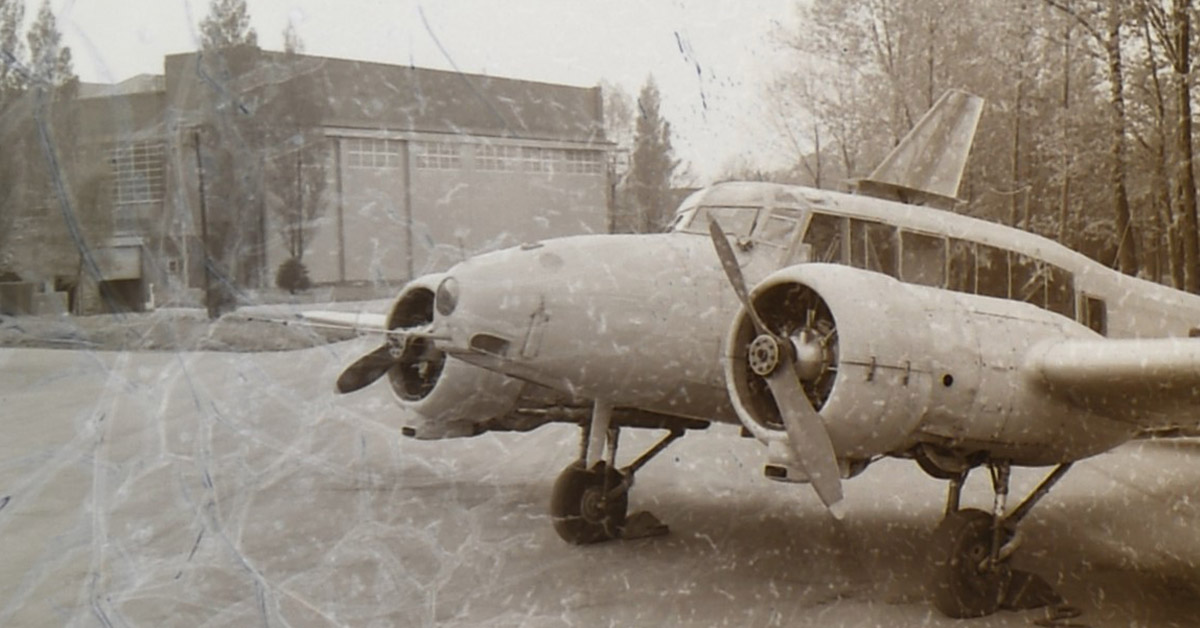
We are delighted to announce that we have been awarded a scoping grant to help us digitise more of our Photographic Archive and make the images available online.
The grant has been provided by Archives Revealed, a partnership programme between The National Archives, The Pilgrim Trust and the Wolfson Foundation, and is the only funding stream in the UK dedicated to cataloguing and unlocking archives.
As the UK’s first College of Aeronautics, which opened in 1946, Cranfield has carried out ground-breaking research and teaching for over seven decades. The output of the Photographic Unit comprised nearly 100,000 negatives, covering the period from 1957 to 2000. It captured Cranfield’s research and teaching facilities and equipment, events, royal visits and Honorary Graduations such as those of Sir Frank Whittle, Freddie Laker and Neil Armstrong. The collection also contains unique photographs of rare aircraft based at Cranfield. These were used either for teaching or exhibited in the air museum the College curated in the 1950s.
Due to access to our airport, the Unit was also in the enviable position of being able to charter aeroplanes to document changes to the local landscape from the air. Importantly, these photographs document the development and evolution of Milton Keynes, Bedford, Welwyn Garden City, Silsoe village, incorporating views of Flitwick Manor and Shuttleworth House.
With the help of Caroline Barrass, the University’s Head of Trust and Foundation Fundraising, in 2020 we were successful in receiving a donation from a local charitable foundation to digitise the first (and oldest) 20,000 negatives. We have shared a selection of these online via #CranfieldPhotoArchive on Twitter and Instagram and will continue to do so.
It has been an absolute joy to unlock the collection and finally see images that have been lost for the last 65 years. However, further funding has proved difficult to attract and so we applied to the Archives Revealed programme to help us access the expert advice we need to maximise the collection’s impact, enable further digitisation to take place, and then publish the images in an online database.
It is a unique collection, of both educational and informational value, which is not only of importance to Cranfield but has extensive national and international significance to the aviation sector. We can’t wait to be able to share more images with you and find out more about the stories behind them!

Categories & Tags:
Leave a comment on this post:
You might also like…
Building more than research: Reflections from the ECRn Symposium 2026
There’s something quietly powerful about a room full of early career researchers. Not just the ideas, although there were plenty of those—but the conversations, the curiosity, and the sense that everyone is figuring things ...
Library services over Easter, 3-6 April
Kings Norton Library will remain open for study 24/7. You will need your University ID card to enter the building and can use the self-service machines to borrow and return items as usual. Barrington Library ...

How do I access the full-text of Harvard Business Review (HBR)?
This is a frequently asked question, and it's worth knowing how to access this key management journal. So, how do you access HBR in full-text? The short answer is via our eJournals finder. You can find ...

Engineering problem to solve? Let Knovel help you find a solution
Did you know that Knovel provides you with more than just eBooks? Knovel is a key database for many engineering, mechanical and materials courses here at Cranfield University, and contains content from an extensive range ...
What happens when female scholars meet influential leaders?
On the 5 March 2026, our British Council Women in STEM Scholars had the privilege of sitting down with two excellent role models of industry and academia: Professor Dame Karen Holford, ...
From MSc to CEO: Igniting a research revolution
For many, a master’s degree is achieving a big milestone. Kilyan Ocampo, Computational Fluid Dynamics alumni shares how studying at Cranfield helped launch his career in the energy sector. Today, Kilyan ...