

From mechanical engineering to management mastery: My Cranfield journey
28/01/2025
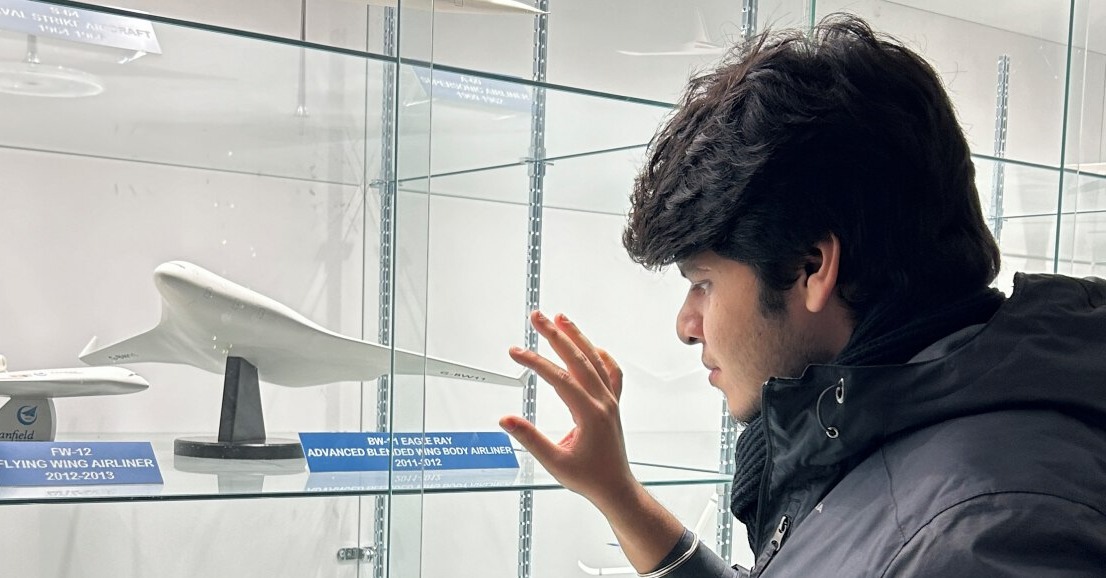
Hi my name is Pravesh-Saaye Amourdalingam. My journey as a student on the Engineering and Management of Manufacturing Systems MSc programme at Cranfield University, graduating in 2024, has been nothing short of transformative. Navigating life between India, France, and the UK while pursuing my studies has added another layer of richness to this experience.
Why Cranfield? The perfect blend
Cranfield stood out as a beacon, one of the few institutions offering a course that seamlessly blends engineering principles with essential management strategies. After completing my undergraduate studies in mechanical engineering, I knew I wanted more than just technical expertise. I yearned to move into leadership roles within the automotive industry. This course offered precisely that: a perfect balance, allowing me to retain my technical foundation while gaining invaluable insights into leadership and management.
Furthermore, the genuine and compelling feedback I received from Cranfield School of Management (SOM) alumni, some of whom are close friends, played a crucial role in my decision. Their stories, filled with opportunities, practical learning, and real-world insights, solidified my choice, and ignited my excitement.
The course experience: More than just theory
My search for the perfect blend of engineering and management led me to research universities across the globe – Australia, the US, Europe, and the UK. Cranfield’s curriculum emerged as the most well-structured and relevant for someone aspiring to leadership in engineering-driven industries.
One of the most striking features of this course is its unwavering commitment to practical application. This isn’t just about dry theory; it’s about preparing you for the real-world challenges of managing a facility, leading a team, or solving complex industrial problems. The methodologies and insights gained from the modules transcend textbooks, making the learning both challenging and incredibly rewarding.
A day in the life: Intense but rewarding
A typical day at Cranfield is intense, starting around 8:30 am and often stretching until 5:30 pm. We dived deep into highly practical modules that challenged us to analyse diverse scenarios and challenges encountered in real-world facilities. This immersive approach pushed us to think critically and strategically. The demanding schedule was balanced by “off-weeks,” essential periods for reflection, assessment work, and much-needed recharging. These breaks allowed us to consolidate the intense learning from the previous week.
Life after Cranfield: Driven by ambition
I’m currently actively pursuing roles such as Trainee, Assistant Manager, or Team Lead. My ultimate goal? To leverage everything I’ve learned at Cranfield to climb the ranks and become a Head of Administration at a leading automotive company, with BMW being my dream employer. Cranfield has instilled in me the skills and confidence to not only believe this aspiration is achievable, but to feel it is inevitable.
Cranfield: A second home and a springboard
Studying in the UK, particularly at Cranfield, has been an incredible experience. The university’s proximity to London offers easy access to a global hub, while the campus itself fosters a close-knit, supportive community. The academic rigour is perfectly balanced by the strong practical focus of the courses, a combination I’ve found invaluable.
The faculty at Cranfield goes beyond theoretical instruction, presenting each module through the lens of real industry needs. While some modules push you to your limits – resulting in the occasional sleepless night – the outcomes are transformative. This challenging environment has trained me to think critically and manage stress effectively.
Cranfield’s recreational amenities, including the gym and sports facilities, provide a much-needed outlet during intense study periods. The Kings Norton Library has become my second home, especially during my Individual Research Project (IRP), where the librarians have been invaluable in helping me find key journals and references.
Advice for future leaders
For anyone considering a similar career path, my advice is simple: The first step is always the hardest, but once you take it, the journey becomes smoother. Perseverance is key. Stay determined, practice your craft relentlessly, and when the right opportunity presents itself, seize it with precision. Success isn’t about luck; it’s about timing and preparation.
A fun fact: Inspiring the next generation
One fun fact about my time at Cranfield: I can already envision myself giving motivational talks to my juniors at my alma mater, sharing my experiences and lessons learned. This journey has been so transformative that I’m eager to pass on what I’ve gained.



Categories & Tags:
Leave a comment on this post:
You might also like…

Moving to the UK to study? How to plan for banking, exchange rates and transfers
Currency and banking are two of the most practical parts of financial planning for international students. They are also often the most overlooked. We asked Dr Lakshmy Subramanian, Course Director for Cranfield University's Banking, ...

Cranfield: an environment where innovation thrives
The latest Knowledge Exchange Framework rankings from UK Research and Innovation (UKRI) gives an insight into the real and meaningful impact that UK universities have. The seven categories that make up KEF6 cover everything ...
How Cranfield accelerated my career in Logistics and Supply Chain Management
After graduating from the MSc in Logistics and Supply Chain Management at Cranfield University, I've been reflecting on the experiences that made my journey so valuable and the impact it has had on my ...

Mendeley: a powerful tool to organise and manage your references
Are you looking for a way to manage your references, create in-text citations and reference lists for your assignments or thesis? If so, you may wish to consider using Mendeley. What is it? Mendeley is ...

Keen to develop your study skills?
Alongside the technical skills and academic knowledge that you will gain on your course, as a Cranfield student you have the opportunity to develop a range of other skills that can enhance your learning experience. ...

The V-conomy: powering the sixth wave of global economic growth
The world could be on the verge of a major surge in economic growth and development, driven by the convergence of AI and clean energy technology. Waiting to ride the K-wave The Russian ...
Comments are closed.