

Defying expectations: Michelle’s MSc journey
24/06/2022
Defying expectations: Michelle’s MSc journey
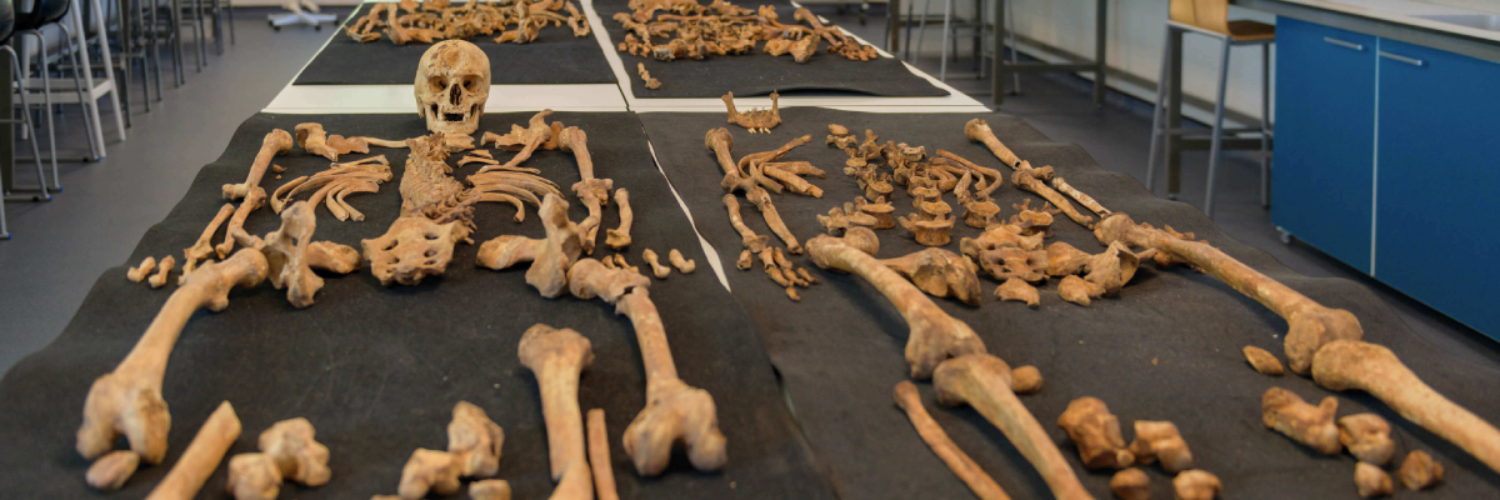
“I’ve always been really passionate about forensics,” remembers Cranfield scholarship student Michelle Holt. “When I was younger, I remember being stuck inside because of the weather, finding CSI on the TV and getting hooked on it. I always knew it was completely fictionalised, but something about it really interested me, and I wanted to know more.”
After studying cultural anthropology in her home state of Virginia, USA, Michelle was keen to pursue further educational opportunities abroad.
“I went on a bio-archaeological dig in Greece one summer,” she said. “We were excavating, recovering, cataloguing, and preserving neonatal remains. It was fascinating.
“When I came back, I worked for a while until the Covid-19 lockdown inspired me to look for study abroad programmes in forensics.
“I liked the fact the Cranfield course covered both forensic archaeology and forensic anthropology, was internationally-accredited, and was a one-year, intensive programme.”
Michelle was awarded a Cranfield forensics scholarship, and started her course in October 2021.
She said: “It’s been so much fun so far. I’ve met some amazing people and made some really good friends. Cranfield has got that quiet, picturesque, country-feel to it, but you’re close enough to everything you need. I wouldn’t hate it if the programme was longer, or some of the modules more in depth, but I also really like the fact we have time for independent study. All the module leaders and lecturers are really friendly. There’s a great camaraderie; you’re not treated as a student – you’re treated as an equal, even if you don’t have their expertise. You’re not talked down to at all, which I love.”
Coming to Cranfield to study forensics was a huge step for Michelle, as it meant overcoming opposition and defying the expectations of many people in her wider circle back home.
“I come from Danville, Virginia, which has the nickname the City of Churches” she explained. “Growing up in a small southern conservative town, whenever I would talk about working in crime investigation or dealing with dead bodies, people would turn their nose up at it and give me odd looks.
“For a lot of the older conservative Christians in my hometown, a woman’s place is either at home or in something like secretarial work or teaching, so this goes outside the norm of what is considered acceptable.
“But I’ve always known that I wanted to continue my schooling. My parents are avid learners and encouraged my passion for education. It’s an integral part of who I am and my escape from things.
“I’ve always had to justify why I want to do what I want to do – I think it’s always going to be something I’m going to have to justify – but, at the same time, if it’s what I’m passionate about then you can say all you want to about it but it’s not going to discourage me.”
After completing her studies, Michelle hopes to gain some work experience before pursuing a PhD in the UK or Europe to further broaden her cultural horizons.
As for an eventual career goal, she says: “I’d like to start off working with the police, but my ultimate goal would be to work with the United Nations, as a forensic anthropologist in the International Criminal Court. I want to be the person that the families of war crimes victims can go to to get answers to their questions, and to help them get closure. To me, that would be a really worthwhile career.”

Categories & Tags:
Leave a comment on this post:
You might also like…

Keen to develop your study skills?
Alongside the technical skills and academic knowledge that you will gain on your course, as a Cranfield student you have the opportunity to develop a range of other skills that can enhance your learning experience. ...

The V-conomy: powering the sixth wave of global economic growth
The world could be on the verge of a major surge in economic growth and development, driven by the convergence of AI and clean energy technology. Waiting to ride the K-wave The Russian ...

Need help using the Python programming language?
We know some of our students are currently trying to learn Python, so we wanted to make you aware of some great LinkedIn Learning videos that can help. But don't you have to pay for ...
What does it really take to become a Chevening Scholar?
Say “Turkmenistan” to most people and you’ll get a blank look. That was true when I left Ashgabat for the UK to study an MSc in Logistics and Supply Chain Management at Cranfield University ...

Get a head start on referencing and plagiarism
We offer a module on Referencing And Avoiding Plagiarism which you can find on your Canvas dashboard. It explains the role and importance of citing references and how to incorporate the work of other authors ...

How Cranfield shaped my journey as an Aerospace Engineer
If I'm being specific about the moment it clicked, it was reading a paper called "On the Role and Challenges of Computational Fluid Dynamics (CFD) in the Aerospace Industry" by two Boeing engineers, P. ...
Comments are closed.