

PhD researcher at the IF Oxford Science and Ideas Festival
16/04/2024
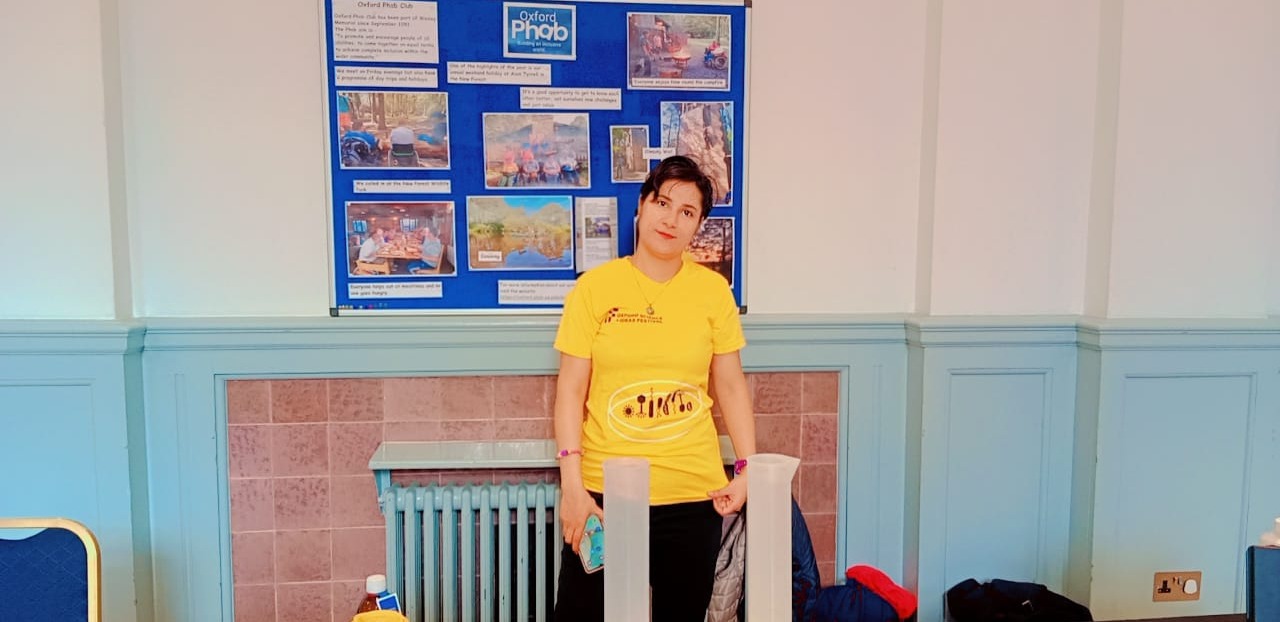
IF Oxford is a science and ideas Festival packed with inspiring, entertaining and immersive events for people all ages. PhD researcher, Zahra attended the festival. Here she shares what motivated her to get involved.
I am thoroughly interested in social communication, as it plays a vital role in fostering connections, understanding diverse perspectives, and building meaningful relationships in today’s interconnected world.
Since this social event spanning technology, art, and science not only entertains but also encourages children and their families to embark on a journey of discovery, igniting curiosity and imagination, I was really interested in being one of the team members. It was a new and interesting experience for me.
Were there any stand-out moments for you?
I found great satisfaction in elucidating experiments to audiences of varying age groups. Particularly engaging were the interactions with younger children, although simplifying explanations presented a challenge. Yet, witnessing their enthusiasm for these novel concepts was immensely rewarding.
In essence, we played a pivotal role in the overarching event, fostering a welcoming and educational atmosphere where both children and families could interact with researchers and creative professionals, experiencing captivating experiments first-hand.
Did your activity relate to your PhD, in what way?
Engaging in conversations and simplifying the explanation of my research project has proven invaluable to my research journey. Additionally, our diverse array of experiments catered to audiences of all ages. It reaffirmed the importance of effective science communication in inspiring curiosity and promoting lifelong learning, driving my passion for engaging with diverse audiences on complex topics in accessible ways.
Do you have any advice to others thinking of participating in outreach activities?
This initiative cultivates social connections by offering a platform for researchers to share their scientific knowledge and ideas with the public. Moreover, it proved to be an enjoyable experience for us, serving as an interactive forum where children could freely question experts, engage in entertaining activities, and explore exciting new experiments.

Categories & Tags:
Leave a comment on this post:
You might also like…

Mendeley: a powerful tool to organise and manage your references
Are you looking for a way to manage your references, create in-text citations and reference lists for your assignments or thesis? If so, you may wish to consider using Mendeley. What is it? Mendeley is ...

Keen to develop your study skills?
Alongside the technical skills and academic knowledge that you will gain on your course, as a Cranfield student you have the opportunity to develop a range of other skills that can enhance your learning experience. ...

The V-conomy: powering the sixth wave of global economic growth
The world could be on the verge of a major surge in economic growth and development, driven by the convergence of AI and clean energy technology. Waiting to ride the K-wave The Russian ...

Need help using the Python programming language?
We know some of our students are currently trying to learn Python, so we wanted to make you aware of some great LinkedIn Learning videos that can help. But don't you have to pay for ...

What does it really take to become a Chevening Scholar?
Say “Turkmenistan” to most people and you’ll get a blank look. That was true when I left Ashgabat for the UK to study an MSc in Logistics and Supply Chain Management at Cranfield University ...

Get a head start on referencing and plagiarism
We offer a module on Referencing And Avoiding Plagiarism which you can find on your Canvas dashboard. It explains the role and importance of citing references and how to incorporate the work of other authors ...