

My Cranfield journey: Choosing a research project for my forensics career
11/06/2021
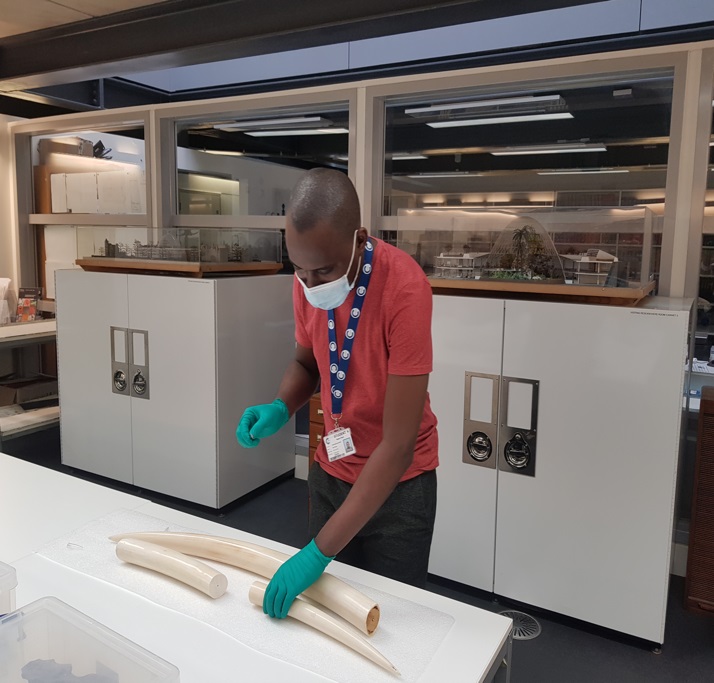
To potentially grow in your career requires sacrifices which impact everyday normal life. In my opinion, it is even harder to climb the ladder whilst developing your knowledge in your current career.
However, with the prior aspirations of becoming a competent and knowledgeable scientist, Yes, you need to take a step toward your desires. The moment to begin an MSc has also been not so accommodative, particularly with the global pandemic. But since I wanted to enrich my career and become a well-informed forensic scientist acquiring skills on diversity of forensic approaches, I therefore had to leave my home country of Tanzania in September 2020 in search of making sure I got what I had been looking for.
My story regarding my desire to study Forensic Archaeology and Anthropology can be traced back to 2018 where I was employed at the Government Chemist Laboratory Authority in Tanzania, working as a Forensic DNA Analyst in the Directorate of Forensic science. Working with DNA analysis requires solid knowledge on the legal requirements such as courtroom skills and various forensic approaches. This is because, most forensic DNA cases end up in court. I was mainly interested in bone analysis which is a challenge in my day job in Tanzania. From my undergraduate degree, I had a good background in molecular biology and technology; nevertheless, there is a demand for highly skilled bone analysis. I had to search via google, universities offering forensic anthropology, of which an enormous number of universities came up, Cranfield was also included.
Having seen various adverts from universities, I was attracted to Cranfield University as it looked like it included more hands-on practical’s which I wanted in an MSc and complemented my desire. I was attracted to the course content as it was directly related to my current job. When I officially started attending class (virtually) I was even more excited, the module delivery was very friendly and accommodating, above all it was engaging.
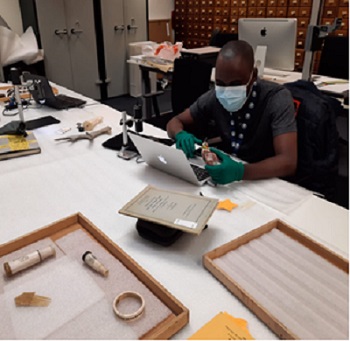
The time to select a research project title was due, I initially wanted to deal with optimization of different DNA extraction methods on skeletal remains. However, with the global pandemic restrictions, ethical approval could pose a challenge. So, just a few days before we had an analytical technique module under Dr. Fiona Brock, which quenched my thirst. In that module, one of the guest lecturers Dr. Ashley Coutu from Oxford University delivered a fantastic analytical technique (Proteomic Analysis), she actually looked at the different peptide masses between elephant and hippopotamus ivories, which in fact was also my point of interest. I therefore opted to do Proteomic analysis of Tanzanian wildlife, the project which is in progress now.
Later I came to realize, it was more fruitful in my career doing proteomic analysis than what I wanted to do, as it has some of the critical stages that I wanted to do with DNA analysis. Apart from my course experience, I’m also enjoying the off-campus life in Bedford, the place is friendly with easy access to local amenities, whilst being immersed in different cultures. I look forward to accomplishing my research project and going back home to utilize the skills learnt from highly skilled lecturers who as well have been acting as my forensic career mentors.
Suffice enough to say, Cranfield University, is home to the highest quality delivered Forensic courses.
To find out more about the MSc in Forensic Archaeology and Anthropology click here.

Categories & Tags:
Leave a comment on this post:
You might also like…

Keen to develop your study skills?
Alongside the technical skills and academic knowledge that you will gain on your course, as a Cranfield student you have the opportunity to develop a range of other skills that can enhance your learning experience. ...

The V-conomy: powering the sixth wave of global economic growth
The world could be on the verge of a major surge in economic growth and development, driven by the convergence of AI and clean energy technology. Waiting to ride the K-wave The Russian ...

Need help using the Python programming language?
We know some of our students are currently trying to learn Python, so we wanted to make you aware of some great LinkedIn Learning videos that can help. But don't you have to pay for ...
What does it really take to become a Chevening Scholar?
Say “Turkmenistan” to most people and you’ll get a blank look. That was true when I left Ashgabat for the UK to study an MSc in Logistics and Supply Chain Management at Cranfield University ...

Get a head start on referencing and plagiarism
We offer a module on Referencing And Avoiding Plagiarism which you can find on your Canvas dashboard. It explains the role and importance of citing references and how to incorporate the work of other authors ...

How Cranfield shaped my journey as an Aerospace Engineer
If I'm being specific about the moment it clicked, it was reading a paper called "On the Role and Challenges of Computational Fluid Dynamics (CFD) in the Aerospace Industry" by two Boeing engineers, P. ...