


My Apprenticeship Journey – Taking on a New Challenge
09/04/2024
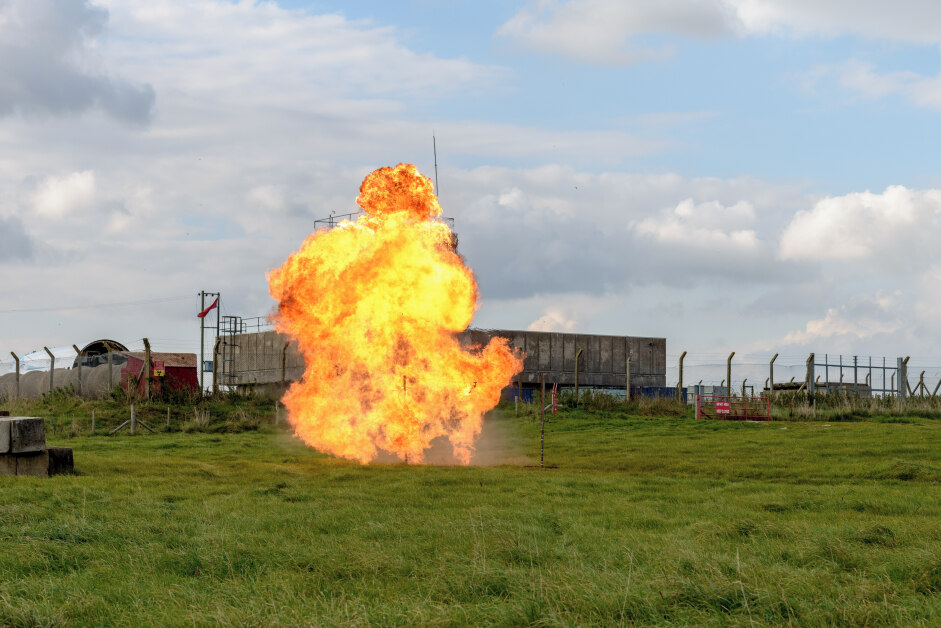
Philip Carey, Senior Environmental Test Engineer at defence company Martin Baker is currently undertaking the Explosives Ordnance MSc Apprenticeship, with the three-year course being partly funded through his employer’s apprenticeship levy payments.
Surprises and support
Philip said: “Part of our work is testing propellants and rocket motors for ejection seats, and I had been looking at doing an MSc part-time to build wider technical knowledge around how these kinds of things operate. I didn’t realise apprenticeships went up to Master’s level – so that was a nice surprise.
“What’s been good about the apprenticeship route is that I’ve had more time to use the knowledge I’m gaining from the course in my role, without having to justify applying it in my day-to-day work. I’ve been able to get more involved in the higher-level parts of the company on research and development projects. It’s been a good experience.
“I’ve also had great support, not just from my employer but from my academic tutors and from Vijaya. If I’ve had any questions, they’ve always been there to help answer them. I’ve also appreciated being able to make new contacts through the course and expand my network.”
Setting expectations
“The challenges have been balancing the additional apprenticeship project work with the demands of the day-to-day job, but my company has been supportive and it’s been manageable.
“There are also a lot of administrative tasks that come with doing an apprenticeship. It feels initially like there is a lot of duplication, as you do the actual learning, examinations and coursework, and then you have to organise everything and write statements about what you learned and how it applies to different areas. At first, I found it difficult to justify taking the time on that side of things, and it was an extra workload on top of everything else, but now I’m coming towards the end of the course I can see how it is necessary to gain the end result.
“Generally, it has been a good, positive experience. There have been challenges, but nothing unexpected. I’m looking forward to finalising my studies soon and getting stuck into the thesis project.”
Philip’s advice to his peers considering undertaking a Master’s-level apprenticeship…
“Be prepared. It’s very niche; it spans a lot of disciplines covering chemistry, mechanics and general engineering. It’s got good practical applications and there is a lot of knowledge you’ll gain that’s not available elsewhere, which is really beneficial.”
I didn’t realise apprenticeships went up to Master’s level – so that was a nice surprise.
There is a lot of knowledge you’ll gain that’s not available elsewhere, which is really beneficial
I’ve had more time to use the knowledge I’m gaining from the course in my role, without having to justify applying it in my day-to-day work.


Categories & Tags:
Leave a comment on this post:
You might also like…

Engineering Tomorrow. Part two: Can we move around the world without emissions?
Moving people and goods around the world is essential to modern life. But every journey has an environmental cost, and reducing the emissions associated with transport is one of the major engineering challenges of ...

Following in the footsteps of aerospace pioneers
I came to Cranfield to understand how aircraft stay in the sky. Months later, I was measuring the performance of aircraft engines in flight aboard the National Flying Laboratory Centre's Saab 340B. My ...

From looking up at jet engines to powering the future of flight
From flying aboard Cranfield's Saab 340B flying classroom to rebuilding a gas turbine component by component, Jouni Kailouh's journey shows how specialist, hands-on experience can turn a fascination with propulsion into a future career ...
Engineering Tomorrow. Part one: Can we power the future without costing the Earth?
The world needs energy. To power homes, industries, transport and the technologies shaping our future. But as demand grows and the pressure to reduce emissions increases, how do we generate the energy we need ...

Looking ahead: Building foresight skills for a more sustainable future
As sustainability challenges become more complex and uncertain, organisations need people who can look beyond today's pressures and think strategically about the future. From changing regulations and emerging technologies to supply chain disruption and ...

Brazil to Cambridge: How Cranfield helped me build a career in data analytics
I was hungry for something bigger. Before Cranfield, I was living in São Paulo, Brazil, working as a Data and Market Intelligence Analyst in the trading division of Raízen. My background is actually ...
Comments are closed.