


New Operating Models – do they deliver the claimed benefits? (Or, never place rocks next to hard places!)
27/09/2017

On our travels, we often see organisations declaring they’re using new operating models (or they’re about to). Someone, somewhere will have done some calculations, simulations or forecasting and arrived at the conclusion “we need to re-organise” or “centralise” or “decentralise”. Interestingly, these new operating models are often introduced by newly into position senior managers and executives, sometimes with the advice of consultants (“it worked in ‘X’ number of previous management roles / assignments, so it will work here”), looking to make their mark.
A benefits case is constructed, sometimes with an already foregone conclusion based on it working in the past – and a team of analysts and some fancy software will crunch some data and out comes the desired answer!
There are one or two problems with this approach! For example:
- Because an operating model worked at some point in time, with one organisation in the context of the services they were offering in their respective market or sector, it does not mean that model will work as well at a different time and out of context. It’s always tempting to copy what looks like a good idea in one situation, and then find in one’s own context it can be less optimal than present – in some cases disastrous. Common use of Best Practice is an example – see previous blog https://cranfieldcbp.wordpress.com/2017/06/12/the-use-of-best-practice-the-well-trodden-path-to-mediocrity/
- Because many analytic tools are based on spreadsheets and macros, there is a tendency to extract a slug of data and analyse it out of context – e.g.:
o the business may be strongly seasonal – so any extract of data shorter that at least 2 years (and preferably more) may yield deceptive results
o the business may be strongly cyclic on a daily or weekly basis, so that using averages (particularly when applying to resourcing) can yield deceptive/inaccurate results
o all businesses experience variation (in control as well as out of control), and most spreadsheet applications do not properly take this into account – see previous blog https://cranfieldcbp.wordpress.com/2017/07/10/forecasting-prediction-is-very-difficult-especially-if-its-about-the-future/
o all businesses will be processing waste- and failure-demand as well as value-demand, so unless the data being analysed considers the whole end-to-end system (i.e. is Systems-thinking), the results could be just processing waste better (rather than removing it)
o with the above, some organisations propose new models based on “efficiency reviews”, not looking at the whole system and certainly not the outcomes and customer experience
o and a final (but not exhaustive) point is that most of the resultant reorganisations fracture long established person-to-person links that made the business processes work – these have to be rebuilt after each reorganisation
We’ll quote just two examples (out of a pool of many we have encountered) to make the point:
- In a UK-based global telecommunications company the business comprised a Planning Function and a Delivery Function. A US-based global consulting firm came in and broke the process into two separate functional areas and in Planning, outsourced the survey work, all based on productivity (efficiency). On paper, the claimed benefits would be an annual saving in Planning of £10m at least. The end result was massive costs moved into the Delivery function driven largely by “Waste and Failure demand” and abhorrent customer service. One end result was that company narrowly escaping break-up by Ofcom because of absurdly long over-runs in delivery of broadband capability.
- In several public sector organisations, we see flip-flopping between centrally organised functional structures and decentralised “push the expertise out to the front-line” structures – with flip-flopping occurring every 5 – 10 years or so (in the private sector we see this happen more frequently, usually with a change in senior management). It’s difficult to establish the waste generated or the negative impact on customer service!
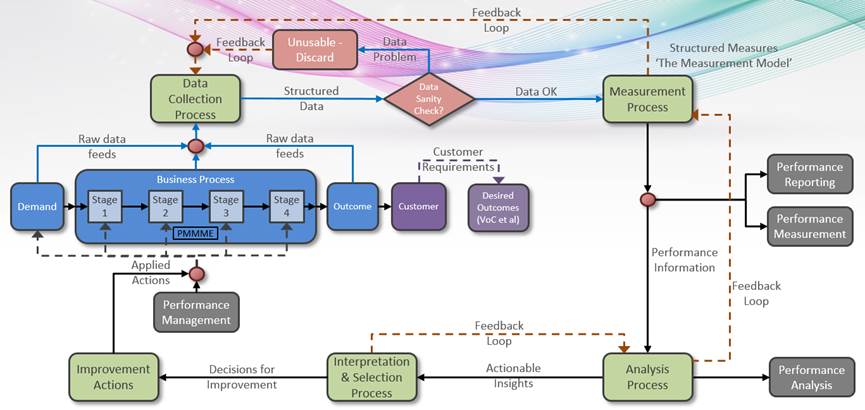
Seems to me that the only way to establish if a new operating model is actually delivering is to ensure we’re measuring the right things in the right way before and after deployment of the model (preferably, if possible, after a partial new model deployment) looking for data-driven evidence that the KPIs to be improved upon are actually statistically showing sustained improvement. For this, you have to have a “closed-loop” control system (unfortunately Matthew Syed in Black Box Thinking uses the term open loop to mean the same thing) where the system (not just the part where the operating model has changed) is monitored continuously prior to, during and after application of the new model. See example below where the business process (in blue) delivers the (hopefully) desired outcomes and the Applied Action in this case is the new operating model:
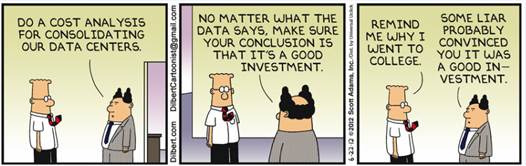
Without this, when someone asks if the new model is working – well, like Dilbert, you may be stuck between a rock and a hard place!
David Anker

Categories & Tags:
Leave a comment on this post:
You might also like…
Building more than research: Reflections from the ECRn Symposium 2026
There’s something quietly powerful about a room full of early career researchers. Not just the ideas, although there were plenty of those—but the conversations, the curiosity, and the sense that everyone is figuring things ...

Library services over Easter, 3-6 April
Kings Norton Library will remain open for study 24/7. You will need your University ID card to enter the building and can use the self-service machines to borrow and return items as usual. Barrington Library ...

How do I access the full-text of Harvard Business Review (HBR)?
This is a frequently asked question, and it's worth knowing how to access this key management journal. So, how do you access HBR in full-text? The short answer is via our eJournals finder. You can find ...

Engineering problem to solve? Let Knovel help you find a solution
Did you know that Knovel provides you with more than just eBooks? Knovel is a key database for many engineering, mechanical and materials courses here at Cranfield University, and contains content from an extensive range ...
What happens when female scholars meet influential leaders?
On the 5 March 2026, our British Council Women in STEM Scholars had the privilege of sitting down with two excellent role models of industry and academia: Professor Dame Karen Holford, ...

From MSc to CEO: Igniting a research revolution
For many, a master’s degree is achieving a big milestone. Kilyan Ocampo, Computational Fluid Dynamics alumni shares how studying at Cranfield helped launch his career in the energy sector. Today, Kilyan ...