


What I learnt from attending the Start-Up Weekend at the Bettany Centre for Entrepreneurship
14/06/2022
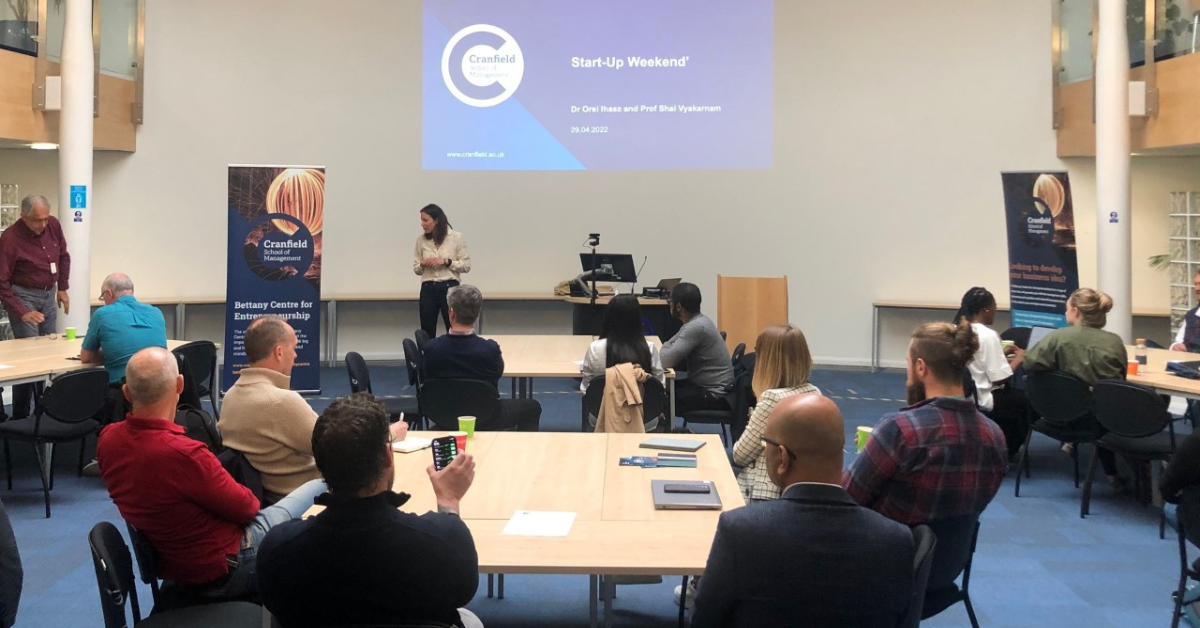
Attending the Start-Up Weekend at the Bettany Centre for Entrepreneurship was invaluable because it allowed me to validate my business ideas and evaluate solutions to the problems. It also allowed me to network with mentors, entrepreneurs, working professionals, and master’s students who are enthusiastic about becoming entrepreneurs or developing their entrepreneurial mindset. The event hosted guest speakers who shared their entrepreneurial journeys, this helped me to better understand the challenges I may face later. I also really enjoyed being immersed in an atmosphere in which I could bounce my ideas off mentors and participants like myself, with the same level of energy and enthusiasm.
Having been busy with course study and other academic activities, I took Start-Up Weekend as an opportunity to further work on my business idea. I learned so much during the two-and-half-day event and was truly inspired by the presentation delivered by Social Entrepreneur Shaz Shah, Co-Founder and Director of Harry Specters, a luxury chocolate brand based in Cambridgeshire. This is where the entrepreneurial spirit comes from – his pain and a wide society’s gain. He not only solved his problem but has also made a huge impact on society – helping young autistic people with their employability. It stands as his reason and motivation for becoming an entrepreneur whenever he faces challenges, such as funding and business growth. I do believe that this is truly putting value and vision before profit-making for him to establish this social enterprise.
The most challenging thing for me is to clearly articulate my business idea in a simplified manner. It is ridiculous, isn’t it? Going through the process of validating my ideas and evaluating solutions with mentors helped and made an enormous difference, especially to my confidence. I talked to four mentors, and each mentor raised doubts in terms of the solution to the problem – whose problem to solve and how to solve it. Each mentor provided me with so much valuable feedback during the process, and now I have a clear understanding of the problem, the market opportunity, and the feasibility of the solution.
I also found the two-minute pitch exciting as it allowed me an opportunity to pitch my idea in front of people who might otherwise be sceptical about my idea or solution. It was a very rewarding and worthwhile process because I received more feedback to refine my solutions further. My call to action is to seek advice from experts in the technology and medical fields and to think about the founding team seriously when getting my project started.
In summary, I benefited from the Start-Up Weekend because it allowed me to pitch my idea in a safe environment, where I could learn and be challenged, with the support of amazing mentors: John Murphy, Orsolya Ihasz, Arun Muthirulan, and Cranfield MBA alumnus – Michael Kenyon, Phil Evans, Ben Pearson, and Richard Leaver who continued to help refine my solution after the event. This process was truly amazing, and it genuinely helped to develop my business idea and build my confidence in taking my idea forward.
I am currently studying the Management and Entrepreneurship MSc at Cranfield School of Management, but I would highly recommend attending events put on by the Bettany Centre for Entrepreneurship as they are an essential first step in building a minimum viable product (MVP) and there might be the potential to attract investors, or funding, as Angel investors often attend and spot opportunities through these kinds of events.


Categories & Tags:
Leave a comment on this post:
You might also like…

Engineering Tomorrow. Part two: Can we move around the world without emissions?
Moving people and goods around the world is essential to modern life. But every journey has an environmental cost, and reducing the emissions associated with transport is one of the major engineering challenges of ...

Following in the footsteps of aerospace pioneers
I came to Cranfield to understand how aircraft stay in the sky. Months later, I was measuring the performance of aircraft engines in flight aboard the National Flying Laboratory Centre's Saab 340B. My ...

From looking up at jet engines to powering the future of flight
From flying aboard Cranfield's Saab 340B flying classroom to rebuilding a gas turbine component by component, Jouni Kailouh's journey shows how specialist, hands-on experience can turn a fascination with propulsion into a future career ...
Engineering Tomorrow. Part one: Can we power the future without costing the Earth?
The world needs energy. To power homes, industries, transport and the technologies shaping our future. But as demand grows and the pressure to reduce emissions increases, how do we generate the energy we need ...

Looking ahead: Building foresight skills for a more sustainable future
As sustainability challenges become more complex and uncertain, organisations need people who can look beyond today's pressures and think strategically about the future. From changing regulations and emerging technologies to supply chain disruption and ...

Brazil to Cambridge: How Cranfield helped me build a career in data analytics
I was hungry for something bigger. Before Cranfield, I was living in São Paulo, Brazil, working as a Data and Market Intelligence Analyst in the trading division of Raízen. My background is actually ...