


‘Drones for Good’: Remotely Piloted Aircraft Systems (RPAS) helping investigators gather evidence and prevent future accidents
01/04/2016
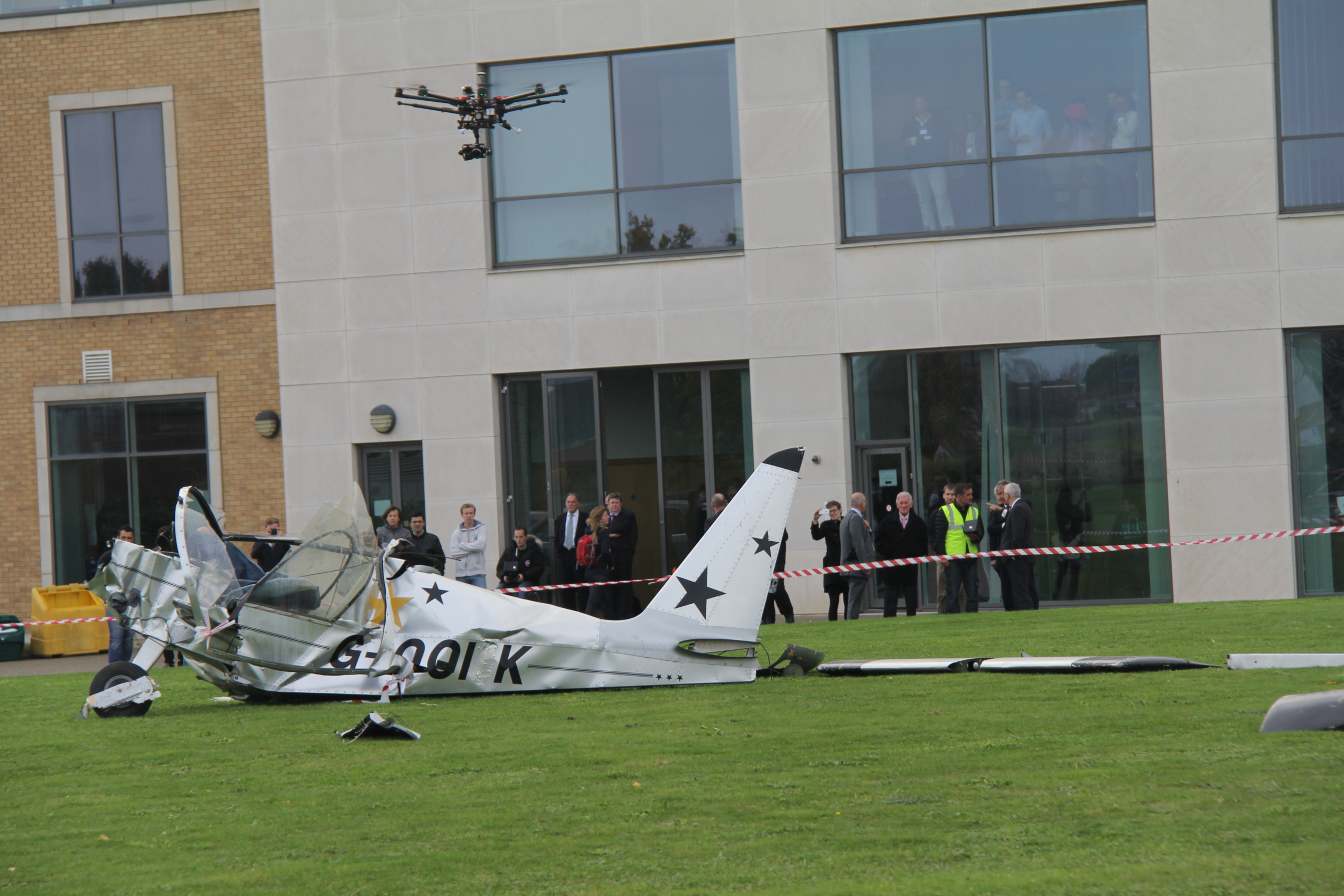
Photo: DJI S1000 “Octocopter” Drone scans a demo accident site outside Martell House, Cranfield University
Accident sites are often dangerous or difficult places to work. There are always hazards that will require the accident investigator to expose themselves to risk. These take many forms – environmental, physical, material, biological, psychological – which will need to be addressed, as the investigator needs to collect as much evidence (particularly perishable evidence which might be washed away, blown away or destroyed) as quickly as possible.
During this initial risk assessment the RPAS cameras (video/stills/thermal/Infrared) are capturing this evidence. This imagery will then be used in real time to assist with communicating the situation to other agencies. This helps confirm the extent of the accident site or even control access, if required.
RPAS allows the investigator to conduct a dynamic risk assessment from a distance whilst also capturing the evidence required with video and stills. Previously helicopters or fixed wing aircraft might have been chartered to provide this service. This is expensive and not always practical.
Based upon the utility outlined above RPAS technology is currently being used by state level investigation agencies including UK Air Accidents Investigation Branch (AAIB) and the UK Rail Accident Investigation Branch (RAIB).
This technology is improving week by week, and some of the best results are being achieved with some of the smallest and most readily available systems.
A key point to the success of their deployment is that they are operated legally and safely by professionals who understand the airspace in which they might operate, but also the hazards present at the accident.
Cranfield University is leading the way in this field. At the Safety and Accident Investigation Centre we continue to test theories and push investigative/research boundaries on the accident site. Flying a range of drones, with a wide array of sensors, we aim to enhance current accident investigation techniques. But more than this we aim to revolutionise how evidence is gathered, analysed and then promulgated to the public and wider safety community.
An example of this is our work with 3D models. We are pioneering new 3D modelling techniques in order to provide accurate, measurable 3D models of accident sites (using the video and stills captured for evidence collection, then applying photogrammetry techniques to convert these images to 3 D models). These can then be used for investigative analysis, and as graphic representation in final accident reports.
This is a hugely exciting area of research, which utilises new and innovative drone technology and gives us an advantage when investigating serious accidents and incidents. Constantly looking to the future, our aim is to continue to be the centre of excellence with regard to this novel and innovative approach.

Categories & Tags:
Leave a comment on this post:
You might also like…
Driving the future of automotive excellence with three new scholarships
Cranfield University has a long history within the top echelon of motorsport, car development and safety designs within the automotive industry, working in the era where we’ve seen significant safety improvements, engineering feats and ...

Academic writing and being critical
Academic writing is daunting. Capturing all your thoughts and analysis and putting them down onto paper in some sort of understandable fashion is a challenge. Did you know we have resources in our Cranfield Study ...
My Cranfield experience: How studying for the Strategic Marketing MSc landed me a job in my dream industry
For Shraddha Mahapatra, studying for a postgraduate master’s degree at Cranfield School of Management unlocked the path to a career working in her dream industry sector. Shraddha had gained an MBA in her native ...
Keen to develop your study skills?
Alongside the technical skills and academic knowledge that you will gain on your course, as a Cranfield student you have the opportunity to develop a range of other skills that can enhance your learning experience. ...
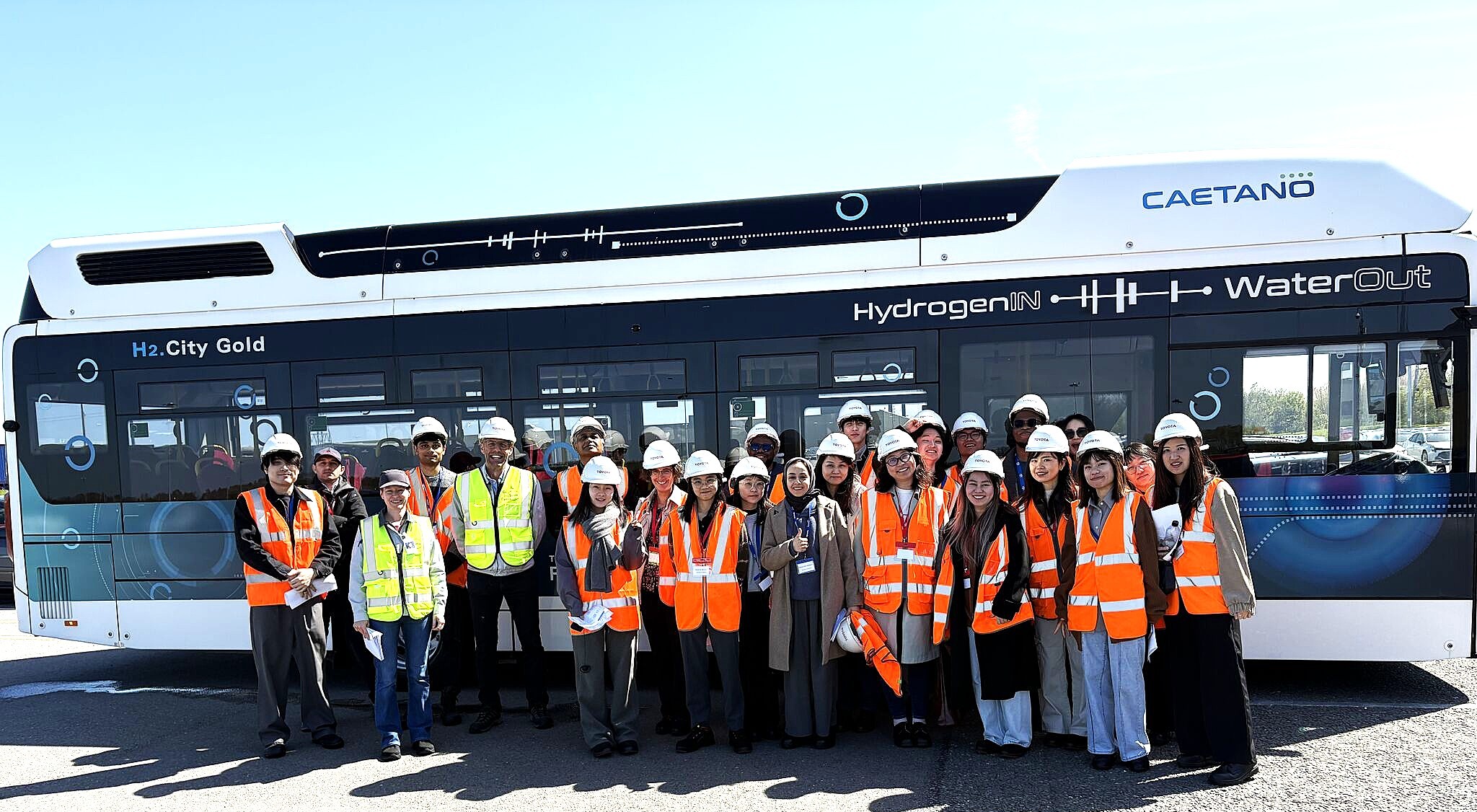
From classroom to reality: Supply chain insights from Cranfield’s Manchester study tour
Each year, Cranfield University organises a study tour for MSc Logistics and Procurement & Supply Chain Management students. For the 2025–2026 cohort, students were given the option to select one of three study groups: ...

Systematic literature review – Managing duplicates
One of the questions which often comes up when discussing the SLR process is how do I manage my references in the most efficient way during the process of going from my search results to ...
I would imagine that quadcopters are the drones of choice for use in these situations. What about fixed wing systems?