


Jenggala Pottery – beauty made in Bali
23/05/2017
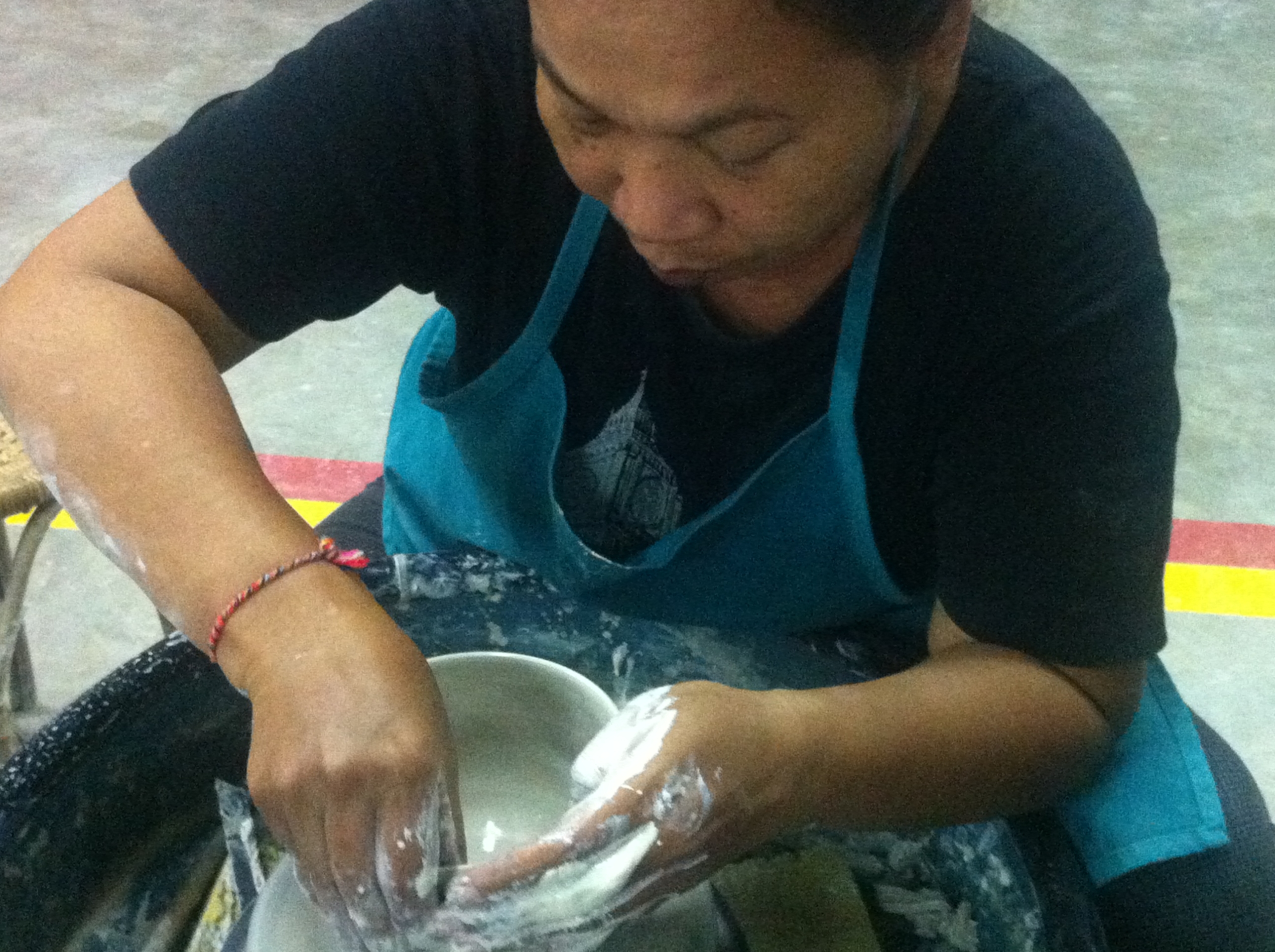
Contrasting to the efficiency of mass manufacturing that we saw over the past days, the Jenggala pottery designs and produces exquisite hand-crafted ceramicware. Forty years ago, the company arose from the friendship between a magnate hotel owner who had looked for prestigious tableware and an artist who specialized in ceramics. Today it is one of the leading providers of high-end pottery for famous hotels and resorts like BVLGARI and Ritz Carlton and exports its products all over the world, though it is smaller than mass manufacturing companies in the same industry. Since its beginning, the company’s core values of exquisite and innovative design and outstanding quality have remained unchanged and will ensure the success of the company also in the future.
The company has segmented their customers and product range into B2C and B2B: To cover the needs of individual private customers, the company has a standard range consisting of various beautiful designs resulting in several hundred different products that are distributed via their own boutiques and flagship stores. The demand of hotels and resorts has resulted in a different structure as they require specific customized products in large quantities and individual designs.
The design of the products is inspired from nature. Predominantly you find motifs of flowers and leaves in natural earth colors. The company cooperates with a number of local and international designers and artists to ensure innovation and to customize orders according to customer request.
The raw material for pottery is imported from Middle East, India and Thailand. One particularly important quality factor for production is the quality of water that is sourced inland from different dwells.
Most stunning for us to see was the hand-made production of various pottery items that are crafted by using three different techniques: slip-casting, ram-press and hand-throwing. The first two require the pre-production of molds and have the advantage of uniformity of items. Hand-throwing is a technique characterized by a piece of clay “thrown” on a potter’s wheel from where it is further crafted by hand. Contrasting to slip-casting and ram-pressing, the final potteries of hand-throwing are not entirely uniform. They vary slightly and thus each piece is unique – a fact that is smartly utilized as a selling proposition. It is fascinating to monitor the creation of a piece of art out of a piece of earth-like material. By coloring and glazing, products get their final look. Finally, they are burned to preserve the colours and shapes.
Even though the company has grown over time (currently they employ 150 people) their output of about 25,000 pieces cannot compete with big manufacturers that produce about a million pieces per month. This notwithstanding, Jenggala has an important footprint in the local market and exports to several South-East Asia markets, as well as to US. At the same time, the company wins on flexibility, for example by offering minimum order quantities as small as 200 units for new B2C designs. For the very same reason, the approach to production is predominantly Make-To-Order, which allows to minimize inventory with a target turnover of max 90 days per item. Finally, an important remark is the well-being of the employees: after so many years of operations, Jenggala still sets up as a big family, which drives workers’ dedication and commitment and has led to a high retention rate. Both of these factors substantially contribute to the fine quality of the outputs.
As the products are so very special and exquisite, we really could not refrain from buying some pieces of souvenirs for our homes before leaving! Thank you Jenggala for having us!

Categories & Tags:
Leave a comment on this post:
You might also like…

Keen to develop your study skills?
Alongside the technical skills and academic knowledge that you will gain on your course, as a Cranfield student you have the opportunity to develop a range of other skills that can enhance your learning experience. ...

The V-conomy: powering the sixth wave of global economic growth
The world could be on the verge of a major surge in economic growth and development, driven by the convergence of AI and clean energy technology. Waiting to ride the K-wave The Russian ...

Need help using the Python programming language?
We know some of our students are currently trying to learn Python, so we wanted to make you aware of some great LinkedIn Learning videos that can help. But don't you have to pay for ...

What does it really take to become a Chevening Scholar?
Say “Turkmenistan” to most people and you’ll get a blank look. That was true when I left Ashgabat for the UK to study an MSc in Logistics and Supply Chain Management at Cranfield University ...

Get a head start on referencing and plagiarism
We offer a module on Referencing And Avoiding Plagiarism which you can find on your Canvas dashboard. It explains the role and importance of citing references and how to incorporate the work of other authors ...

How Cranfield shaped my journey as an Aerospace Engineer
If I'm being specific about the moment it clicked, it was reading a paper called "On the Role and Challenges of Computational Fluid Dynamics (CFD) in the Aerospace Industry" by two Boeing engineers, P. ...