


When ideas take flight – exploring entrepreneurship whilst studying
24/01/2017

I am now in the final year of my four-year PhD studentship at Cranfield. It’s been a real journey for me – academically, personally, and geographically too. With the advice and support from my colleagues and supervisors, I have been able to diversify my experience and maximise the impact of my work, both in and out of the laboratory.
From travel grants to policy fellowships, public speaking on STEM careers (with audiences ranging from kids to MPs), sustainability and food security, to living abroad and working in ice cream design – my PhD has taken me to 10 countries, across three continents, and I have been able to build new collaborations, both home and abroad, with research groups in academia and industry.
Eight months ago in my penultimate year of study, I decided to take on a completely separate challenge, and in a completely different area of expertise. I started my own robotics business with my friends. Little did I know back then that in the months following our founding, we would be going on trade missions with the UK Consul for Science & Innovation in China, being appointed as a CommonwealthFirst Export Champion, and attending the National Business Awards – where I was announced as an InnovateUK Women in Innovation winner.
It all started with a problem. Over the last few years, many case studies have been published that demonstrate the value of drones to civil sectors – whether it was for spotting crop disease in its earliest stages, or delivering vital blood packs and vaccines to dangerous or remote areas.
However, time and time again these case studies kept on coming up against the same barriers to wide-scale deployment, which prevented the setup of drone tech in areas that could most benefit. It was here that we saw a huge opportunity, to both enhance drone-tech and make significant societal impact.
Our solution was to create infrastructure for drones that was easy to use and maintain, and able to perform for a variety of applications. This would give remote communities, with limited access to training or power, the ability to use emerging drone-tech. Farmers would be able to automate field-inspection without the need for a human operator. Monitoring activities are also very important to large infrastructure and offshore inspection. We will also be able to create logistical routes that can operate in difficult or dangerous locations.
Following our founding in June, we were successful in winning pre-seed funding from the Bettany Centre for Entrepreneurship in July, and later in the year I obtained the Women in Innovation prize. We also won a grant from ICUK and the Foreign Office Global Prosperity Fund to go on an Innovation Mission to China in November, and are going back to follow up with our connections next month. In March we have also been invited to present at CleanEquity in Monaco (a world-leading conference on emerging clean-tech) alongside other start-ups based at Cranfield University.
With nine months to go until my PhD submission date, I’ve now formally started to write up my thesis. Here comes the work-life balance bit:
At the moment, this is a project that my team works on in addition to our full-time study and work. This means working very late nights and weekends. We do this because we love it, and we truly believe in what we are doing. Even so, looking ahead on our route to the commercialisation of our technology – I need to be in a position to employ my team full-time to keep up our R&D momentum. This means more grant applications; more pitch preparation; more networking – all to secure more funding. With every attempt at this, regardless of the outcome, we learn and grow as a unit. Needless to say, I am grateful for the access to academic support and advice, as well as business mentorship that keep me on track with my studies, AND my start-up.
My advice for other PhD students is: seize every chance to grow, learn and diversify your studentship. It’s an opportunity like no other in your career – make the most of it!

Categories & Tags:
Leave a comment on this post:
You might also like…
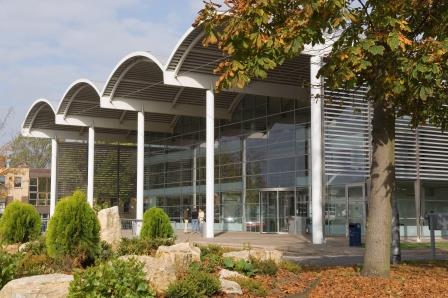
Introducing Kings Norton Library
Welcome to all our new students! We are looking forward to meeting you soon. You will find Kings Norton Library in the centre of the Cranfield campus, and it is open 24/7 to all staff ...

Setting your research on the right course: Four questions every researcher should ask
Whether you are just beginning your doctoral journey or are already well into your research career, successful research rarely happens by accident. Like any successful mission, it depends on good planning, informed decisions, and getting ...

5 budgeting mistakes students make (and how to avoid them)
Good financial planning isn't about how much money you have. It's about the habits you build. We asked Dr Lakshmy Subramanian, Course Director for the Banking, Economics and Finance MSc, about the budgeting mistakes ...

Finding your reading materials
Use Library Search Library Search is the first place to start when you are trying to find academic sources for your work. This is the search box on the library website homepage. It allows you ...

Formula 1 was the dream and Cranfield was the conduit
I still remember the exact moment Formula 1 (F1) got its hooks into me. I was in my first year of an aerospace undergraduate engineering degree when I watched a video about the sport ...

Introducing Barrington Library
Welcome to all our new students! Barrington Library supports all the students and staff at Cranfield Defence and Security on the Shrivenham site. We are looking forward to meeting you all soon, in person or ...